Architectural Splendor: Valérie Messika Unveils Masterpiece Setting for Botswana’s Historic 20.46-Carat Okavango Blue Diamond
By
•
August 17, 2026
An Epochal Masterpiece: The Okavango Blue Unveiled
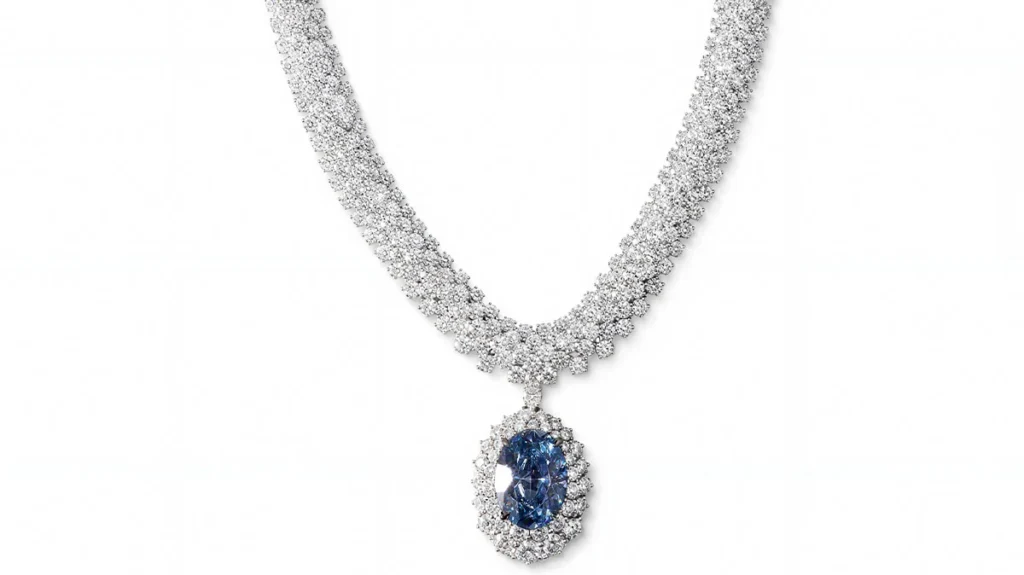
In a landmark convergence of geological rarity and contemporary French haute joaillerie, Parisian jewelry house Messika has officially revealed a bespoke high jewelry creation featuring the Okavango Blue—the largest and rarest blue diamond ever discovered within the borders of Botswana.
Commissioned directly by the Government of the Republic of Botswana, which retains sole ownership of the sovereign treasure, the one-of-a-kind pendant necklace frames the legendary 20.46-carat, oval-cut, Fancy Deep Blue diamond within a celestial array of more than 500 custom-cut white diamonds. Rather than serving as an acquisition piece for private commercial markets, the creation stands as an enduring cultural artifact and a definitive tribute to natural diamond geology, African resource stewardship, and artisanal Place Vendôme craftsmanship.
The unveiling represents a critical milestone in high jewelry diplomacy. By entrusting an institutional treasure of this magnitude to Valérie Messika, founder and artistic director of her eponymous maison, Botswana’s state leadership has signaled a deliberate shift toward celebrating mineral wealth through elevated artistic narratives rather than immediate private liquidation.
From Earth to Atelier: Chronology of an Iconic Gemstone
The trajectory of the Okavango Blue spans billions of years of subterranean crystallization, culminated by an extraordinary journey from a deep open-pit volcanic pipe in southern Africa to the meticulous workbenches of Paris.
+-----------------------------------------------------------------------------------+
|                           THE OKAVANGO BLUE TIMELINE                              |
+-----------------------------------------------------------------------------------+
|  2019          | Unearthed as a 41.11-carat rough at the Orapa Mine in Botswana.  |
|  2019–2020     | Precision analysis and cutting yields a 20.46-carat polished gem.|
|  2020–2023     | Sovereign custody maintained; Messika selected for the project.  |
|  1-Year Build  | Intensive Parisian atelier design & setting of 500+ diamonds.    |
|  Present       | Global unveiling as a sovereign cultural and gemological monument.|
+-----------------------------------------------------------------------------------+
2019: Discovery at the Orapa Mine
In mid-2019, diamond recovery operations at the Orapa diamond mine—situated roughly 240 kilometers west of Francistown, Botswana—uncovered an extraordinary 41.11-carat rough diamond exhibiting an unmistakable, deep azure saturation. Operated by Debswana (a joint venture between the Government of Botswana and the De Beers Group), Orapa is historically recognized as one of the most prolific kimberlite pipes in the world. However, discovering a colored diamond of such mass and purity remains a once-in-a-generation occurrence for the deposit.
The Precision of Transformation
Following its extraction, the rough stone was entrusted to world-class master polishers to navigate the complex internal stresses common to colored roughs. The resulting yield was a monumental 20.46-carat oval brilliant diamond. Graded by the Gemological Institute of America (GIA) as Fancy Deep Blue with a clarity grade of Very Very Slightly Included 1 (VVS1), the stone displayed an astonishing degree of optical purity and color saturation, immediately distinguishing itself within the upper echelon of historic blue diamonds.
The Commission and the Year-Long Crafting Process
Recognizing the stone’s national significance, Botswana’s sovereign representatives sought a collaborative partner to craft a permanent setting capable of highlighting its brilliance without obscuring its identity. Valérie Messika was selected based on her progressive design sensibilities and a proven track record with monumental African stones, including a previous commission involving a 33-carat D-Flawless diamond from Botswana’s Karowe mine. The design, structural engineering, and setting process required a full year of intensive labor within Messika’s Parisian high jewelry workshop.
Gemological Rarity and Technical Profile
To fully grasp the magnitude of the Okavango Blue, the gemstone must be understood through the lens of ultra-rare diamond physics.
+-----------------------------------------------------------------------------+
|                     GEMOLOGICAL & DESIGN SPECIFICATIONS                     |
+-----------------------------------------------------------------------------+
| Characteristic          | Specification                                     |
+-------------------------+---------------------------------------------------+
| Gemstone Name           | The Okavango Blue                                 |
| Rough Weight            | 41.11 Carats                                      |
| Polished Weight         | 20.46 Carats                                      |
| Color Grade             | Fancy Deep Blue                                   |
| Clarity Grade           | VVS1 (Very Very Slightly Included 1)               |
| Chemical Classification | Type IIb (Boron-bearing, Nitrogen-free)           |
| Cut                     | Oval Brilliant                                    |
| Origin                  | Orapa Kimberlite Pipe, Botswana                   |
| Setting Design          | Medallion Pendant Necklace                        |
| Supporting Stones       | 500+ D/F Color Natural White Diamonds             |
| Ownership               | Sovereign Property of the Republic of Botswana   |
| Commercial Status       | Not for Sale / Institutional Museum Exhibition    |
+-------------------------+---------------------------------------------------+
The Physics of Type IIb Diamonds
The Okavango Blue is classified as a Type IIb diamond, a category that encompasses less than 0.02 percent of all natural diamonds mined globally. Unlike the vast majority of diamonds (Type Ia), which contain nitrogen clusters that impart faint yellow undertones, Type IIb stones are virtually free of measurable nitrogen impurities.
Instead, the striking blue coloration is the result of trace boron atoms trapped within the carbon crystal lattice during diamond formation in the Earth’s lower mantle—typically at depths between 410 and 660 kilometers. Boron absorbs red, yellow, and green light wavelengths while transmitting and reflecting blue hues. Additionally, this unique lattice configuration makes Type IIb diamonds semi-conductors of electricity, an extraordinary physical property among gemstones.
Grading Benchmarks: Fancy Deep Blue and VVS1
Achieving both a "Fancy Deep" color grading and a "VVS1" clarity rating at more than 20 carats is historically anomalous. Most colored diamonds sacrifice clarity for color depth, frequently exhibiting structural inclusions or internal graining caused by the immense tectonic pressures required to form them. The Okavango Blue, however, retains near-flawless internal architecture, allowing light to refract through the stone with minimal optical dispersion or obstruction.
Creative Vision and Official Commentary
Valérie Messika on Design Restraint and Optical Framing
For Valérie Messika—daughter of prominent diamond merchant André Messika—the project demanded a fundamental departure from conventional commercial high jewelry.
"I tried to let the diamond speak by itself," Messika explained during the unveiling. "I had so much respect for the beauty of the stone that I wanted it to be the absolute central element. It reminds me of something vintage, conceived as an architectural medallion surrounded by white diamonds. I wanted the blue to pop—the more it is encircled by pristine white, the stronger and more magnetic the blue becomes."
The resulting collar-style necklace uses negative space, articulated precious metals, and an intricate halo of more than 500 pavé and fancy-cut white diamonds to create an unbroken sea of scintillation. The geometric setting directs the viewer’s gaze inward, ensuring that the optical density and blue saturation of the Okavango Blue remain the uncompromised focus of the composition.
Addressing the allocation of substantial studio resources to an unsellable item, Messika framed the endeavor as an act of artistic stewardship:
"This project is, for me, a tribute to natural diamonds. It is one of a kind, occurring at a definitive moment in my career where I have been granted access to work with such a singular stone. It took a year to produce, with our design and craftsmanship teams focused entirely on this vision. I saw it as a profound tribute to our expertise as diamond jewelers."
A Sovereign Perspective on Mineral Heritage
For the Government of Botswana, retaining the diamond and mounting it within an internationally celebrated design represents an assertion of national pride and economic sovereignty.
Botswana’s modern history is intrinsically linked to diamond revenue, which has historically funded the nation’s healthcare networks, universal primary education, and critical civic infrastructure. Rather than exporting the rough stone for uncredited foreign processing and private auction, the state’s deliberate stewardship of the Okavango Blue highlights the country’s beneficiation strategies—elevating domestic resources into the upper echelons of global luxury and cultural recognition.
Industry and Market Implications
+-------------------------------------------------------------------------------------+
|                              MACRO-INDUSTRY IMPACT                                  |
+-------------------------------------------------------------------------------------+
|  1. SOVEREIGN MINERAL BENEFICIATION                                                 |
|     Nations retain high-value natural assets to project cultural diplomacy rather  |
|     than immediate foreign raw liquidation.                                         |
|                                                                                     |
|  2. THE NATURAL VS. SYNTHETIC PARADIGM                                              |
|     Historic mega-stones reinforce the narrative of authentic geological provenance |
|     against the backdrop of industrialized lab-grown production.                    |
|                                                                                     |
|  3. INDEPENDENT MAISON PRESTIGE                                                     |
|     Positions independent family-founded houses as serious rivals to historic       |
|     luxury conglomerates on the world stage.                                        |
+-------------------------------------------------------------------------------------+
The Natural vs. Synthetic Diamond Narrative
The debut of the Okavango Blue necklace arrives during an intense period of introspection across the global diamond sector, fueled by the rapid growth of lab-grown diamonds in the commercial jewelry market.
Messika leveraged the project to draw a sharp philosophical line between natural, mantle-born mineral rarities and factory-synthesized alternatives:
"I started the relationship with Botswana to promote the beauty of their land and celebrate natural diamonds. It is vital to put into light the magic of these natural wonders from the Earth. Lab-born diamonds are, in essence, like photocopies from a laboratory."
The Okavango Blue functions as an unassailable symbol of natural diamond scarcity. With only 0.01 percent of all diamonds exhibiting blue coloration—and an infinitesimally smaller fraction achieving more than 20 carats at VVS1 clarity—such stones exist entirely outside the manufactured predictability of synthetic substitutes.
The Rise of Sovereign Wealth in High Jewelry
Historically, diamonds of this scale were purchased by royal dynasties or sold through auction houses like Sotheby’s and Christie’s to private ultra-high-net-worth collectors, often disappearing into private vaults.
Botswana’s decision to maintain institutional ownership of the Okavango Blue—while simultaneously commissioning an elite Place Vendôme jeweler to create a contemporary setting—establishes a new precedent for mineral-producing nations. It transforms raw geological wealth into an instrument of global cultural prestige, cementing Botswana’s role as a sophisticated leader in responsible diamond mining and luxury heritage.
As the Okavango Blue begins its life as an icon of natural history and high jewelry design, it reinforces a fundamental truth of gemology: true rarity cannot be manufactured, accelerated, or replicated. It remains an enduring testament to the geological forces of the Earth and the height of human artisanal achievement.