
To the average observer, the passage of a day is a fundamental constant—a rhythmic, unwavering cycle of 24 hours governed by the Earth’s rotation. It is the bedrock of human civilization, the foundation upon which we schedule our lives, our economies, and our global navigation systems. Yet, beneath this veneer of predictability lies a far more volatile reality. Earth’s rotation is not a perfect, immutable clockwork mechanism; it is a dynamic, shifting process subject to the tumultuous movements of the planet’s deepest, most inaccessible layers.
Recent research published in the journal Nature has provided a groundbreaking look into why our days fluctuate by mere milliseconds, revealing that the planet’s solid inner core is far more active—and influential—than previously imagined.
The Core Facts: Why Seconds Matter
For decades, geophysicists have understood that the length of a day (LOD) is not strictly fixed. While the variations are measured in the infinitesimal units of milliseconds, they are profound enough to be detected by modern instrumentation. These shifts are not random errors in measurement; they are the physical manifestation of a "planetary tug-of-war" occurring thousands of kilometers beneath our feet.
At the heart of this phenomenon is the law of conservation of angular momentum. In a closed system like Earth, the total momentum must remain constant. However, as the planet’s liquid outer core speeds up or slows down, the mantle—the massive, 3,000-kilometer-thick rocky layer that encompasses the crust—must compensate by rotating in the opposite direction to maintain that balance. Even the slightest alteration in the mantle’s rotation speed has a ripple effect on the surface, causing the Earth to spin slightly faster or slower, thereby stretching or shrinking the length of our day.
Chronology of a Geophysical Mystery
The history of this discovery dates back roughly thirty years, when scientists first began to notice decadal fluctuations in Earth’s rotation. Early models suggested that the liquid outer core, composed primarily of molten iron and nickel, does not rotate in perfect synchronicity with the rest of the planet. Instead, it exhibits complex, shifting patterns driven by the Earth’s magnetic field.
- The 1990s: Scientists identify a correlation between changes in the Earth’s magnetic field and subtle variations in the length of a day. It becomes clear that the liquid core undergoes periodic accelerations and decelerations.
- The 2000s: Researchers establish the "Mantle-Core Coupling" theory, positing that the mantle must respond to the core’s changes to conserve angular momentum. However, the precise mechanism of how this momentum is transferred remained elusive.
- The 2020s: With the advent of high-resolution seismic data and improved satellite-based gravimetry, the focus shifted toward the planet’s deepest point: the solid inner core.
- September 2024: Researchers Huifeng Zhang and Professor Mathieu Dumberry of the University of Alberta publish their findings in Nature, pinpointing the "gravitational torque" exerted by the inner core as the missing link in the puzzle.
The Hidden Gravitational Tug: A New Paradigm
For years, the scientific community struggled to explain the physical coupling between the mantle and the core. The new study by Zhang and Dumberry provides a compelling, if complex, answer: the gravitational interaction between the solid inner core and the mantle.
The Role of Asymmetry
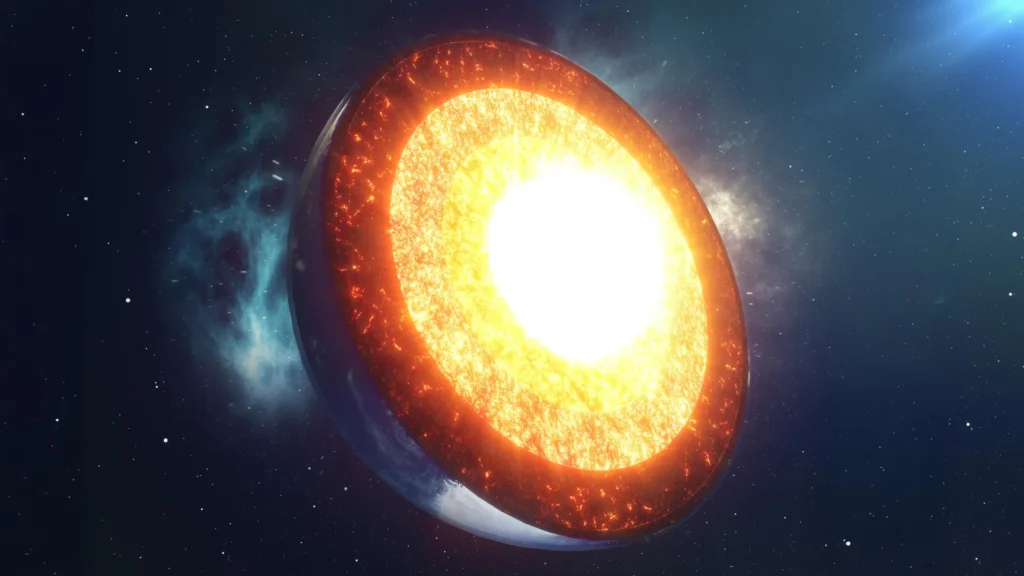
The inner core is not a perfect, smooth sphere. Its irregular shape means that its mass is not distributed uniformly. As it rotates, its uneven mass distribution creates a gravitational pull—or "gravitational torque"—on the mantle.
"Because the inner core is not perfectly spherical, changes in its motion can gravitationally interact with uneven distributions of mass in the mantle," explains the study. This interaction effectively acts as a gear system, where the movement of the inner core forces a response from the rocky mantle, thereby altering the rotation of the entire planet.
Competing Forces
However, the inner core does not operate in a vacuum. The study identifies a secondary, opposing force known as "core-mantle boundary torque." This is characterized by friction and electromagnetic drag at the interface between the molten outer core and the solid mantle. This boundary acts as a brake, resisting the gravitational pull exerted by the inner core.
The observed variation in the length of a day, therefore, is not the result of one single force, but a delicate, shifting equilibrium between these two competing phenomena. When the balance tilts, the Earth’s rotation shifts, and the length of our day adjusts by those critical milliseconds.
Implications: A More Dynamic Interior
Perhaps the most significant takeaway from the Zhang and Dumberry study is the revelation that Earth’s interior is far more malleable than previously assumed.
Viscous Deformation
The researchers observed that the inner core appears to "deform viscously" on a timescale of approximately ten years. In geology, "viscous deformation" implies that the solid material is capable of flowing or changing shape under pressure, much like thick honey or heated glass, rather than behaving as a rigid, static block.
This suggests that the deep interior of our planet is in a constant state of flux. The implications of this are vast:
- Refining Earth Models: Our current models of the Earth’s interior may be too rigid. Recognizing the plasticity of the inner core requires a fundamental update to geophysical simulations.
- Magnetic Field Evolution: Because the rotation of the core is linked to the generation of Earth’s magnetic field, understanding these fluctuations could lead to better predictions regarding the long-term stability and shifts of our protective magnetosphere.
- Timekeeping Accuracy: While milliseconds seem trivial, they are critical for high-precision technologies. Global Positioning Systems (GPS), deep-space communication, and high-frequency trading rely on extreme time accuracy. Understanding these natural fluctuations allows for better calibration of atomic clocks and temporal synchronization across the globe.
Official Responses and Peer Perspective
The scientific community has received these findings with significant interest. While the study provides a robust mathematical framework for the inner core’s role in rotational changes, experts emphasize that this is one piece of a much larger planetary puzzle.
"The work of Zhang and Dumberry bridges a critical gap in geophysics," notes a spokesperson from the International Union of Geodesy and Geophysics (IUGG). "For decades, we have looked at the outer core as the primary driver of these shifts. By identifying the gravitational torque exerted by the inner core, we are finally seeing the ‘hidden’ mechanics that dictate the pulse of our planet."
Other researchers have pointed out that while the ten-year timescale for viscous deformation is a "bold estimate," it aligns with observational data regarding the Earth’s nutation (the wobbling of the Earth’s axis) and polar motion.
Looking Ahead: The Future of Deep-Earth Studies
As we refine our understanding of the planet’s interior, the study of Earth’s rotation transitions from a niche interest of chronometry to a vital component of planetary science. We are moving toward a future where we don’t just view the Earth as a static platform, but as a living, breathing, and shifting entity.
The research conducted by the University of Alberta team underscores a fundamental truth about our world: the stability of our daily lives is anchored to a volatile, shifting, and surprisingly dynamic core. As our technology becomes more sensitive, and our desire to understand the deep history of our planet grows, the "milliseconds" that once seemed like noise are now revealed to be the vital heartbeat of the Earth.
Whether this discovery will lead to new ways of predicting geological events or simply provide a deeper appreciation for the mechanics of our home, one thing is certain: the Earth is far more complex than we ever dared to imagine. As we continue to probe the depths, we are reminded that even the smallest movements beneath our feet can shape the time we measure on the surface, binding us in an eternal dance with the forces deep within the planet.