

The landscape of the Middle Eastern art market is undergoing a seismic shift, signaled by a symbolic move from one of the world’s most prestigious auction houses. Twenty years after Christie’s became the first international auction house to establish a permanent footprint in the United Arab Emirates, the institution is celebrating its platinum anniversary not in its traditional regional home of Dubai, but in the nation’s capital.
On November 1, Christie’s will conduct its inaugural fine art auction in Abu Dhabi. Titled “MAWASIM: 20 Years of Modern and Contemporary Middle Eastern Art,” the sale will take place at the Abu Dhabi Edition hotel. Featuring over 70 masterworks from across the Middle East and North Africa (MENA) region, the event represents more than just a commemorative sale; it signals a new era for Abu Dhabi as it transitions from a center of institutional culture to a powerhouse of commercial art trade.
Main Facts: The "MAWASIM" Sale and the Abu Dhabi Debut
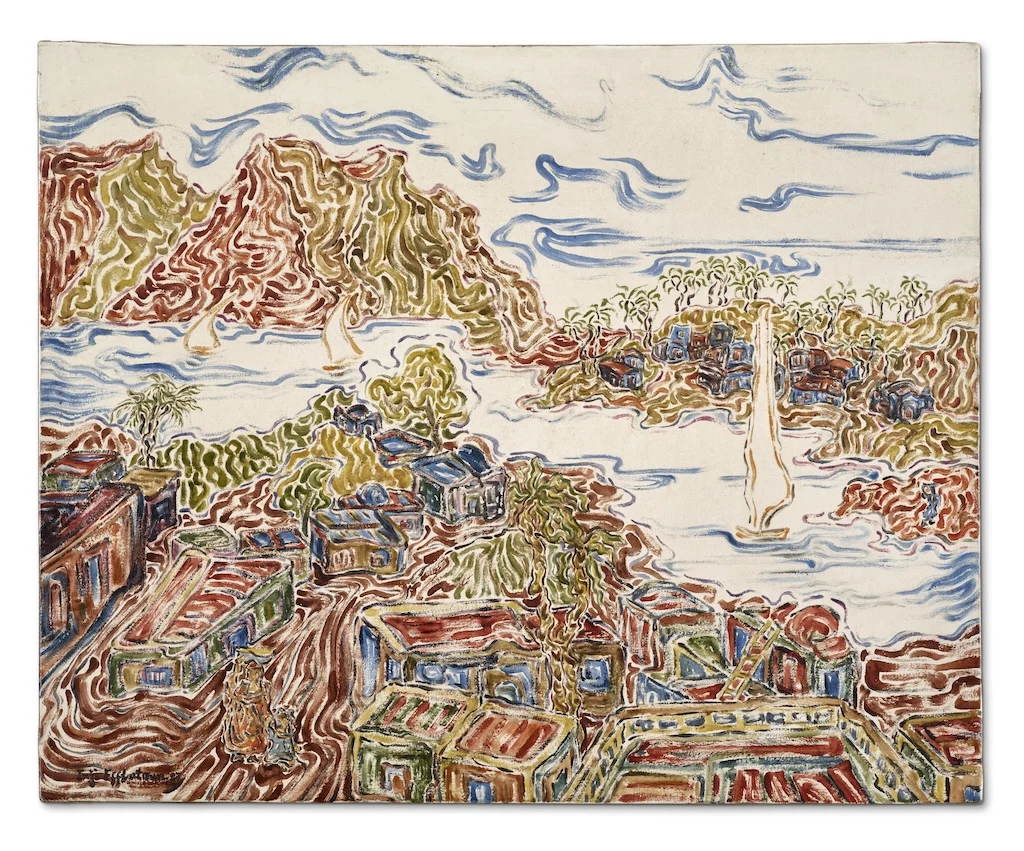
The "MAWASIM" auction is curated to reflect the "seasons" (the literal translation of the Arabic word Mawasim) of artistic evolution in the region over the last two decades. The sale includes a high-caliber selection of works by the most influential figures in modern Arab art, including Paul Guiragossian, Samia Halaby, Mohamed Melehi, Marwan Kassab-Bachi, Inji Efflatoun, and Nabil Nahas.
Key Highlights and Estimates
The auction is anchored by several "trophy" lots that have high expectations from regional and international collectors:
- Paul Guiragossian, Noces (Wedding) (1958–59): A monumental canvas from the Lebanese-Armenian master, estimated at $300,000 to $500,000.
- Samia Halaby, Yesterday (1978): A significant work of abstraction by the Palestinian pioneer, carrying an estimate of $200,000 to $300,000.
- Marwan Kassab-Bachi, Kopf (Head) (1987): A haunting example of the Syrian artist’s psychological portraiture, also estimated at $200,000 to $300,000.
- Mohamed Melehi, A30 (1962): Painted during the Moroccan artist’s influential years in Rome, this work is expected to fetch between $100,000 and $150,000.
The provenance of the works is equally notable. Eight pieces are consigned from the renowned Dalloul Collection in Beirut, while five come from the Barjeel Art Foundation in Sharjah. The inclusion of works from these collections—led by Basel Dalloul and Sultan Sooud Al Qassemi, both fixtures on the ARTnews Top 200 Collectors list—lends the auction a layer of institutional prestige.
Chronology: From Dubai’s Emergence to Abu Dhabi’s Commercial Maturity
To understand the significance of this move, one must look at the 20-year trajectory of the UAE art market, which has evolved in distinct phases.
2006–2010: The Dubai Foundation
In 2006, Christie’s held its inaugural UAE auction in Dubai. At the time, Dubai was positioning itself as the commercial gateway to the Middle East. This period saw the rise of Alserkal Avenue and the launch of Art Dubai (2007). Christie’s presence was a vote of confidence in the region’s nascent secondary market. For the next decade, Dubai remained the undisputed commercial hub, focusing on galleries, art fairs, and high-volume sales.

2007–2017: Abu Dhabi’s Institutional Building
While Dubai focused on the trade, Abu Dhabi embarked on a long-term "soft power" strategy centered on Saadiyat Island. In 2007, plans for the Saadiyat Cultural District were unveiled, promising a concentration of museums unparalleled in the world. This phase culminated in the 2017 opening of the Louvre Abu Dhabi, which transformed the city into a global destination for cultural tourism.
2023–Present: The Commercial Pivot
The current phase is defined by Abu Dhabi’s aggressive expansion into the commercial sector. In 2023, Sotheby’s established a new permanent presence in the capital. In 2024, the Abu Dhabi-based sovereign wealth fund ADQ invested $1 billion into Sotheby’s, effectively making the emirate a major stakeholder in the global art trade. Christie’s move to hold its 20th-anniversary sale in Abu Dhabi is the latest data point in this trend, suggesting that the "division of labor" between Dubai (commerce) and Abu Dhabi (institutions) is dissolving.
Supporting Data: A Growing Appetite for MENA Art
The decision to hold a high-stakes auction in Abu Dhabi is backed by robust market data indicating that Middle Eastern art is no longer a "niche" category but a resilient global asset class.
The Dalloul Collection Benchmark
Recent results from Christie’s London sale of works from the Dalloul Collection (November 2023) provide a snapshot of current demand:
- Total Sales: £4.1 million ($5.4 million).
- Sell-through Rate: 93% by value and 85% by lot.
- Performance: More than 50% of lots sold above their high estimates.
- Records: Eight new auction records were set in a single evening.
Shifting Demographics
Perhaps most importantly for the long-term health of the market, the buyer profile is diversifying. In the Dalloul sale, 38% of buyers were new to Christie’s, and of those new buyers, 21% were millennials. This influx of younger, tech-savvy, and globally-minded collectors suggests that modern Arab art is successfully bridging the gap between traditional regional interest and contemporary global investment.
Individual Outperformers
The demand is particularly high for female Arab modernists and Palestinian artists:
- Saloua Raouda Choucair’s Poem (1966–68) sold for 363% above its high estimate.
- Sliman Mansour’s Untitled (2014) fetched 80% above its high estimate.
- Kamal Boullata’s Nocturne I more than tripled its high estimate.
Official Responses: A "20-Year Arc" Comes Full Circle
The leadership at Christie’s views this move as a strategic alignment with the UAE’s broader cultural vision.

Meagan Kelly Horsman, Managing Director of Christie’s UAE, emphasized the historical weight of the anniversary. "This year marks twenty years since Christie’s inaugural Modern and Contemporary Art auction in Dubai," Horsman stated. She noted that the period has been defined by the "growing recognition of artists from the Middle East internationally," and described the current moment as a "20-year arc" coming full circle.
In its official release, Christie’s described the Abu Dhabi sale as a "milestone," highlighting the synergy between the house’s commercial history and Abu Dhabi’s burgeoning cultural infrastructure. While the house has not explicitly stated that it will move all operations to Abu Dhabi, the choice to celebrate its most significant anniversary in the capital suggests a permanent shift in focus.
Implications: The Convergence of Culture and Commerce
The arrival of Christie’s in Abu Dhabi, coinciding with other major market entries, has profound implications for the future of the art world in the Middle East.
The "Frieze Effect"
The Christie’s auction arrives just weeks before the inaugural edition of Frieze Abu Dhabi (November 19–22). The fair, held in partnership with Abu Dhabi’s Department of Culture and Tourism (DCT), will feature 84 galleries from 37 countries, including blue-chip giants like Gagosian, Pace, and Thaddaeus Ropac. The proximity of a Christie’s auction to a Frieze fair creates a "major art week" ecosystem similar to those in London, New York, and Hong Kong.
The Sotheby’s Rivalry
The competition for dominance in the region is heating up. Sotheby’s inaugural program in Abu Dhabi culminates in Collectors’ Week in early December, featuring auctions of jewelry, watches, cars, and real estate, alongside an Old Masters exhibition. With both houses now active in the capital, Abu Dhabi is rapidly becoming a year-round destination for high-net-worth collectors.
The Institutional Anchor
Unlike other emerging markets that rely solely on commercial speculation, Abu Dhabi’s market is anchored by massive institutional investment. The Guggenheim Abu Dhabi is scheduled to open in December 2025, further solidifying the Saadiyat Cultural District’s status. The presence of world-class museums provides a "safety net" for the commercial market, as institutional interest often stabilizes artist prices and ensures long-term historical relevance.
Conclusion
Christie’s decision to move its gavel "down the road" from Dubai to Abu Dhabi is more than a change of venue; it is a recognition of the UAE’s evolved status. For twenty years, the UAE has been building the stage; now, with international auction houses, global art fairs, and sovereign-backed investments converging in the capital, the performance has truly begun. The "MAWASIM" sale will be the first major test of whether Abu Dhabi can sustain the commercial heat required to match its institutional cold-storage prestige. If successful, it may well mark the moment the UAE officially became the third pillar of the global art market, alongside the West and East Asia.



