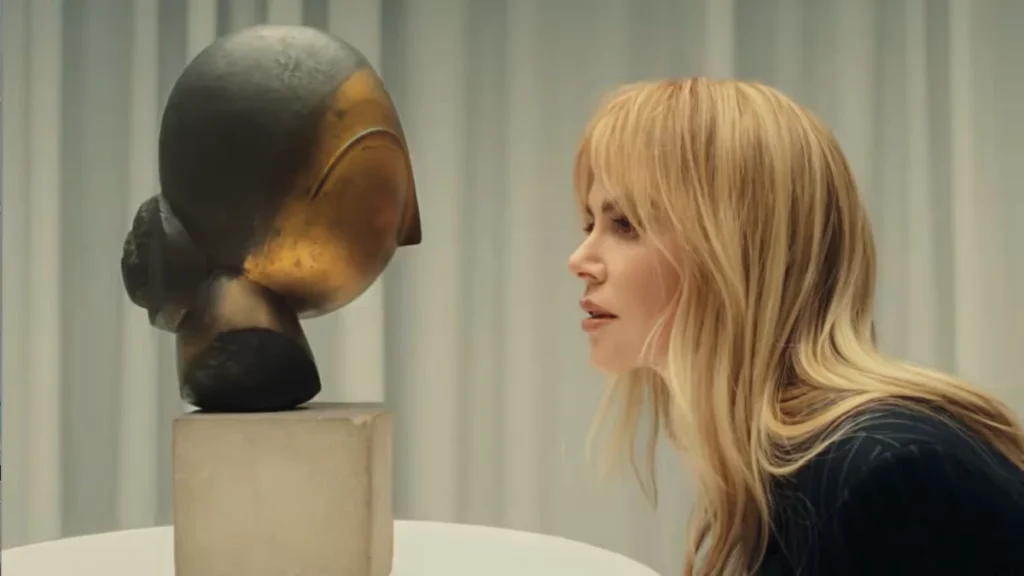
In the high-stakes theater of the international art market, the boundary between aesthetic appreciation and performative spectacle has never been more porous. This past spring, as the art world turned its gaze toward a record-breaking auction, Christie’s unveiled a cinematic short film featuring Nicole Kidman. The Hollywood star, moving through the gallery at Rockefeller Center, finds herself entranced by Constantin Brâncuși’s Danaïde (1913)—a masterwork of bronze and gold leaf.
The film is a study in calculated allure: Kidman dismisses an unseen caller, stalks the sculpture in stilettos, and, to the syncopated rhythm of David Bowie’s "Golden Years," engages in a silent dialogue with the work’s burnished, enigmatic visage. It is a piece of marketing theater that, whether by design or accident, mirrors the broader, often contentious, ways in which Brâncuși’s legacy is being repackaged for a new generation. When Danaïde eventually hammered down for a staggering $107.6 million, setting a new world record for an auctioned sculpture, it signaled that Brâncuși’s "minimalist" vision remains the ultimate luxury commodity.
A Legacy in Motion: The 2026 Survey
While the market treats Brâncuși as a trophy, the museum world is currently engaged in a more earnest, if occasionally flawed, reassessment of his contributions. Following the French government’s preservation of the artist’s 15th arrondissement studio—a condition of his 1957 bequest—the contents of the "Atelier Brâncuși" have been temporarily displaced due to the ongoing renovations of the Centre Pompidou.

This summer, these contents arrived at Berlin’s Neue Nationalgalerie, marking the first major Brâncuși exhibition in Germany in half a century. With over 150 sculptures, archival photographs, and personal ephemera, the survey offers an expansive look at the Romanian-born sculptor. As the show prepares to travel to the Museum of Modern Art (MoMA) in New York this October, the art world is forced to reconcile the man behind the "minimalist" label with the reality of his complex, labor-intensive practice.
Chronology and Context: From Târgu Jiu to Berlin
Constantin Brâncuși (1876–1957) did not emerge in a vacuum. His artistic trajectory is a bridge between folk tradition and the high-modernist avant-garde.
- 1910–1920: The era of the "Sleeping Muses" and the debut of Princess X. During this time, Brâncuși moved away from the influence of his mentor, Auguste Rodin, seeking a "subtractive" truth in stone and bronze.
- 1926: The pivotal U.S. retrospective organized by Edward Steichen. This event triggered the famous legal battle over the classification of Bird in Space. U.S. Customs officials initially attempted to tax the work as a "manufactured metal object" (a kitchen tool), necessitating a court deposition to affirm its status as fine art.
- 1935–1937: The construction of the war memorial at Târgu Jiu, Romania, featuring the Endless Column and the Kiss Gate. These works cemented his status as a pioneer of architectural sculpture.
- 2026: The current retrospective at the Neue Nationalgalerie, curated by Klaus Biesenbach and Maike Steinkamp, which seeks to contextualize his studio practice within a contemporary framework.
The Architecture of Display: Mies van der Rohe vs. Brâncuși
The choice of Berlin’s Neue Nationalgalerie, a masterpiece of modernist architecture designed by Mies van der Rohe, was theoretically perfect. The open-plan gallery, punctuated by only four structural columns, seemed to invite a dialogue with Brâncuși’s verticality.

However, in practice, the exhibition exposed the difficulties of curating "minimalism." Some critics have noted that the placement of works—often against walls or behind protective glass—undermined the spatial fluidity that Brâncuși intended. His Bird in Space (1923), for instance, felt stifled by its enclosure, while the maquette for the Kiss Gate was placed in a position that made it nearly impossible to appreciate its architectural scale. The curation opted for traditional, somewhat restrictive categories: "Portraits," "Animals," and "Bird in Space." These groupings often bypassed more profound themes, such as the intersection of folk culture, gender fluidity, and the artist’s engagement with primitivism.
The "Minimalism Glut" and Modern Consumption
The influence of Brâncuși’s "less is more" ethos has arguably transcended the gallery wall to become a defining aesthetic of the 21st-century elite. As Kyle Chayka argues in The Longing for Less (2020), there is a "minimalism glut" that permeates contemporary culture—from the design of sleek, high-end kitchen appliances to the "decluttered" lifestyles of the wealthy.
Brâncuși’s work is frequently cited as the spiritual ancestor of this movement. Designers and brands, from Rick Owens to the Tokyo-based firm Ambush, have co-opted his visual language. Even Bulgari designer Mary Katrantzou has expressed a desire to emulate the "devoid of intricacy" nature of Sleeping Muse. Yet, to call Brâncuși "devoid of intricacy" is to fundamentally misunderstand his process. The artist’s taille directe (direct carving) method and his obsessive polishing of bronze surfaces were acts of extreme labor. He did not remove detail to create simplicity; he erased the traces of his own effort to achieve a state of "lapidary certainty."

Official Perspectives: The Artist as Myth
The Christie’s vignette with Nicole Kidman is not the first time Brâncuși’s work has been utilized for its "erotic frisson." In 1930, Man Ray filmed Lee Miller running her hand over the neck of Princess X. Even then, the focus was as much on the fame of the model as the sculpture itself.
The exhibition in Berlin attempts to pivot away from this celebrity-adjacent history by highlighting the artist’s intellectual life. The central pavilion—a reconstruction of his studio—serves as a necessary reminder that the sculptor was a man of letters, a photographer, and a constant correspondent with the likes of Fernand Léger and Blaise Cendrars. This archival material provides the essential "flesh" to the "bareboned" nature of his sculptures, grounding his abstract forms in the reality of a lived, professional, and personal life.
Implications: The Future of the Brâncuși Canon
As the exhibition prepares for its move to MoMA, several critical questions remain. How does the art world balance the commercial, celebrity-driven consumption of Brâncuși—as seen in the record-breaking $107.6 million auction—with the historical integrity of his work?

The "Brancusi Effect," a term coined by curator Nicolaus Schafhausen in 2014, continues to hold weight. It suggests that Brâncuși’s influence is not merely visual but structural, affecting how we understand the relationship between an object and its environment. Whether it is the kinetic energy of the spinning Leda (1926) or the tactile invitation of Sculpture for the Blind (c. 1920), Brâncuși constantly challenged the viewer to move beyond the rational.
Ultimately, Brâncuși remains a paradox. He is the sculptor of the absolute, yet his work is filled with the messy, human elements of eroticism, myth, and vernacular culture. As we approach a hundred years since his first American retrospective, the upcoming MoMA exhibition will be the next litmus test. It will determine whether Brâncuși will continue to be a commodity for the beau monde to dance around, or if he will be reclaimed as the radical, deeply labor-focused innovator who redefined the nature of modern form.
If the current Berlin survey teaches us anything, it is that Brâncuși’s sculptures, despite their "sententious certitude," are far from static. They are, and perhaps always have been, in a constant state of transformation—shifting under the lights of a gallery, the lenses of a camera, and the changing demands of the history that continues to rewrite them.