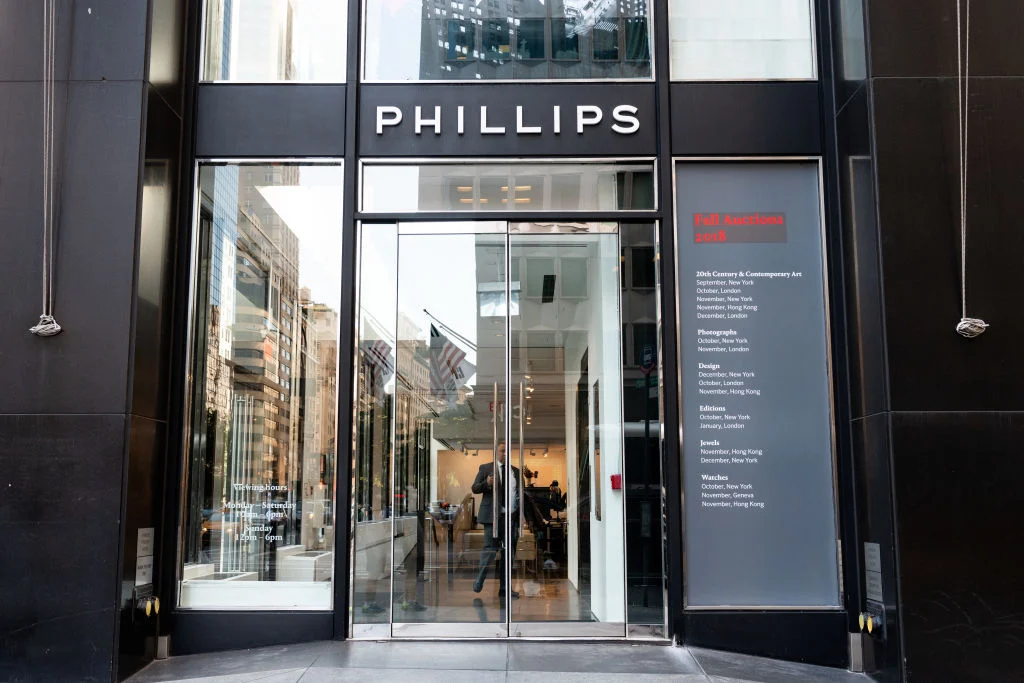
The global art market, often characterized by its high-stakes drama and carefully curated public image, is currently focused on the internal mechanics of Phillips. In a series of high-profile departures that have sent ripples through the secondary market, it has been revealed that half of the executive leadership team at Phillips is no longer with the firm. Following a successful but transitional May sales season, the auction house is grappling with the loss of several "rainmakers"—the seasoned specialists and executives whose personal relationships with billionaires often dictate the success of multi-million dollar evening sales.
As the industry prepares for the pivotal fall season, beginning with London’s Frieze Week in October, the vacuum left by these veterans raises critical questions about the auction house’s strategic direction under its new Chief Executive, Martin Wilson.
I. Main Facts: The Scope of the Departure
The scale of the turnover at Phillips is significant, affecting both the highest levels of global management and key regional specialist roles. The two most prominent departures are Miety Heiden, the Chairman of Private Sales, and Jonathan Crockett, the Chairman for Asia. Both figures have been instrumental in Phillips’ aggressive expansion over the last decade, particularly in the lucrative Asian market and the increasingly important sector of private treaty sales.
Until recently, the core executive leadership team reported directly to CEO Martin Wilson and consisted of four pillars:
- Miety Heiden (Departing)
- Jonathan Crockett (Departing)
- Robert Manley, Chairman and Worldwide Head of Modern and Contemporary Art (Remaining)
- Marianne Hoet, Head of Business Development and Chairman of Europe (Remaining)
The departures are not limited to the executive quartet. The summer of 2024 has seen a steady stream of resignations and exits from other high-ranking staff, including:
- Scott Nussbaum: Deputy Chairman and Senior International Specialist (Left in June).
- Vivian Pfeiffer: Deputy Chairman and Head of Business Development (Left in August).
- Meiling Lee: Senior International Specialist for 20th-century and Contemporary Art (Resigned recently).
- Annette Schwaer: Chief Financial Officer (Departed after 11 years).
- Jennifer Jones: Senior Vice President and Senior Director for Trusts, Estates, and Valuations.
- Carolina Lanfranchi: Regional Director in Milan (Departed recently).
This turnover represents a significant loss of institutional memory and "deal-making" DNA. Many of these individuals were recruited during the "Dolman Era"—the period under former CEO Ed Dolman when Phillips aggressively poached talent from Christie’s and Sotheby’s to establish itself as a legitimate third competitor in the global market.
II. Chronology: From the Dolman Era to the Wilson Transition
To understand the current volatility, one must look at the leadership transition that began in late 2023.
The Departure of Ed Dolman (Early 2024):
For years, Ed Dolman was the face of Phillips. A former CEO of Christie’s, Dolman was credited with transforming Phillips from a niche boutique house into a global powerhouse. His decision to step down in 2024 to start his own consultancy marked the end of an era of rapid, high-capital expansion.
The Rise of Martin Wilson (2024):
Martin Wilson, who joined Phillips in 2019 as Chief Legal Officer after two decades at Christie’s, was tapped to lead the firm. Wilson’s background is rooted in law and compliance rather than the "specialist" track of traditional art dealers. His appointment signaled a potential shift toward operational efficiency and structural stability.
December 2023 – April 2024: Early Warning Signs:
In December 2023, Deputy CEO Amanda Lo Iacono stepped down, creating the first major vacancy in the upper echelon. By April 2024, the house attempted to bolster its ranks with a flurry of internal promotions and new hires, including India Phillips as Managing Director for Europe and Rebekah Bowling as Head of 21st-century Art.
May 2024: The Last Hurrah for the Old Guard:
The marquee May sales in New York were a resounding success. Phillips achieved a "white-glove" evening sale (100% of lots sold) and a total of $145.6 million. This performance was a 90% increase year-over-year by lot. However, behind the scenes, the friction of leadership changes was already taking its toll.
June – September 2024: The Wave of Resignations:
Immediately following the May successes, the resignations of Nussbaum, Pfeiffer, and eventually Heiden and Crockett became public. This "summer exodus" has left the house in a state of visible transition just as the fall auction calendar begins.
III. Supporting Data: Market Performance vs. Personnel Stability
On paper, Phillips is performing exceptionally well. The contrast between the firm’s financial health and its personnel turnover is one of the most striking aspects of this story.
Financial Momentum:
- The May Sales: The $145.6 million total in New York was bolstered by a $115.2 million Modern and Contemporary evening sale.
- The Basquiat Factor: Senior specialist Meiling Lee (who is now departing) was credited as a primary force behind the 2022 sale of Jean-Michel Basquiat’s Untitled (1982) for $85 million.
- Private Sales Growth: Under Miety Heiden’s leadership, Phillips reported a 46% growth in annual private sales. Private sales are often more profitable for auction houses than public auctions because they involve lower overhead and more predictable margins.
The Cost of Talent:
Industry insiders suggest that the high salaries required to lure "star" specialists from Christie’s and Sotheby’s in the mid-2010s may now be viewed as a liability in a cooling global art market. According to a New York-based art adviser, some of the departures may be an intentional effort by Phillips to "trim the cost basis" of the business. The adviser noted that seasoned figures like Heiden and Nussbaum are "senior enough that they no longer necessarily need an auction house behind them," suggesting that their high compensation packages might have been targets for a "leaner" operational model under CEO Martin Wilson.
IV. Official Responses: Continuity vs. Evolution
Phillips has maintained a stoic and optimistic public stance regarding the departures. In a statement to ARTnews, a spokesperson emphasized that the house is focusing on "uninterrupted performance" and the cultivation of "next-generation" talent.
"Phillips’ priority firmly remains on delivering uninterrupted performance for our clients and building on the strong momentum we’ve achieved across the business," the spokesperson said. The firm also highlighted recent hires, such as Annie Wallington (Senior Specialist, London) and Kristen Yraola (Global Head of Digital Marketing), as evidence of a forward-thinking strategy.
Regarding Miety Heiden, the spokesperson was particularly complimentary: "During her tenure, [Heiden] has played an important role in Phillips’ growth and success… She leaves behind a talented and highly capable team."
Similarly, for Jonathan Crockett, the firm noted his role in "establishing and growing the company’s presence across Asia," while hinting at potential future collaborations.
However, independent voices in the art world are less sanguine. Gabriela Palmieri, a prominent art adviser, expressed concern: "How can you secure confidence from your clients if you can’t secure confidence from your team?" This sentiment highlights the fundamental truth of the auction business: it is a relationship-driven industry where clients follow specialists, not just brand names.
V. Implications: The Road Ahead for Phillips
The departure of such a large swath of leadership carries several long-term implications for Phillips and the broader market.
1. The Risk of Client Attrition:
The primary risk for Phillips is that departing specialists like Miety Heiden or Scott Nussbaum will transition into private advisory roles, taking their "Black Books" of high-net-worth collectors with them. If a collector has spent a decade working exclusively with a specific specialist, they are likely to follow that individual to a new firm or a private practice, potentially depriving Phillips of future consignments.
2. A Shift in Corporate Culture:
The transition from Ed Dolman (the consummate art salesman) to Martin Wilson (the legal and operational strategist) suggests that Phillips is moving away from the "star specialist" model toward a more corporate, efficiency-focused structure. This may help the firm’s bottom line in the short term, but it risks diluting the "boutique" feel that allowed Phillips to compete with the larger resources of Sotheby’s and Christie’s.
3. The Asian Market Pivot:
With both Jonathan Crockett and Meiling Lee departing, Phillips faces a critical juncture in Asia. Since opening its Hong Kong outpost in 2015, Phillips has fought hard for market share in the region. The elevation of Cherry Lam to General Manager of Asia suggests the house is looking to local, perhaps more operationally focused leadership to maintain its foothold in a region that is currently experiencing economic cooling.
4. The "Leaner Business" Strategy:
As one anonymous adviser suggested, this may not be an "exodus" so much as a "right-sizing." If Phillips can achieve "white-glove" results with a younger, less expensive team, the firm’s profitability could increase significantly. The upcoming fall sales in London and New York will be the ultimate litmus test for this theory. If Phillips can maintain its $100M+ evening sale totals without its veteran chairmen, it will prove that the brand has finally achieved the institutional weight necessary to survive without its founding "rainmakers."
Conclusion:
Phillips is currently a house in transition. While its financial results suggest a company at its peak, its internal roster tells a story of a major structural overhaul. As the art world descends on London for Frieze Week, all eyes will be on the new leadership to see if they can maintain the "strong momentum" promised in their official statements, or if the loss of these industry titans will lead to a retreat in market share. For now, the "Big Three" remains intact, but the internal DNA of its third member has been fundamentally altered.