

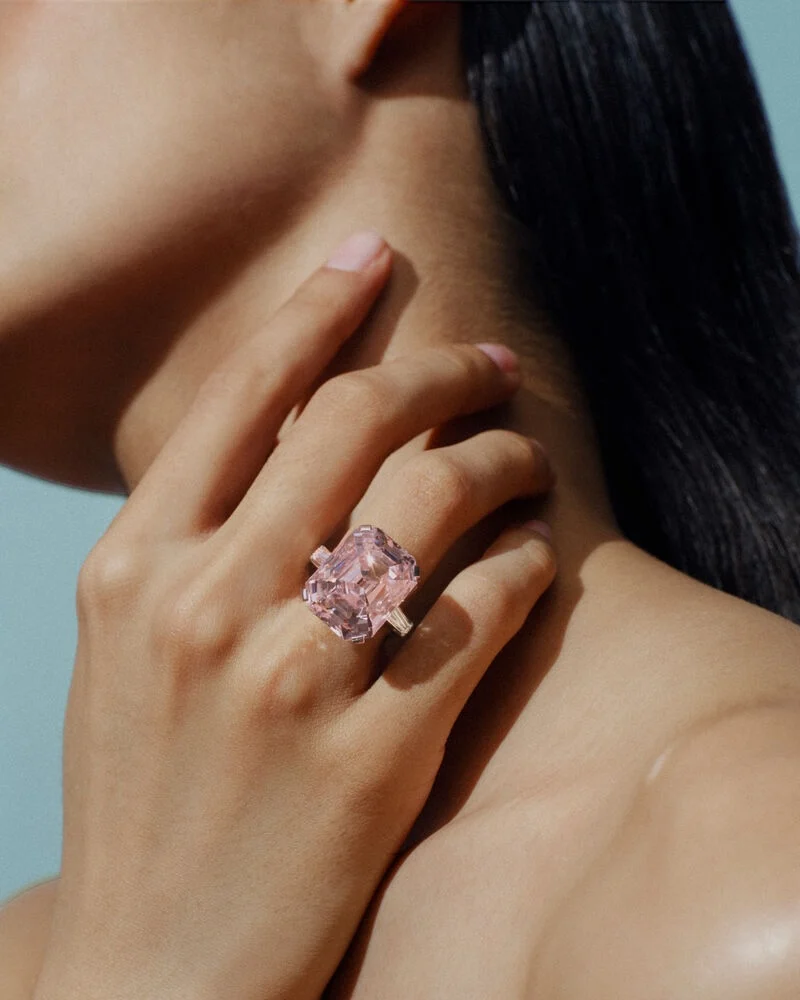
The international jewelry market is bracing for a landmark event this November as Christie’s prepares to headline its "Magnificent Jewels" sale in Geneva with a gemstone of singular rarity and historical importance. The centerpiece of the Autumn Luxury Week is a "Fancy Intense Pink" diamond ring, weighing a staggering 24 carats, crafted by the legendary Italian house of Bulgari during the height of the mid-century "Dolce Vita" era.
Estimated to fetch between $12 million and $18 million, the ring is not merely a masterwork of gemology but a physical chronicle of 20th-century aristocratic taste and the evolution of high jewelry. Held within the private collection of a distinguished European noble family for over seven decades, its appearance at auction marks the first time this "hidden" treasure has been seen by the public since its commission in the 1950s.
Chronology: From the Mines of India to the Boutiques of Rome
The journey of this 24-carat marvel begins in the diamond fields of India, a region historically synonymous with the world’s most famous stones, including the Koh-i-Noor and the Hope Diamond. According to provenance records provided by Christie’s, the raw stone was acquired by the great-grandfather of the current owner. During the early 20th century, Indian mines—particularly those in the Golconda region—remained the premier source for Type IIa diamonds, known for their exceptional optical transparency and chemical purity.
By the mid-1950s, the stone was brought to Rome, the spiritual and operational heart of Bulgari. At the time, Rome was undergoing a cultural renaissance. Following the hardships of World War II, the city transformed into a vibrant epicenter of fashion, cinema, and high society. This era, famously dubbed "Hollywood on the Tiber," saw the Cinecittà Studios become the preferred filming location for massive American productions like Ben-Hur and Roman Holiday.
The "European noble family" that owned the diamond sought a setting that reflected the newfound optimism and grandeur of the age. They turned to Bulgari’s flagship boutique at Via Condotti. Under the stewardship of the Bulgari family, the house had moved away from the strict Parisian school of jewelry design—which favored platinum and delicate lace-like patterns—toward a bolder, more architectural aesthetic. The resulting ring was a testament to this transition: a sophisticated setting designed to highlight the diamond’s massive scale and its delicate, saturated pink hue.
For 70 years, the ring remained a closely guarded family heirloom, passed down through three generations. Its preservation in a single private collection has ensured that the stone remains in pristine condition, untouched by the frequent re-cutting or modern modifications that often affect historic gems.
Supporting Data: The Rarity and Science of the "Fancy Intense Pink"
To understand the projected $18 million valuation, one must look at the intersection of geology and market scarcity. The Bulgari Pink is classified as a Type IIa diamond, a technical distinction that places it in the top 1-2% of all diamonds ever mined.
The Type IIa Distinction
Type IIa diamonds are characterized by an almost total absence of nitrogen or boron impurities within the carbon lattice. While most diamonds contain nitrogen (which lends a yellowish tint) or boron (which creates blue hues), Type IIa stones are chemically the most pure. This lack of impurities results in an extraordinary level of transparency, often described as "water-like." When this purity is combined with a vivid color like pink, the result is a stone that possesses a brilliance and "fire" that inferior grades cannot match.
The Physics of Pink
Unlike other colored diamonds, the origin of the pink hue is not due to chemical trace elements. Instead, pink diamonds owe their color to a phenomenon known as "plastic deformation." During the diamond’s formation billions of years ago, intense heat and pressure caused a rare distortion in the crystal lattice. This structural shift changes the way the stone absorbs and reflects light, manifesting to the human eye as various shades of pink.
The GIA (Gemological Institute of America) grade of "Fancy Intense Pink" is particularly coveted. It represents a perfect balance of saturation and tone—deep enough to be unmistakably pink, yet bright enough to maintain the diamond’s internal life.
Market Context and Comparisons
The auction of a 24-carat pink diamond is a rare occurrence. For comparison, the "Pink Star," a 59.60-carat Fancy Vivid Pink, holds the world record at $71.2 million. However, in the 20-to-30-carat range, the Bulgari Pink enters a highly competitive tier of "investment-grade" assets. Recent years have seen a surge in demand for colored diamonds following the 2020 closure of the Argyle Mine in Australia, which previously supplied over 90% of the world’s pink diamonds. With the primary source of new supply extinguished, historic stones like the Bulgari Pink have seen their valuations skyrocket.
The Bulgari Legacy and the "Hollywood on the Tiber" Era
The ring’s association with Bulgari adds a layer of "brand provenance" that significantly enhances its value. During the 1950s and 60s, Bulgari was the jeweler of choice for the world’s elite. The Via Condotti boutique served as a social crossroads where European royalty mingled with Hollywood icons.
Christie’s notes that the era of this ring’s creation was defined by legendary figures such as Elizabeth Taylor, who famously remarked, "The only word Elizabeth knows in Italian is Bulgari," according to her husband Richard Burton. Other regulars included Audrey Hepburn, Sophia Loren, and Ingrid Bergman.
The 1950s Bulgari style was characterized by a move toward yellow gold, the use of cabochon-cut gemstones, and a focus on "wearable" opulence. While this specific pink diamond is set with the traditional elegance required of such a massive stone, it carries the "DNA" of a period when Bulgari was redefining luxury for the modern woman. To own a Bulgari piece from this era is to own a fragment of the most glamorous chapter in Italian history.
Official Responses and Auction Expectations
Max Fawcett, Head of Jewelry at Christie’s Geneva, has signaled that the Bulgari Pink is expected to be one of the most talked-about lots of the decade. "This diamond is a miracle of nature," Fawcett stated in a preliminary briefing. "To find a pink diamond of over 20 carats is rare enough, but to find one with this level of saturation, Type IIa purity, and a pristine 1950s provenance from a house like Bulgari is almost unheard of in the current market."
Market analysts suggest that the estimate of $12 million to $18 million may be conservative. "We are seeing a flight to quality," says Elena Volumina, an independent luxury asset consultant. "Ultra-high-net-worth individuals are moving away from volatile equities and toward ‘portable wealth’—assets that are rare, historical, and globally recognized. A 24-carat pink diamond is the ultimate hedge against economic uncertainty."
Christie’s has confirmed that the ring will undergo a global tour, with viewings scheduled in Hong Kong, New York, and London, before arriving in Geneva for the final sale on November 10. The auction house expects significant bidding interest from private collectors in Asia and the Middle East, regions that have recently shown an insatiable appetite for rare colored gemstones.
Implications for the Global Gem Market
The sale of the Bulgari Pink is poised to set the tone for the 2025 luxury market. Several key implications emerge from this upcoming auction:
- The Rise of Provenance: In an era of lab-grown diamonds and synthetic enhancements, the "story" of a stone has become as valuable as the stone itself. The fact that this diamond was held by a single noble family for 70 years provides a "clean" history that is highly attractive to institutional collectors.
- Geneva as the Luxury Capital: Despite the rise of Dubai and Singapore as wealth hubs, Geneva remains the undisputed capital for the "Magnificent Jewels" circuit. The city’s neutrality and long history of high-stakes auctions continue to draw the world’s most serious buyers.
- The "Pink" Premium: As supply continues to dwindle, the "Pink" premium—the price gap between white diamonds and pink diamonds—is widening. Investors now view these stones not just as jewelry, but as a distinct asset class, similar to fine art or rare vintage Ferraris.
As the gavel falls in Geneva this November, the Bulgari Pink will likely transition from a private family secret to a public record-breaker, cementing its place in the pantheon of the world’s most significant gemstones. For the winning bidder, it represents a rare opportunity to acquire a piece of "La Dolce Vita" that remains as radiant today as it was when it first left the Via Condotti boutique seven decades ago.



