In the rarefied air of independent haute horlogerie, few names command the reverence—and spark the debate—of MB&F. Founded by Max Büsser in 2005, the Geneva-based laboratory has spent two decades defining the avant-garde. Today, the brand marks a significant milestone by revisiting its past to secure its future: the introduction of the MB&F LM1 EVO. By housing the iconic movement of the 2011 Legacy Machine No. 1 within the modern, performance-oriented "EVO" case, MB&F is not merely releasing a new watch; it is defining its current identity as a bridge between historical reverence and contemporary utility.
Main Facts: A Hybrid Masterpiece
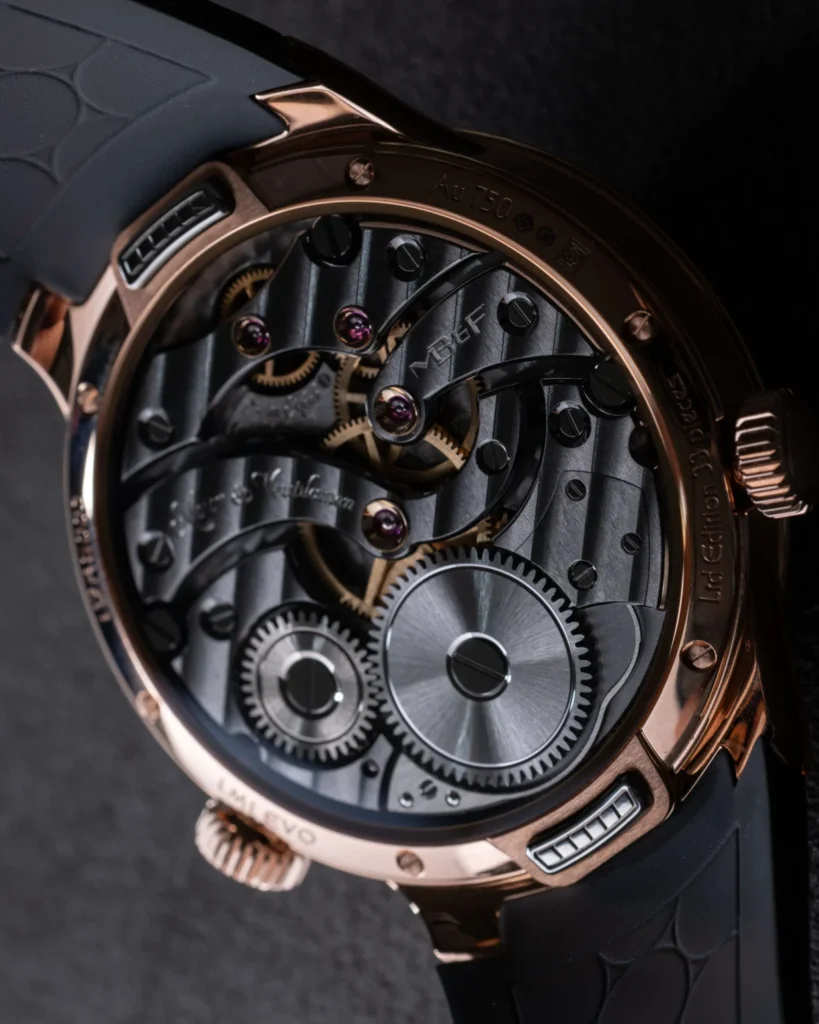
The LM1 EVO serves as a compelling synthesis of MB&F’s dual personality. At its heart lies the legendary manual-wind movement co-developed by Jean-François Mojon and originally manufactured with the input of master watchmaker Kari Voutilainen. This movement, celebrated for its suspended central balance wheel, is now encased in the robust, ergonomically advanced EVO chassis.
The collection debuts in two distinct iterations:

- The Limited Edition: Crafted in 18k rose gold with a striking green dial, limited to just 33 pieces, retailing at $137,000 USD.
- The Non-Limited Edition: Featuring a lightweight titanium case with a sophisticated silver-tone dial, retailing at $109,000 USD.
Both models feature the "FlexRing" shock-absorption system—a rubberized gasket designed to protect the movement from the rigors of an active lifestyle—and offer an impressive 80 meters of water resistance, a rarity for this level of mechanical complexity.
The Chronology: From Rebellion to Refinement
To understand the significance of the LM1 EVO, one must look back at the brand’s trajectory.
The Horological Machine Era (2005–2010)
In its infancy, MB&F was defined by the Horological Machines (HM). These were unapologetically futuristic, non-round, and functionally abstract. They were designed for the "rebel" collector, someone who viewed traditional watchmaking as an outdated relic. Max Büsser famously noted that these pieces were intended to challenge the status quo, even if it meant a slower adoption rate by the traditional retail market.

The Legacy Machine Shift (2011)
The introduction of the Legacy Machine No. 1 (LM1) in 2011 was a watershed moment. It was a strategic pivot that saw Büsser pay homage to the 19th-century masters of horology. By creating a round, traditionally finished watch with a massive, suspended balance wheel, MB&F proved it could play by the rules of classical watchmaking while still imbuing them with a singular, artistic vision. This shift proved vital; the Legacy Machine series eventually became the financial and cultural anchor of the company.
The EVO Integration (2021–Present)
By 2021, MB&F recognized a new need: durability. The "EVO" case was introduced to provide a more robust, daily-wear experience. By moving away from the delicate nature of the early Legacy Machines and integrating screw-down crowns and superior shock protection, MB&F signaled that its collectors wanted to wear their art, not just display it in a safe. The LM1 EVO is the culmination of this fifteen-year journey—a marriage of the 2011 movement’s mechanical beauty and the 2021 case’s modern practicality.
Supporting Data: Technical Specifications and Architecture
The technical prowess of the LM1 EVO remains largely faithful to its 2011 roots, yet it benefits from modern manufacturing refinements.

- Movement Architecture: The caliber consists of 270 components. It maintains a low frequency of 2.5Hz (18,000 vibrations per hour), chosen specifically to allow the wearer to visually track the hypnotic oscillation of the balance wheel.
- Power Reserve: The watch offers a 60-hour power reserve. While the original LM1 featured a complex, three-dimensional vertical indicator, the EVO version opts for a slightly more streamlined approach to the "flat" power reserve display, enhancing readability without sacrificing the visual drama of the dial.
- Materials and Finishing: The movement now features a dark, anthracite-style NAC finish, providing a contemporary contrast to the polished elements. The signatures of Jean-François Mojon and Kari Voutilainen remain, signifying the technical provenance, though the production has transitioned to the internal industrial capabilities developed by Mojon’s firm over the last decade.
- Ergonomics: The watch sits at 42mm in diameter and 16.8mm in height. While the thickness is significant, it is necessitated by the domed sapphire crystal that protects the suspended balance wheel. The 52mm lug-to-lug measurement, combined with the quick-release strap system, ensures it remains wearable for a variety of wrist sizes.
Official Responses and Strategic Vision
In internal communications and industry discussions, Max Büsser has often addressed the tension between his initial, radical vision and the current market reality. He has admitted that while his heart remains in the abstract, the "mixed" approach to product development has been the engine of the brand’s longevity.
MB&F does not view the LM1 EVO as a step backward. Instead, they position it as "evolutionary continuity." By recycling the successful movement of the LM1, the brand isn’t lacking in ideas; rather, it is fulfilling a request from a new generation of collectors who were too young to purchase the original 2011 edition. The brand’s official stance is that the EVO case represents the "final form" of the Legacy Machine concept: a watch that retains the soul of the past while meeting the performance demands of the modern era.
Implications: What This Means for the Market
The release of the LM1 EVO carries several implications for the secondary market and the future of the brand:

1. The Normalization of "Neo-Vintage"
MB&F is effectively creating its own "neo-vintage" market. By re-releasing the LM1 movement in a new case, they are signaling to collectors that an MB&F watch is an asset that can be iterated upon. This provides long-term stability for the brand’s value proposition.
2. The Mainstreaming of the Independent
The "EVO" aesthetic is, by design, more accessible to a broader audience. While $109,000 is hardly a mass-market price, the watch is significantly more "approachable" in terms of style than the wilder Horological Machines. This indicates a strategic push to expand the brand’s reach among collectors who value luxury and robustness over the avant-garde designs that previously defined the company.
3. A Shift in Creative Focus
Critics may argue that the focus on "mixing and matching" existing movements and cases suggests a cooling of the brand’s legendary inventiveness. However, a more nuanced view suggests that MB&F has reached a level of maturity where it no longer needs to reinvent the wheel with every release. Instead, it is curating a "greatest hits" portfolio that honors its history while ensuring the technical performance remains at the cutting edge.

4. Impact on Collectors
For the long-term enthusiast, the LM1 EVO offers a chance to experience one of the most important movements of the 21st century in a package that is actually suitable for daily wear. It is a win-win for those who want the mechanical poetry of Voutilainen and Mojon without the fear of damaging a piece of "fragile" horological history.
Conclusion
The MB&F LM1 EVO is more than a timepiece; it is a document of a brand that has grown up. It reflects a shift from the rebellious, experimental startup phase into a period of established, refined mastery. While some purists may long for the wild, non-round shapes of the early HMs, the reality is that the Legacy Machine series, and now the EVO evolution, represents the bedrock of the company.
By combining the heart of the 2011 Legacy Machine with the skin of the 2021 EVO, MB&F has created a watch that is at once a tribute to its origins and a nod to its future. Whether the market sees this as a dilution of the brand’s radical DNA or a sophisticated maturation of its design language, one thing is certain: the LM1 EVO is destined to become a centerpiece of the modern MB&F collection, standing as a testament to the fact that even the most forward-thinking brands must occasionally look back to see how far they have come.