

Introduction: A Shield Against Maritime Lawlessness
In the vast, ungoverned stretches of the world’s oceans, where sovereignty often blurs and law enforcement is miles away, the ICC International Maritime Bureau’s (IMB) Piracy Reporting Centre (PRC) has stood as a solitary lighthouse since 1991. For over thirty years, this 24-hour nerve center has functioned as the primary defensive line for the global shipping industry, bridging the gap between distressed mariners and the fragmented response capabilities of international authorities.
As global trade remains inextricably linked to maritime transit, the role of the PRC has evolved from a simple reporting hub into a sophisticated clearinghouse of intelligence. By monitoring real-time threats and disseminating critical alerts, the Centre provides the maritime community with the situational awareness necessary to navigate increasingly volatile waters.
Main Facts: The Mandate of the PRC
The IMB Piracy Reporting Centre is not merely a bureaucratic body; it is a tactical lifeline. Its core mission is twofold: immediate intervention and long-term analytical insight.
24/7 Operational Vigilance
The Centre operates around the clock, providing a single point of contact for ships facing piracy or armed robbery. When a vessel is under threat, time is the most precious commodity. The PRC’s ability to coordinate instantly with local response agencies, coast guards, and naval assets has saved countless lives and preserved billions of dollars in cargo.
Information Dissemination
Beyond individual interventions, the PRC acts as an information hub. It issues rapid-response warning broadcasts and email alerts to ships operating in high-risk zones. By keeping captains and shipping companies informed of active threats—such as drifting skiffs in the Gulf of Guinea or suspicious movements in the Singapore Strait—the Centre empowers the industry to employ preventative measures, such as hardening vessels or altering transit routes.
Advocacy for Reporting
A recurring challenge in maritime security is underreporting. The IMB maintains that every incident, whether an actual boarding, a failed attempt, or a mere sighting of suspicious activity, must be logged. This data is the foundation of global maritime policy; without it, the international community cannot effectively allocate resources, patrol assets, or pressure governments to secure their territorial waters.
Chronology: A History of Maritime Security
The establishment of the PRC in 1991 was a reactive necessity born of a global spike in maritime crime. Looking back through the decades reveals a shifting landscape of danger.
The 1990s: The Genesis
In the early 1990s, the world saw a dramatic surge in piracy, particularly in Southeast Asian waters. Recognizing that shipping companies were suffering in isolation, the International Chamber of Commerce (ICC) launched the IMB Piracy Reporting Centre. Its goal was to formalize the reporting process, which had previously been fragmented across various national maritime authorities.
The 2000s: The Somalia Crisis
The turn of the millennium introduced a new, more lethal breed of piracy: the Somali hijackings. As the state collapsed in Somalia, pirates armed with AK-47s and rocket-propelled grenades moved from coastal robbery to deep-sea ship seizures. The PRC became the primary conduit for information between the shipping industry and the international naval task forces that were eventually deployed to the region. The Centre’s ability to map these "hotspots" proved invaluable to the international naval response.
The 2010s to Present: Diversification of Threats
In recent years, the theater of operations has shifted again. While Somali piracy was largely suppressed by naval patrols, the Gulf of Guinea became the world’s most dangerous region for crew kidnappings, while the Singapore Strait saw a resurgence in petty armed robbery. The PRC has remained consistent, adapting its communication protocols to handle the high-speed digital reporting requirements of modern commercial fleets.
Supporting Data: Understanding the Landscape
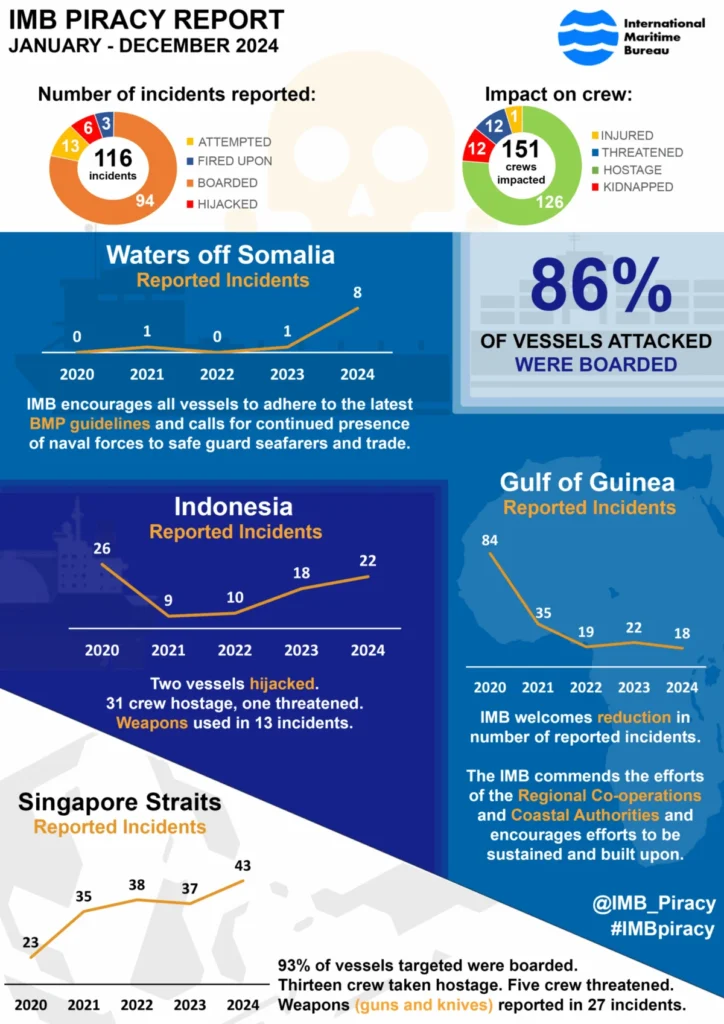
The value of the IMB’s work is best captured in its annual reporting. The 2024 Piracy and Armed Robbery Against Ships report provides a granular look at the trends defining modern maritime security.
Patterns of Modern Piracy
- The "Opportunity" Factor: Data consistently shows that many incidents occur when vessels are at anchor or moving slowly through narrow straits. The PRC’s data emphasizes that pirates are often opportunistic, targeting vessels with low freeboards or insufficient watch-keeping.
- The Geography of Risk: The IMB’s data visualization tools allow ship owners to see exactly where incidents cluster. By layering this data over maritime traffic maps, the Centre provides a "heat map" of danger that is used by insurance companies to set premiums and by ship operators to plan security protocols.
- The Underreporting Gap: Despite the PRC’s best efforts, the IMB estimates that a significant percentage of minor incidents go unreported. This "dark figure" of piracy remains a major hurdle, as it leads to a false sense of security in regions that may be on the cusp of an escalation.
Official Responses and Strategic Impact
The IMB works in close consultation with the International Maritime Organization (IMO) and various regional coast guards. Its reports are widely cited in legislative sessions and by international bodies such as the United Nations.
Institutional Collaboration
When the PRC receives a report of an active hijacking, it immediately escalates the information to the relevant coastal state’s maritime rescue coordination center. This process is not merely administrative; it is a diplomatic bridge. By providing a neutral, third-party verification of incidents, the PRC often compels regional governments to take action where they might otherwise remain passive.
The Role of the Shipping Community
The IMB’s influence is only as strong as the participation of the shipping industry. Shipmasters who report incidents are not just filling out forms; they are feeding the engine of global maritime security. Director Michael Howlett has consistently emphasized that "accurate, timely reporting is the strongest weapon we have against maritime crime." By documenting the modus operandi of attackers, the PRC helps ship designers and security experts develop better countermeasures, such as improved citadel designs and non-lethal deterrents.
Implications: The Future of Maritime Security
As we look toward the future, the maritime industry faces new, unconventional threats. From the rise of maritime cyber-piracy—where systems are held for ransom—to the geopolitical instability that turns shipping lanes into zones of conflict, the mandate of the IMB Piracy Reporting Centre is more relevant than ever.
The Shift Toward Intelligence-Led Security
The future of the PRC lies in predictive intelligence. By leveraging Big Data and AI, the Centre aims to transition from a reactive reporting body to a proactive security partner, capable of predicting where piracy will occur before the first skiff is launched.
Strengthening Global Governance
Maritime security is inherently a global challenge. The IMB’s ongoing advocacy serves to remind the international community that the high seas are not a lawless vacuum. By ensuring that piracy remains at the forefront of the global political agenda, the PRC protects the integrity of the supply chains that support modern civilization.
A Call to Action
The IMB encourages all stakeholders—from independent vessel owners to the largest shipping conglomerates—to integrate the PRC’s reporting protocols into their standard operating procedures. As the global economy continues to rely on the safe transit of goods, the work of the IMB Piracy Reporting Centre remains the most vital investment in the stability of our oceans.
Contact Information
For those requiring further data, incident logs, or details on how to bolster security protocols, the IMB remains accessible and responsive.
For more information, please contact:
Michael Howlett
Director, ICC International Maritime Bureau
Tel: +44 207 423 6960
Email: [email protected]
Resources:
To request a comprehensive copy of the 2024 Piracy and Armed Robbery Against Ships report, please visit the official IMB website here.
The IMB Piracy Reporting Centre stands as a testament to what international cooperation can achieve. By turning data into defense, it remains the silent guardian of the world’s mariners, ensuring that the lights of commerce continue to burn bright across the darkest corners of the globe.



