

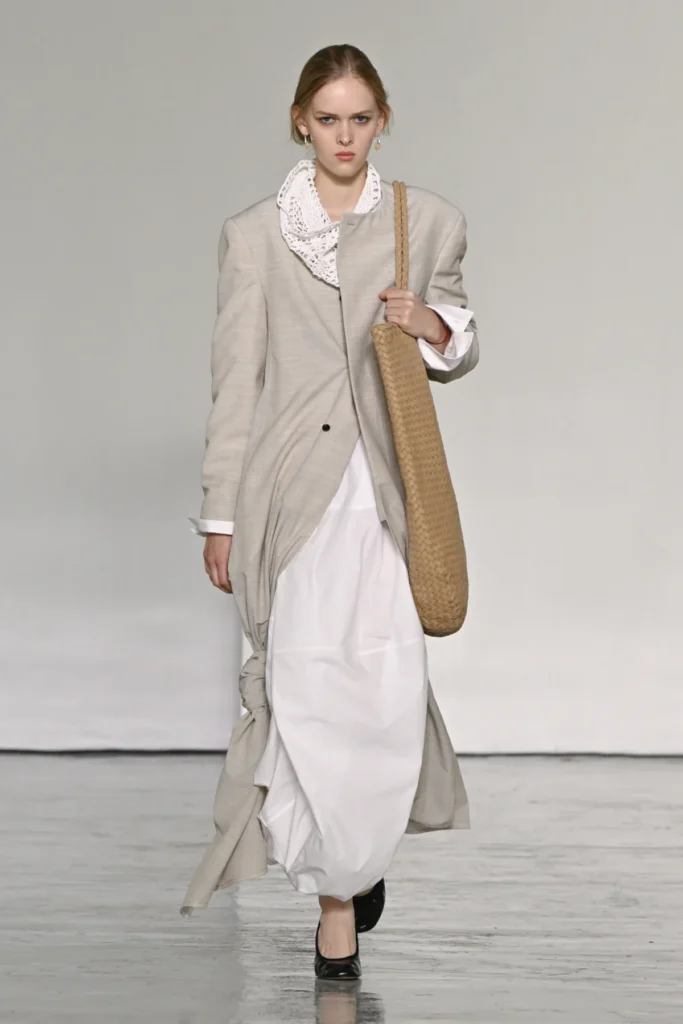
The fashion world is rarely accused of subtlety, but Saturday night’s Bottega Veneta runway presentation in Milan achieved a rare, delicate balance between high-concept art and wearable ease. Held in a sprawling, stark white space that evoked the clinical yet cinematic precision of 2001: A Space Odyssey, the show served as a pivotal moment for creative director Louise Trotter. While the front row hummed with the electric energy of celebrity culture, the collection itself whispered a new philosophy for the house: one defined by lightness, organic textures, and a return to the artisanal roots that define the Venetian legacy.
The Star Power: Jacob Elordi and the Front Row Frenzy
Before a single model hit the runway, the atmosphere inside the venue was thick with the frenetic energy of the digital age. The arrival of Australian actor Jacob Elordi—sporting his now-signature goatee—triggered a ripple of excitement that momentarily distracted even the most seasoned fashion editors.
Elordi, embodying a relaxed, modern masculinity, arrived in a dark olive Harrington jacket paired with loose-fitting chinos. The look was punctuated by a vibrant red intrecciato fold-over pouch, a subtle nod to the brand’s heritage accessory lines. Even as the lights dimmed, the actor kept his sunglasses on, maintaining an aura of enigmatic cool that fit perfectly within the minimalist, futuristic environment.
The presence of a star of Elordi’s caliber serves as a reminder of Bottega Veneta’s unique position in the luxury market. It is a house that commands both the quiet appreciation of textile experts and the loud, rapid-fire endorsement of social media influencers. As editors and content creators vied for the perfect angle of the actor, it became clear that the brand’s reach is as broad as its craftsmanship is deep.
Chronology of a Collection: From Minimalism to Texture
The setting of the show was a masterclass in atmospheric design. Neat rows of crushed cardboard boxes formed the backbone of the seating arrangement, each topped with a single, hyper-realistic parrot tulip crafted entirely from leather. These floral accents were more than mere decoration; they acted as a prologue to a collection that sought to marry the rigid, structured history of the brand with the softness of a summery, natural aesthetic.
As the show commenced, the progression of the garments told a story of evolution. Early looks focused on the brand’s foundational silhouettes: crisp, clean lines and the iconic woven leather that has been the bedrock of the house. However, the rigidity that had characterized previous seasons—and which had occasionally drawn criticism for being too heavy—was noticeably absent.
The middle phase of the runway show introduced an influx of airiness. We saw the introduction of sheer lace and intricate crochet work, techniques that pay homage to the rich history of Venetian knitting. These pieces floated down the runway, catching the light and providing a necessary contrast to the heavier, structured coats that appeared intermittently.
The finale was marked by a celebration of movement, with fringe playing a starring role. Whether cascading from hip scarves, coiled into voluminous bubble skirts, or trailing from oversized straw bags that brushed the floor, the fringe added a kinetic quality to the collection. It was a rhythmic, tactile display that emphasized the “undone” nature of the spring vision.
Supporting Data: The Anatomy of the Collection
To understand the shift in Trotter’s vision, one must look at the technical choices made behind the scenes.
- Materiality: The transition from dense leathers to gauze-like silks, airy crochet, and lightweight lace suggests a deliberate pivot toward comfort.
- Tailoring: The menswear segment, in particular, showcased a departure from oversized, cumbersome cuts. The tailoring was trim, elongated, and possessed a bohemian flair that felt both modern and timeless.
- Color Palette: While Bottega Veneta is often associated with its deep, signature greens and blacks, this collection experimented with softer, more organic hues. Pale pinks, muted earth tones, and crisp whites dominated the runway, reinforcing the "summery" narrative.
- The "Undone" Aesthetic: Trotter’s approach to shirting demonstrated a move away from hyper-polished formality. By limiting the volume of the shirts and embracing a more relaxed fit—at times allowing for a glimpse of lingerie beneath a short-sleeved white top—the collection bridged the gap between haute couture and everyday wardrobe staples.
Official Responses: Craft as a Language
Following the conclusion of the show, Louise Trotter held a brief session with the press to discuss the direction of the brand. Her remarks centered on the idea that while the house is built on the foundation of craft, that craft must evolve to meet the needs of the contemporary consumer.
"We’re a house of craft," Trotter stated, addressing a crowd of reporters. "Craft really is our logo, but there was a lot of work this season on trying to find techniques that brought lightness and wearability, but still have all of the incredible handwork that this house is capable of doing."
When pressed about the intentional "looseness" of the collection compared to her previous runway outings, Trotter elaborated on the emotional resonance of the clothes. "There is this sense of being a little bit undone," she explained. "It’s about finding a language between things being quite polished and a language with things being a little more organic."
This philosophy—the tension between the refined and the raw—is what Trotter is attempting to establish as her legacy at Bottega Veneta. It is a departure from the "heft" of her initial collections, signaling a willingness to listen to feedback and adapt the brand’s identity without compromising its technical integrity.
Implications: The Future of Bottega Veneta
The implications of this spring collection are significant for both the brand and the wider luxury fashion industry.
Firstly, it addresses the "weight" critique. By shifting toward lighter, more breathable fabrics, Bottega Veneta is signaling that it understands the demands of a global climate that is increasingly warm and a consumer base that is increasingly mobile. The collection is not merely an aesthetic choice; it is a functional one.
Secondly, the success of the menswear indicates that Bottega is successfully capturing a new demographic. By leaning into a "bohemian, trimmer" look, the house is appealing to a younger, style-conscious male audience that values luxury but rejects the stiff, archaic silhouettes of traditional menswear.
Finally, the focus on artisanal techniques like crochet and intricate stitching reinforces the "quiet luxury" trend that has dominated fashion for the past several years. By highlighting the handwork rather than just the label, Bottega Veneta is positioning itself as a brand for those who value substance. The parrot tulips, the fringe, and the sheer fabrics are all manifestations of a house that is confident enough to play with its own identity.
As the attendees filtered out of the white, space-age box and back into the humid Milanese evening, the consensus was clear: Bottega Veneta is finding its stride. It has successfully moved past the growing pains of a creative transition, embracing a lighter, more organic, and decidedly more human aesthetic. Whether it is the buzz surrounding a star like Jacob Elordi or the quiet, meticulous stitching on a leather-craft tulip, the brand continues to hold the fashion world’s attention with a firm, yet increasingly relaxed, grip.
In the competitive landscape of Italian luxury, where history is heavy and the pressure to innovate is constant, Louise Trotter’s latest effort suggests that the best way forward is not necessarily to reinvent the house, but to allow its long-standing craftsmanship to breathe. This spring, Bottega Veneta isn’t just showing clothes; it is articulating a new, lighter way of being.



