

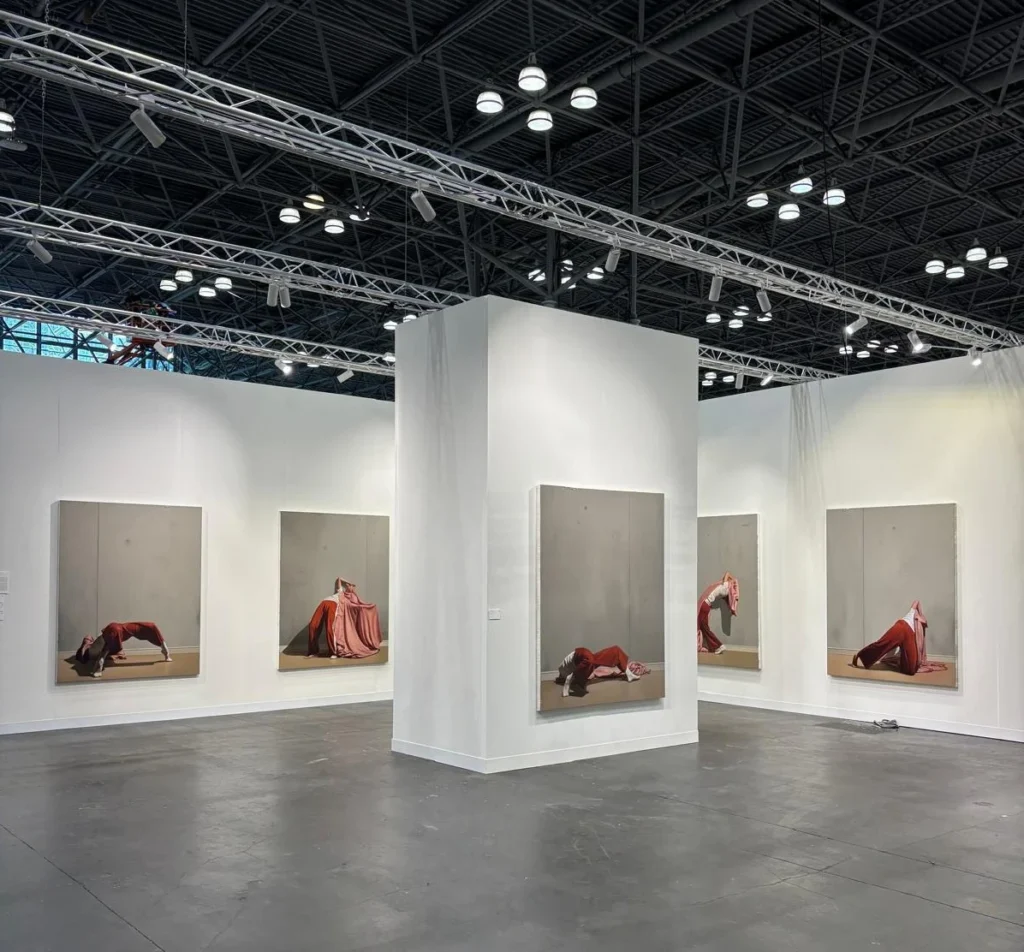
For over a decade, the Armory Show has existed in a state of perpetual reinvention. It has been a nomadic institution, wandering from the atmospheric, industrial piers of the Hudson River to the clinical, high-security confines of the Javits Center on Manhattan’s West Side. It has shuffled its calendar, changed leadership, and recalibrated its exhibitor list with the nervous energy of a brand desperate to maintain its relevance in an increasingly saturated global market.
Following its 2023 acquisition by Frieze—the powerhouse organization that also manages the fair at The Shed—the Armory Show has entered its most pivotal chapter yet. As the 32nd edition opened its doors on Thursday, September 24, the art world arrived with a burning question: In a city teeming with competing events and shifting allegiances, what, and who, is the Armory Show actually for?
The Opening Pulse: A Measured Start
At 11:00 a.m., one hour after the VIP preview commenced, the answer was not immediately clear. The fair’s decision to shift its dates to late September was, by all accounts, a strategic maneuver to decouple itself from the frantic, claustrophobic crush of early-month gallery openings and the logistical shadow of Frieze’s concurrent Seoul fair.

The result was a more civilized, albeit occasionally quiet, atmosphere. The Javits Center, a sprawling, cavernous venue, often struggles with its own architecture. The floor is bisected by a heavy concentration of hospitality—the VIP lounge, the restaurant, and the champagne bar—creating an asymmetrical experience where one section of the hall can feel buzzing with activity, while another, just a few hundred feet away, feels remarkably sparse.
Yet, this "anemic" attendance, as some early critics noted, belied the underlying reality of the contemporary market. Several dealers pointed out that the frantic, "grab-it-all-in-the-first-hour" mentality of art fairs has largely dissipated. In its place is a more deliberate, conversational pace. Jayne Drost Johnson of New York’s JDJ Gallery noted that the market has fundamentally changed. "We’ve all noticed that fairs have a different pace the last couple of years," she explained. "It’s more consistent. It’s not just about one crazy morning. You can have better, more meaningful conversations. A slow first morning is not a sign of failure; it’s a sign of a more mature market."
Chronology of the Opening Day
The day’s trajectory followed a distinct pattern. By 2:00 p.m., the initial quiet had given way to the familiar, rising hum of an opening-day crowd. While the morning may have felt "leisurely," the afternoon brought a steady influx of collectors, industry insiders, and celebrity observers.

VIPs spotted navigating the aisles included New York First Lady Rama Duwaji, alongside high-profile figures such as Jodie Foster, Paul Rudd, and NBA star Karl-Anthony Towns. The presence of major collectors—including the likes of Beth Rudin DeWoody, Estrellita Brodsky, and the husband-and-wife duo Jill and Peter Kraus—confirmed that despite the fair’s identity crisis, it remains a critical nexus for the New York art-buying elite.
By the time the sun began to dip, the narrative of a "slow" fair had been thoroughly debunked by the sales ledgers. Galleries that had focused on strong pre-fair engagement—sending digital previews and securing early commitments—found the physical space served as a final, high-impact closing room.
Supporting Data: Sales and Market Resilience
The financial performance of the 32nd Armory Show serves as a vital barometer for the current state of the art market. Across the board, galleries reported steady, if not record-breaking, activity.

Highlights of Key Transactions:
- Kamel Mennour: In a successful debut at the fair, the gallery sold seven of nine paintings by Dhewadi Hadjab by 1:00 p.m., each fetching $110,000.
- Norr Cohan: In its first outing since David Norr became sole owner, the gallery moved a major Yinka Shonibare multimedia work for an estimated $180,000–$220,000, alongside two Eamon Ore-Giron mosaics ($80,000–$120,000).
- Sean Kelly Gallery: Proving that established blue-chip names still hold sway, the gallery sold Janaina Tschäpe’s Picking Flowers Quietly for $170,000 and a Sam Moyer marble work for $125,000.
- Gazelli Art House: Demonstrating a bold commitment to historical material, the gallery sold a rare, historic Lilly Fenichel painting to a European private museum for roughly $200,000.
Smaller galleries also found success in niche segments. Shrine reported the sale of 10 paintings by Michelle Paterok, all sourced via social media, at accessible price points between $5,500 and $11,000. Dimin gallery offered a look at the emerging market, selling works by Kelli Vance and a whimsical ceramic effigy of auctioneer Phylis Kao for $4,800.
Official Perspectives: The Director’s Vision
Armory Show director Kyla McMillan views the current iteration not as a competitor to the world’s most prestigious fairs, but as a distinct platform for discovery. "This fair has always been about discovery," McMillan noted, highlighting the expanded Presents section—now boasting 55 galleries—and the specialized Focus and Platform sectors.
For McMillan, the later September date is a logistical masterstroke. It allows collectors to return from their summer hiatus and approach the fair with "intentionality." By positioning the Armory as the definitive "kickoff" for the fall season, she is attempting to anchor the fair in the cultural calendar of New York, rather than having it compete with the noise of early September.

Implications for the Future of Art Fairs
The broader implications of this year’s fair are twofold. First, it suggests that the "fair fatigue" felt by many in the industry is being addressed by a move toward smaller, more focused, and more regionalized presentations. The inclusion of sections dedicated to the Caribbean, overseen by curators like Jovanna Venegas and María Elena Ortiz, adds a necessary layer of intellectual rigor that differentiates the Armory from its more "red-chip" focused rivals.
Second, the acquisition by Frieze is beginning to show its long-term strategy. While some critics initially feared that the Armory would be subsumed by the Frieze brand, it appears that the management is positioning the Armory to cater to a specific demographic of younger, emerging, and mid-career artists. Veteran art adviser Lara Björk noted that this might be exactly what the market requires. "In a market that has many markets and layers," she observed, "there is in fact room for everyone."
As the fair concludes, the consensus remains cautiously optimistic. The 32nd Armory Show is not trying to be Basel or Frieze London. Instead, it is embracing its role as a uniquely New York institution—a place where the season begins, where local collectors test the waters, and where the next generation of artists is introduced to the city’s complex, competitive, and ultimately resilient art market.

By prioritizing "civilized" engagement over "frenzy," the organizers have provided a roadmap for how these events might survive in a post-peak-fair world: by becoming more than just a marketplace, and instead, a genuine cultural anchor for the city.



