

LONDON, 15 January 2026 – The fragile security of the world’s oceans has faced a renewed test, according to the latest data from the ICC International Maritime Bureau (IMB). In its comprehensive Annual Piracy and Armed Robbery Report, the IMB confirms a troubling upward trajectory in global maritime security incidents throughout 2025. With 137 recorded incidents, the industry is grappling with a resurgence of hostile activity that threatens not only the lives of seafarers but the operational integrity of global supply chains.
The State of Global Maritime Security: Key Facts
The 2025 report paints a complex picture of maritime criminality. While the vast majority of incidents are classified as "low-level" opportunistic attacks—typically occurring while vessels are anchored or underway in congested straits—the sheer volume of activity signals a degradation in regional security.
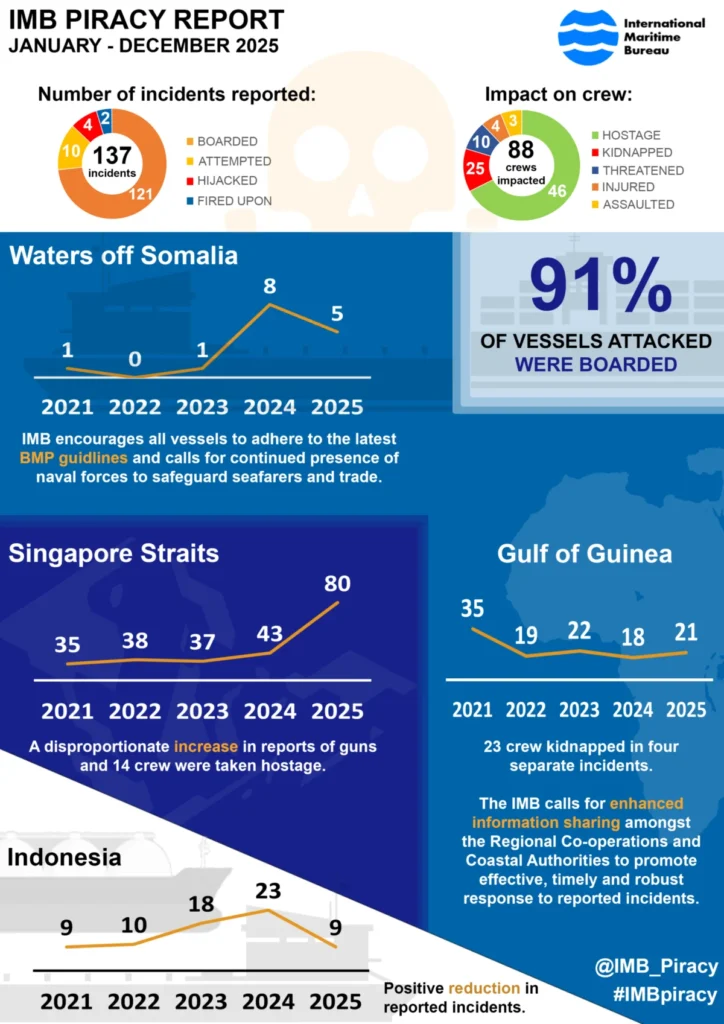
In 2025, the IMB recorded 137 incidents, a marked increase from the 116 cases documented in 2024 and the 120 observed in 2023. The breakdown of these hostile encounters is stark:
- 121 vessels were boarded: The most common form of attack, often involving perpetrators seeking to steal ship stores or personal belongings.
- Four vessels were hijacked: Representing a more sophisticated level of criminal operation.
- Two vessels were fired upon: A dangerous escalation that underscores the growing lethality of maritime piracy.
- 10 attempted attacks: Instances where vigilant crew members and hardened security measures successfully repelled intruders.
While the number of hostage incidents decreased significantly compared to the high of 126 in 2024, the human cost remains unacceptable. Forty-six crew members were held hostage in 2025, while 25 seafarers were kidnapped—a figure that has nearly doubled compared to the 12 kidnappings reported in 2024.
A Chronology of Escalation: 2023–2025
To understand the current crisis, one must look at the three-year trend. The period from 2023 to 2025 has seen a shift in both the frequency and the nature of maritime threats.
2023: The Baseline of Instability
In 2023, the industry faced a post-pandemic landscape where maritime crime began to stabilize at a worrying plateau of 120 incidents. The focus was largely on the Gulf of Guinea and the Singapore Straits. During this year, 73 crew members were taken hostage, and 14 were kidnapped. It was a year characterized by opportunistic theft, but the seeds of greater volatility were being sown.
2024: The Surge in Hostage-Taking
The year 2024 saw a slight dip in the total number of incidents (116) but a dramatic spike in the victimization of crew. The 126 hostage cases reported in 2024 served as a grim reminder that maritime criminals were becoming more aggressive in their tactics to secure leverage. The reliance on knives remained high, and the maritime community began calling for more robust naval patrolling.
2025: The Rise of Weaponized Piracy
The 2025 report marks a departure from previous years, not just in the total volume of incidents (137), but in the weaponry involved. The most alarming trend is the proliferation of firearms. In 2025, guns were reported in 42 incidents, a significant jump from 26 in 2024. This trend suggests that piracy is moving away from purely "opportunistic" petty theft toward more heavily armed, organized criminal enterprises.
Supporting Data: The Weaponization of the Seas
The IMB’s data regarding weaponry provides an empirical look at why current maritime security protocols are struggling. The shift from "knives and clubs" to "firearms" represents a fundamental change in the threat profile.
- Gun-Related Incidents: In 2025, 42 incidents involved the use of firearms, compared to 26 in 2024. This increase is a primary concern for the International Maritime Organization (IMO) and naval coalition forces, as it increases the probability of fatal confrontations.
- Knife-Related Incidents: Conversely, there was a slight reduction in knife-reported incidents, dropping from 39 in 2024 to 33 in 2025. This inverse relationship suggests a strategic shift: perpetrators are moving toward weaponry that provides a greater psychological and tactical advantage, allowing them to exert control over a vessel and its crew more rapidly.
- Regional Focus: The Singapore Straits continue to record the highest number of incidents. The congestion in these waters makes ships "sitting ducks" for fast-moving skiffs that can board a vessel, loot the bridge, and vanish before authorities can respond.
Conversely, the threat posed by Somali-based piracy—once the primary terror of the high seas—remains largely contained. This is a direct testament to the efficacy of sustained international naval presence and the widespread adoption of Best Management Practices (BMP) by merchant vessels. The contrast between the "contained" threat in the Indian Ocean and the "resurgent" threat in Southeast Asia highlights the necessity of localized, persistent security strategies.
Official Responses: A Call for Global Solidarity
The publication of the report has elicited a strong reaction from global shipping authorities. ICC Secretary General John W.H. Denton AO issued a clear, urgent directive to the international community:
"Maritime trade remains a cornerstone of real economic activity and growth. The rise in reported maritime incidents highlights the importance of protecting seafarers and securing key shipping routes not only for crew safety, but for the stability of global supply chains and the economies that depend on them."
Denton emphasized that the solution cannot be unilateral. "Ensuring safe passage at sea requires sustained cooperation, with regional and international partners working together to safeguard maritime commerce," he stated. This call to action is directed at coastal states, which are urged to increase their maritime patrols, and at ship operators, who are encouraged to maintain high levels of vigilance and adhere strictly to security protocols.
Industry experts have also weighed in, noting that while naval presence is essential, it is not a "silver bullet." There is a growing consensus that intelligence-sharing between shipping companies and regional authorities—coupled with the hardening of vessel perimeters—must become the industry standard.
Implications for Global Trade and Future Security
The implications of these findings extend far beyond the maritime industry. When a vessel is boarded, or a crew is kidnapped, the consequences ripple through the global economy:
- Supply Chain Disruption: Every hijacked vessel represents a potential bottleneck. With the global economy already strained by geopolitical tensions, any further interference with shipping lanes can lead to delays in the delivery of essential goods, medical supplies, and energy resources.
- Increased Insurance Premiums: Persistent piracy in key shipping straits leads to higher "War Risk" insurance premiums. These costs are inevitably passed down to the consumer, contributing to inflationary pressures.
- The Seafarer Welfare Crisis: The most human impact is on the crew. Serving at sea is becoming an increasingly high-risk profession. The psychological trauma associated with hostage-taking and the constant threat of violence is contributing to a recruitment and retention crisis in the maritime sector. If seafarers feel that their safety is not a priority, the long-term viability of the maritime labor force could be threatened.
- Geopolitical Stability: The concentration of incidents in vital choke points like the Singapore Straits and the Gulf of Guinea forces nations to re-evaluate their maritime security budgets. It necessitates a more permanent naval footprint, which can sometimes lead to diplomatic friction in crowded, contested waters.
Conclusion: A Turning Point for Maritime Policy
The IMB’s 2025 Annual Report serves as a sobering reminder that the oceans are not a self-policing domain. The rise in gun-related incidents and the increase in kidnappings suggest that maritime criminals are evolving alongside the industry.
As we look toward the remainder of 2026, the maritime community faces a clear mandate. The "low-level" classification of these incidents should not lead to complacency; rather, it should be seen as a warning. Without robust international cooperation, shared intelligence, and a renewed commitment to the protection of the world’s seafarers, the safety of the global maritime commons will continue to erode.
The security of the global supply chain depends on the security of the individual ship. As the ICC and other international bodies continue to lobby for improved maritime governance, the onus remains on the global community to ensure that the seas remain open, safe, and navigable for all. The statistics of 2025 are not merely data points; they are a call for a unified, proactive response to the oldest crime on the high seas.



