

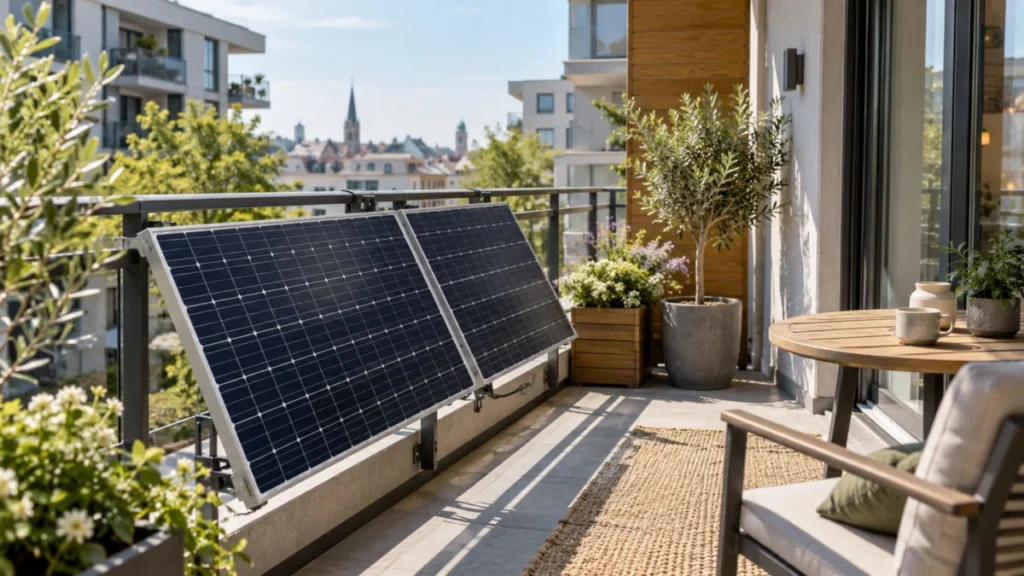
For decades, the narrative of the solar energy transition was written exclusively for the suburban homeowner. The image of the "energy-independent household" was synonymous with sprawling, south-facing rooftops and substantial financial investments in massive, grid-tied arrays. For the millions of residents living in urban apartment complexes, high-rises, and rental units, the renewable energy movement felt like an exclusive club with a strict "roof-access only" entry policy.
That paradigm is undergoing a tectonic shift. As solar technology becomes more modular, efficient, and affordable, the "balcony solar" movement is emerging as a critical component of the global push toward net-zero living. No longer confined to the rafters, solar power is moving to the railings, turning once-passive outdoor spaces into active, energy-generating assets.
The Main Facts: Democratizing the Grid
At its core, balcony solar—often referred to as "plug-and-play" or "plug-in" solar—is a simplified, compact renewable energy system. Unlike traditional residential solar, which requires professional roof mounting, complex permitting, and significant electrical grid integration, balcony systems are designed for accessibility.
A typical setup consists of one or two high-efficiency photovoltaic panels, a micro-inverter to convert direct current (DC) into usable alternating current (AC), and a mounting bracket designed to hook securely onto existing balcony railings. These systems are designed to be plugged directly into a standard household wall outlet, feeding electricity into the home’s circuit to offset the "baseload" power consumption—the energy used by refrigerators, Wi-Fi routers, and standby appliances.
The primary benefit is immediate: it lowers the barrier to entry. For many urban dwellers, the initial investment for a small-scale, two-panel system is a fraction of the cost of a full residential rooftop array, often paying for itself within a few years through reduced monthly utility bills.
A Chronological Evolution of Urban Energy
The trajectory of balcony solar is a story of technological miniaturization and regulatory catch-up.
- The Early 2010s: Solar energy was largely industrial or residential-scale. The idea of "plug-in" solar was relegated to DIY hobbyist forums and fringe green-tech enthusiasts.
- 2018–2020: As the cost of photovoltaic cells plummeted, startups in Europe—particularly in Germany, Switzerland, and Austria—began to formalize the concept of the "balcony power plant." These companies developed safety standards for connecting low-wattage solar devices directly into domestic sockets.
- 2021–2023: Regulatory frameworks began to evolve. Germany, for instance, introduced simplified registration processes for small solar systems, acknowledging that these devices were not a threat to the grid but a contribution to national energy resilience.
- 2024–Present: The market has hit a tipping point. Major retailers are now stocking "all-in-one" kits, and urban design firms are increasingly incorporating solar-ready balcony structures into new apartment developments. We have moved from the era of "can we do this?" to "how do we scale this?"
Supporting Data: Efficiency and Impact
While a balcony system will not power an entire apartment building, its impact is cumulative and statistically significant. A standard 800-watt balcony system, depending on orientation and solar irradiance, can produce between 600 and 900 kilowatt-hours (kWh) of electricity annually in a Central European climate.
Comparative Metrics:
- Cost Efficiency: A balcony system costs approximately $600 to $1,200, whereas a full rooftop installation can range from $15,000 to $30,000.
- Offset Potential: For a typical apartment resident, a balcony system can offset between 10% and 25% of their annual electricity bill.
- Environmental Impact: Each system is estimated to prevent the emission of approximately 300–400 kilograms of CO2 per year, depending on the local energy grid’s carbon intensity.
These numbers illustrate that while the individual output is modest, the aggregate potential is massive. If just 20% of suitable apartment balconies in a major city were equipped with these systems, the resulting energy production would rival that of a small-to-medium-sized utility-scale solar farm, all without requiring additional land usage.
Official Responses and Regulatory Challenges
The rapid rise of balcony solar has forced municipal governments and energy regulators to adapt. In many jurisdictions, the debate centers on the "safety of the connection."
The Regulatory View
Energy grid operators have historically been wary of "prosumers"—individuals who both produce and consume electricity—due to concerns about voltage stability and the safety of the grid. However, official responses have shifted from skepticism to cautious support.
- Simplified Standards: Many countries have adopted the "plug-in" standard, which allows devices under a certain wattage (often 600W or 800W) to be connected to standard outlets without requiring a specialized electrician.
- Landlord-Tenant Law: One of the most significant hurdles remains the relationship between landlords and tenants. In several European nations, new legislation is currently being debated to prevent landlords from unreasonably denying requests to install balcony solar, treating it similarly to other green improvements.
Safety Protocols
Professional associations emphasize that the "plug-and-play" nature does not exempt the system from physical safety standards. Because these panels are often installed several stories up, mounting systems must be wind-tunnel tested. Insurance companies and housing associations are increasingly requiring proof of safety certification (such as IEC standards) to ensure that panels are securely anchored and electrical components are surge-protected.
The Behavioral Shift: The "Energy-Aware" Resident
Beyond the kilowatt-hours, the most profound impact of balcony solar is psychological. When a resident can log into an app and see, in real-time, how their own balcony is generating electricity, their relationship with energy consumption changes.
Developing "Energy Literacy"
The phenomenon of "energy awareness" is well-documented in solar-adopting households. Users become conscious of their "baseload" consumption. They begin to time their heavy-energy tasks—like running the dishwasher or charging an electric bike—to coincide with the peak sunshine hours of the day. This shift in behavior turns the household into a more efficient, responsive unit. It transforms the resident from a passive customer of a utility company into an active participant in the energy market.
Practical Implications for Future Urban Living
As we look toward the future, the implications for urban planning are clear:
- Architecture as Energy Infrastructure: We are entering an age where building design must account for the solar potential of vertical surfaces. Architects are now exploring "solar-ready" balconies that incorporate standardized mounting points, hidden cabling, and optimized shading.
- Rental Mobility: As the gig economy and transient living become more common, the demand for portable energy solutions will increase. The ability to disassemble a solar system and move it to a new apartment is a key driver for younger demographics.
- The "Virtual Power Plant" (VPP) Potential: In the near future, the integration of small-scale battery storage with balcony solar will allow apartment dwellers to store excess daytime energy for evening use. When aggregated via smart-grid software, these thousands of tiny batteries could function as a "Virtual Power Plant," helping grid operators balance loads during peak demand hours.
Conclusion: A Manageable First Step
The rise of balcony solar is not merely a technical trend; it is a movement toward the democratization of energy. For the millions who previously felt excluded from the green transition, the balcony has become a platform for agency.
While it is true that these systems require careful planning—from checking sunlight orientation and local building codes to ensuring secure mounting—the barriers are no longer insurmountable. When the conditions are right, a simple balcony rail can become a generator, a learning tool, and a statement of intent.
As cities become denser and the need for decentralized, resilient energy grows, the balcony will likely play an outsized role in our collective future. It is a reminder that you do not need a sprawling estate to make a difference; you only need a little bit of space, a lot of sunlight, and the initiative to claim a piece of the renewable revolution for yourself.



