

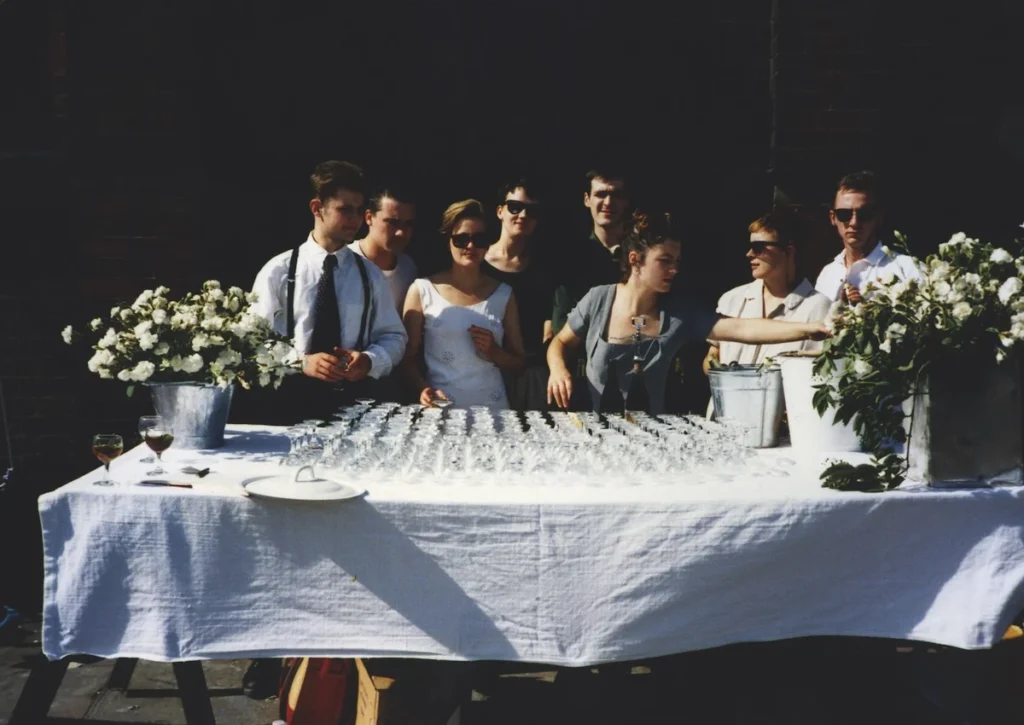
In the prologue of his latest bestseller, London Falling, Patrick Radden Keefe invokes a singular image to capture the tectonic shift of London at the close of the 20th century: a derelict warehouse in the docklands of southeast London. In 1988, a cohort of young, ambitious artists claimed this industrial shell for an exhibition titled "Freeze." Keefe offers no further explanation, trusting that the reader recognizes the genesis of a movement that would fundamentally rewrite the rules of the international art world: the Young British Artists, or YBAs.
More than a mere collection of practitioners, the YBAs were a symptom of a feverish moment in British history. They rocketed to prominence in the early 1990s, a period when London was undergoing a profound renaissance—or, depending on one’s critical perspective, a violent rupture from its traditionalist past. As the United Kingdom navigated the transition into the new millennium, the YBAs mirrored the country’s fluctuating national image, oscillating between a rebellious "Cool Britannia" optimism and a stark, market-driven cynicism.
A Chronology of Chaos and Commerce
Defining the "official" roster of the YBAs is an exercise in futility. The designation is fluid, applied variously to the original "Freeze" exhibitors, the artists featured in Charles Saatchi’s eponymous 1992–1995 exhibitions, or the participants in the Royal Academy’s landmark 1997 show, "Sensation."

The movement’s epicenter was arguably Goldsmiths College, where many of the key figures—Damien Hirst, Sarah Lucas, and others—honed their craft in the late 1980s. The core constellation of the movement includes Hirst, Tracey Emin, Lucas, Jenny Saville, Marc Quinn, the Chapman Brothers, Gary Hume, Michael Landy, Gillian Wearing, Chris Ofili, Angus Fairhurst, Rachel Whiteread, and Anya Gallaccio.
The "Freeze" Catalyst (1988)
When "Freeze" opened in 1988, it was more than an exhibition; it was a scene. As critic and curator Gregor Muir recalled in his memoir Lucky Kunst, the show established a new template for artistic community. It was defined by crowded openings, excessive substance consumption, and a tight-knit network of peers who prioritized genuine, often chaotic friendship over formal aesthetic movements. If there was a shared "YBA style," it was a primal desire to elicit a reaction—whether that reaction was physical revulsion, moral outrage, or intellectual shock.
The Saatchi Era and "Sensation" (1992–1997)
In 1992, the British-Iraqi advertising magnate Charles Saatchi hosted the first "Young British Artists" exhibition at his gallery near Sloane Square. This marked the commercial birth of the movement. The exhibition debuted Hirst’s The Physical Impossibility of Death in the Mind of Someone Living (1991)—a tiger shark suspended in formaldehyde that would become the movement’s totem.

Simultaneously, the London art scene was flooded with works that would define the decade:
- Marc Quinn’s Self (1991): A bust of the artist’s head cast in eight pints of his own frozen blood.
- Sarah Lucas’s Two Fried Eggs and a Kebab (1992): A visceral, suggestive arrangement of food on a table.
- Rachel Whiteread’s Ghost (1990): A haunting plaster cast of an abandoned Victorian room.
- Tracey Emin’s My Bed (1998): A raw, autobiographical installation that stunned the global art market.
The trajectory of the YBAs culminated in the 1997 Royal Academy exhibition "Sensation." It broke visitor records and triggered international condemnation, with figures like Rudy Giuliani and the Clintons famously decrying the show’s content.
Supporting Data: The Market as Muse
The YBAs were the beneficiaries—and arguably the victims—of unprecedented branding. Charles Saatchi, the mastermind behind Margaret Thatcher’s election campaigns, applied the same strategic, aggressive marketing to art. Saatchi bought heavily from these young artists, often at prices that were modest by today’s standards, only to generate massive media frenzies that drove the resale value of the works to astronomical levels.

For instance, Saatchi purchased Quinn’s Self for £13,000 in 1991; by 2005, it sold for approximately £1.5 million. Similarly, Emin’s My Bed was acquired for £150,000 in 2000 and fetched £2.5 million in 2014. These figures underscore a reality that even the artists themselves eventually acknowledged: the YBA brand was, in many ways, the ultimate product of neoliberal market dynamics.
Institutional and Critical Responses
The legacy of the YBAs is currently being reexamined through a series of high-profile institutional retrospectives. Tate Modern’s recent exhibition for Tracey Emin, the National Portrait Gallery’s 2025 spotlight on Jenny Saville, and the 2023 Tate Britain survey of Sarah Lucas signify that these artists have transitioned from "enfant terribles" to established, canonized figures. Furthermore, the upcoming October exhibition at Tate Britain, "The 90s: Art and Fashion," promises to contextualize the movement within the broader pop culture of the era.
Critically, however, the reception has grown more complex. In 1998, Observer writer Andrew Anthony presciently noted that the art world surrounding the YBAs had become more interesting than the art itself. The line between the creator and the celebrity had been erased. While the movement initially promoted itself as an outsider force, it was deeply intertwined with the establishment—facilitated by dealers like Jay Jopling of White Cube and supported by the elite educational and institutional structures of the UK.

Implications: The Legacy of Neoliberal Art
Looking back, the YBA movement serves as a case study in the commodification of transgression. The artists who have aged most gracefully in the eyes of the market and academia are often those who moved beyond the initial shock-value tactics. Rachel Whiteread’s sculptural practice has maintained a quiet, monumental relevance, while Anya Gallaccio’s engagement with decay has evolved into a thoughtful commentary on eco-consciousness.
Conversely, the male YBAs—particularly Damien Hirst—have faced criticism for a perceived stagnation. Hirst’s later work, such as the 2017 "Treasures from the Wreck of the Unbelievable," has been described by critics as specifically conceived for asset-class collectors, favoring scale and marketability over artistic depth. As Tom Whyman noted in ArtReview in 2023, these artists have become so integrated into the financial structures of the art world that they are effectively immune to the cycles of cultural "cancellation."
The "Butler to the World" Malaise
The YBA phenomenon is inextricably linked to the rise and fall of "Cool Britannia." It was a period of optimism that has since curdled into a distinct malaise. The contemporary British identity, characterized by a self-deprecating resignation, stands in stark contrast to the aggressive confidence of the 1990s.

We now recognize that the YBA moment was defined by a Faustian bargain: the sale of the artistic self to the highest bidder. This ethos, while highly successful in the short term, resulted in an art form that often feels "comically empty" when stripped of its media-manufactured hype.
Today, the YBA legacy serves as a warning and a template. It represents the moment when art became an asset class, and when the artist became a brand manager. While the movement successfully placed Britain on the map of contemporary global art, it did so by embracing a soulless, neoliberal framework that continues to echo through the corridors of every major auction house and gallery today. The YBAs did not just change art; they changed what it means to be an artist in a world where the market is the final, and often only, arbiter of value.



