For the past two years, the Aspen Art Museum’s AIR (Artist-in-Residence) festival in Colorado has served as a crucible for the visionary work of Matthew Barney. A defining figure in contemporary art, known for his sprawling, mythic narratives and obsession with physical endurance, Barney has utilized the rugged expanse of the American West to synthesize two of his most significant recent projects: the 2019 film Redoubt and the 2023 exploration of sports violence, Secondary.
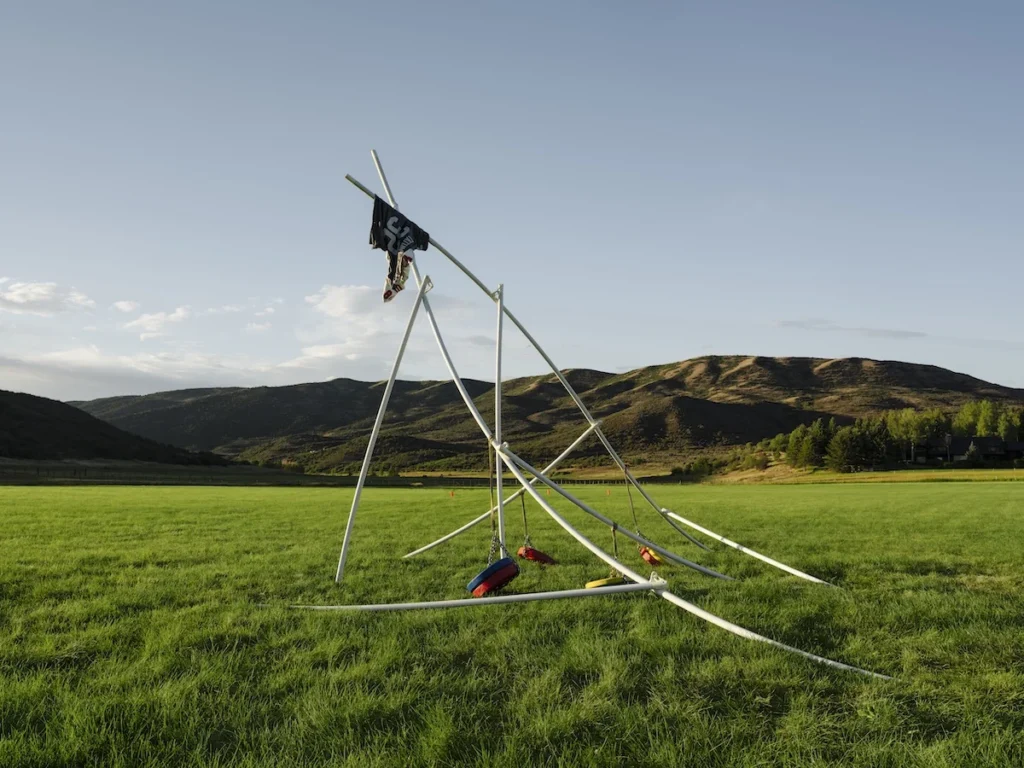
This summer, the dialogue between these works reached a new zenith with the debut of ZONE DEFENSE: Old Snowmass Parallax, a sculptural installation set against the dramatic backdrop of the Rocky Mountains. The work, which remains on view through the summer, represents a departure from Barney’s typical reliance on the raw, intrinsic behavior of materials, opting instead for an illusionistic, diagrammatic approach that challenges the viewer’s perception of property, territory, and history.
Chronology: From the Drill Hall to the Open Range
The trajectory of Barney’s engagement with the AIR festival began in 2025 at the McCabe Ranch. The site, a historic cattle ranch that once housed a military drill hall—repurposed after the decommissioning of the nearby Camp Hale training base—provided the physical and historical framework for TACTICAL Parallax, an abstract musical revue performed during the festival’s inaugural edition.

Barney recounts that the specific architecture of the drill hall, with its history of post-WWII military repurposing, acted as a catalyst for the performance. "The architecture is so specific," Barney explains. "It synthesized the idea… it was compelling as a military training site and essentially a field."
Collaborating with frequent partner Jonathan Bepler, who composed the score, Barney utilized the performance to collide disparate narrative threads. By treating the live event as a musical revue or medley, the duo created a "jarring moment of dissonance," cutting between the alchemical, pioneering themes of Redoubt and the visceral, often brutal, realities of professional football explored in Secondary.
Following the success of that performance, the 2026 iteration of the AIR festival saw the evolution of these concepts into ZONE DEFENSE: Old Snowmass Parallax. While the performance relied on the fleeting, improvisational use of PVC piping to demarcate space, the new sculpture translates those ephemeral moments into a permanent, albeit trompe l’oeil, installation.

Supporting Data: The Anatomy of a Sculpture
ZONE DEFENSE is a masterclass in material subversion. While the structure mirrors the PVC piping used in the performance, it is fabricated from stainless steel, painted with such precision that it tricks the eye into seeing plastic. Similarly, the "weights" anchoring the base are cast bronze, meticulously finished to mimic the gym-grade equipment found in Secondary, complete with the tactile residue of synthetic hand chalk.
At the summit of the structure sit two cast-aluminum football jerseys, a memorial to the infamous 1978 collision between Darryl Stingily and Jack Tatum—a moment that remains a haunting touchstone for the violence inherent in American sport.
The installation’s layout is equally deliberate. The sculpture is surrounded by orange end-zone markers, arranged to form a larger-scale version of the "Field Emblem," a geometric parallax symbol that recurs throughout Barney’s visual lexicon. The markers, cast in polymer, serve as a boundary, mapping the territory in a way that recalls the surveyor’s tools found in Redoubt.

Alchemy and Narrative Collision
Barney’s artistic process has long been rooted in the principles of alchemy—the belief that by forcing two "unlike" elements into a confined space, a third, transformative state can be achieved.
"I’m interested in aspects of alchemy, where you put two unlike things together and create a compound," Barney notes. "The more reactive the two elements are, the more potential there is to create a change."
This philosophy is the engine behind ZONE DEFENSE. By placing the sculpture in an open landscape, Barney invites a collision between the high-modernist aesthetic of the weight plates and the raw, unpredictable nature of the Colorado wilderness. When questioned about the primary colors of the weights—red, blue, and yellow—Barney clarifies that while they evoke a Bauhaus sensibility, they are also a literal reference to the standardized colors of Olympic bumper plates.

This tension between the "failed Modernist" aesthetic of the sculpture and the encroaching landscape is intentional. It represents a shift in Barney’s practice from the biological to the diagrammatic. The sculpture acts as an aerial map, a static record of a dynamic performance, where the "absence of the figure" becomes a presence in itself.
Implications: The Politics of Property in the American West
Perhaps the most compelling aspect of ZONE DEFENSE lies in the reaction of the local community. During the installation process, the presence of the sculpture—and particularly the placement of the end-zone markers—triggered a palpable shift in the atmosphere among local ranchers.
"As soon as I started placing stakes in the ground… the mood completely changed," Barney recalls. The act of marking territory, which might seem purely aesthetic to an art-world observer, carries heavy political weight in a region defined by debates over public land, grazing rights, and the reintroduction of wolves.

For the ranchers, the installation was not merely art; it was a territorial claim. This friction is exactly what Barney intended. The piece serves as a microcosm of the wider cultural divide in the American West, where the voices of conservation and the voices of those working the land are constantly, and often violently, at odds. The sculpture, therefore, does not just sit on the land; it participates in the ongoing discourse about who owns the American landscape and how it should be used.
Future Prospects
As the summer concludes, the question of the sculpture’s future remains open. Barney has expressed a desire to see the work installed in an interior, architectural setting, where the "compression of space" would fundamentally alter the viewer’s relationship to the piece.
"I’m looking forward to installing it inside," he says. "You can feel the point of contact between the weights and the ground… it gives the piece a sense of touch, from an absent hand."

Whether in the open range of Snowmass or the white-walled containment of a gallery, ZONE DEFENSE marks a significant evolution in Barney’s career. It suggests a future where his fascination with the body and the machine is increasingly filtered through the lens of the diagram, the map, and the silent, heavy history of the materials he chooses to deploy. By stripping away the literal body, Barney has paradoxically made his work more human, more vulnerable, and more urgently connected to the land that holds it.