

Introduction: The Invisible Frontline
In the vast, ungoverned stretches of the world’s oceans, where 90% of global trade traverses, the threat of maritime piracy remains a persistent and evolving menace. While the romanticized images of 18th-century buccaneers have long faded, their modern counterparts—armed with GPS technology, high-speed skiffs, and sophisticated networks—continue to endanger the lives of seafarers and the integrity of global supply chains. At the heart of the international effort to combat this instability is the ICC International Maritime Bureau’s (IMB) Piracy Reporting Centre (PRC). Since its inception in 1991, the PRC has acted as the world’s maritime "911," serving as a 24-hour nerve center that coordinates responses, tracks trends, and provides an indispensable lifeline for vessels under threat.
Main Facts: The PRC’s Operational Mandate
The IMB Piracy Reporting Centre functions as a unique, non-governmental clearinghouse for maritime security data. Unlike national coast guards, which operate within sovereign territorial waters, the PRC provides a global perspective. Its mandate is tripartite:
- Immediate Response: The Centre acts as a centralized reporting hub. When a shipmaster reports an incident—be it a suspicious approach, an attempted boarding, or an actual hijacking—the PRC immediately broadcasts warnings to other vessels in the vicinity and coordinates with regional maritime authorities.
- Data Intelligence: By aggregating reports from across the globe, the PRC transforms raw incident data into actionable intelligence. This allows the shipping industry to map "hotspots" and adjust transit routes accordingly.
- Advocacy and Allocation: The PRC serves as an essential evidence base. By documenting the frequency and severity of attacks, it compels governments and international naval coalitions to allocate resources to high-risk zones, such as the Gulf of Guinea, the Singapore Straits, and the waters off Somalia.
Chronology: Three Decades of Vigilance
The necessity of the IMB Piracy Reporting Centre was born out of a stark increase in maritime violence in the late 1980s. When the Centre was formally established in 1991, the maritime industry was entering a period of unprecedented globalization, where the speed of trade began to outpace the security capabilities of individual port states.
- 1991–1999: The Formative Years. The Centre was established to fill a void in communication. In its first decade, it focused on standardizing how piracy was defined and reported, ensuring that shipmasters had a reliable point of contact that transcended local jurisdictional squabbles.
- 2000–2010: The Somali Crisis. This decade marked the most challenging period in the Centre’s history. As piracy off the Horn of Africa surged into a multi-million-dollar industry, the PRC became the primary conduit for the "Best Management Practices" (BMP) protocols. Its role shifted from simple reporting to active tactical coordination with international naval task forces.
- 2011–2020: Diversification of Threats. As the international response (including armed guards and naval patrols) suppressed Somali piracy, the threat shifted toward armed robbery in the Southeast Asian archipelago and the kidnapping of crew members for ransom in the Gulf of Guinea. The PRC evolved to track these more localized, highly aggressive criminal groups.
- 2021–Present: Digital Transformation. Today, the Centre integrates satellite tracking and automated reporting systems. Its 2024 reporting initiatives emphasize the importance of cyber-security and the role of real-time data sharing in preemptive defense.
Supporting Data: The Anatomy of Modern Piracy
The IMB’s annual Piracy and Armed Robbery Against Ships report is widely considered the "gold standard" for maritime security analysis. According to recent data, the nature of these crimes is shifting.
High-Risk Zones and Incident Trends
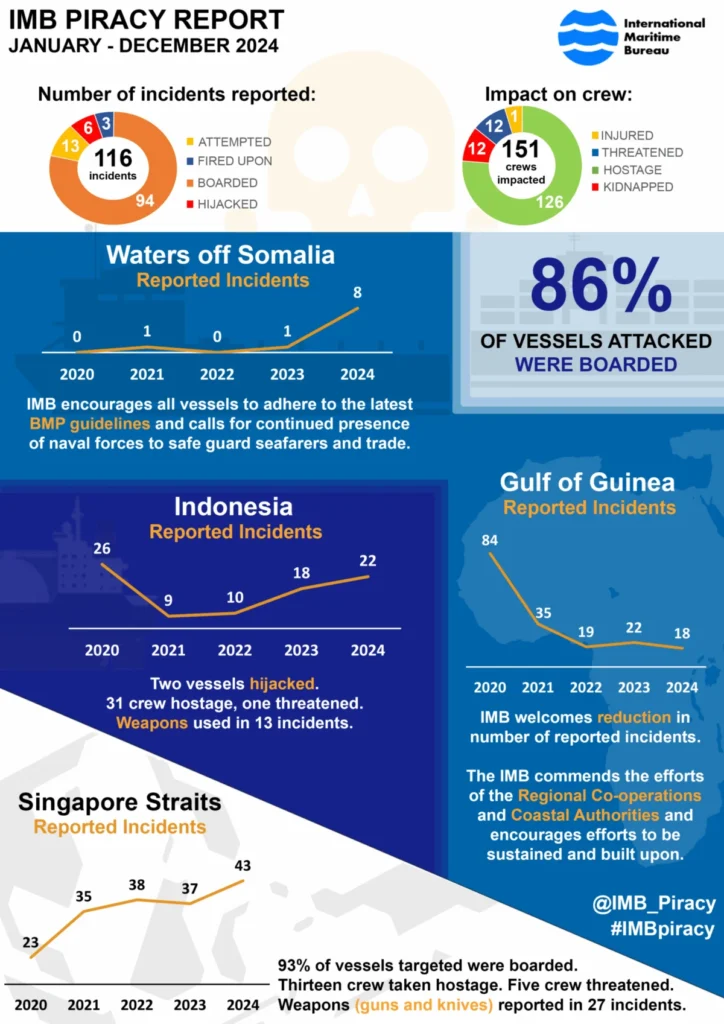
Data collected by the PRC reveals that while the total number of incidents fluctuates, the nature of the violence is becoming more tactical. The 2024 report highlights that:
- Attempted vs. Actual: The PRC’s intervention is often credited for the high number of "attempted" rather than "actual" boardings. When a shipmaster follows the PRC’s protocols—such as increasing speed, utilizing fire hoses, and reporting the incident immediately—the likelihood of a successful boarding drops significantly.
- The Geographic Shift: While the Gulf of Guinea was long the epicenter for kidnappings, recent data indicates a resurgence of activity in the Singapore Straits, where low-level armed robbery against tankers has become a persistent nuisance for the world’s busiest shipping lane.
The Statistical Importance of Reporting
The IMB stresses that the "dark figure" of unreported piracy remains a significant hurdle. Many shipowners, fearing increased insurance premiums or delays in port, choose not to report minor incidents. The PRC serves as an educational body, emphasizing that under-reporting leads to under-policing. When an area shows a "clean" record due to lack of reporting, authorities are less likely to deploy patrol vessels, creating a cycle of impunity for criminals.
Official Responses and Industry Collaboration
The credibility of the IMB Piracy Reporting Centre rests on its collaborative relationships with international bodies. It does not operate in a vacuum; it acts as a bridge between the private sector and public authorities.
Cooperation with the IMO and UN
The Centre works closely with the International Maritime Organization (IMO) to ensure that the data it collects aligns with the requirements of the UN Convention on the Law of the Sea (UNCLOS). By providing the IMO with verified data, the PRC helps shape global maritime policy, including the deployment of "Combined Maritime Forces" (CMF) in various regions.
Statement from the Director
Michael Howlett, Director of the ICC International Maritime Bureau, has frequently emphasized that the safety of the crew is the primary objective of every report received. "The PRC is more than a database; it is a shield," Howlett notes. "Every report submitted by a shipmaster is a piece of a larger puzzle. Without this information, our ability to lobby for naval presence or to warn a vessel three miles away from an attack is significantly diminished."
Implications: The Future of Maritime Security
As we move further into the 21st century, the implications of the IMB’s work are profound. Maritime security is no longer just about preventing theft; it is about maintaining the stability of the global economy.
Economic Consequences
Piracy acts as a "hidden tax" on global trade. Costs associated with rerouting vessels, hiring private maritime security contractors, and surging insurance premiums are eventually passed down to the consumer. A robust, well-funded reporting mechanism like the PRC acts as a deterrent that keeps these costs in check.
Technological Challenges
The future of the PRC lies in its ability to adapt to new technologies. As pirates begin to utilize drones for reconnaissance and sophisticated cyber-attacks to track cargo, the PRC is pivoting to provide guidance on digital security. The integration of artificial intelligence to predict "attack patterns" based on weather conditions, seasonal fishing activity, and past incident data is the next frontier for the Bureau.
The Duty of the Shipmaster
The IMB’s call to action remains clear: the onus of security begins at the bridge. By encouraging all shipmasters and owners to report all incidents—including those that seem minor—the PRC is building a comprehensive picture of maritime risk. This proactive stance ensures that when a genuine crisis occurs, the response infrastructure is already in place, alerted, and ready to act.
Conclusion: A Call to Vigilance
The ICC International Maritime Bureau’s Piracy Reporting Centre stands as a testament to the power of international cooperation. In an era where the seas are increasingly contested, the PRC provides the clarity needed to navigate safely. Whether through its 24-hour hotline or its exhaustive annual reports, the Centre remains the essential link in the chain of maritime safety.
For shipowners, operators, and the global shipping community, the message is clear: the PRC is an ally in the fight against maritime lawlessness. By continuing to support its efforts and contributing to its data, the global shipping industry can ensure that the high seas remain a space for commerce rather than a hunting ground for criminals.
Requesting Further Information:
For those interested in the latest trends and specific data breakdowns, the 2024 Piracy and Armed Robbery Against Ships report is available for request through the official ICC-CCS portal. For direct inquiries regarding security consultations or reporting protocols, please contact:
Michael Howlett
Director, ICC International Maritime Bureau
Tel: +44 207 423 6960
Email: [email protected]



