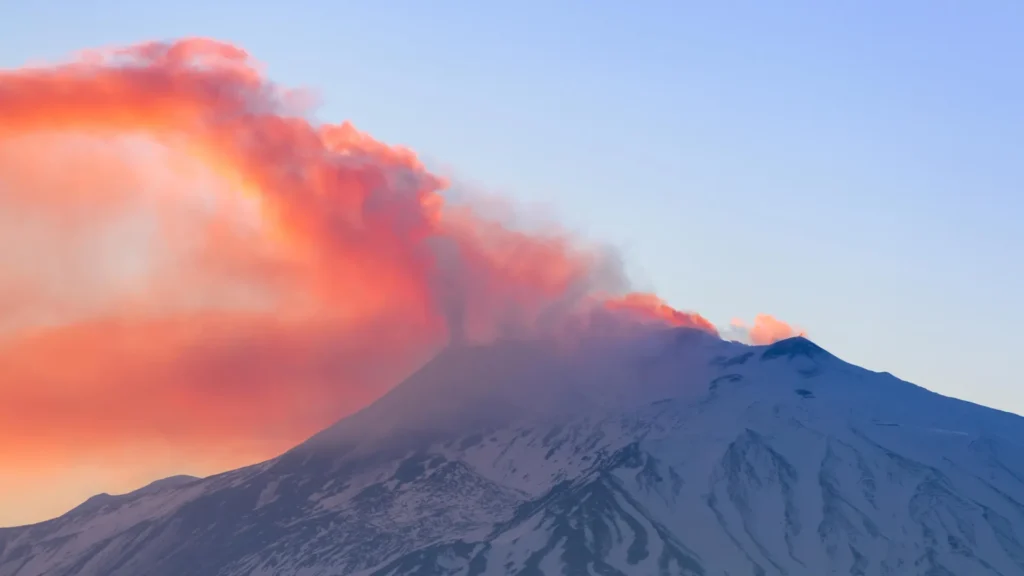
For over half a millennium of recorded observation, Mount Etna has served as a primary laboratory for the world’s most intrepid volcanologists. Looming over the Sicilian coastline, this behemoth—Europe’s most active volcano—regularly paints the Mediterranean sky with incandescent fountains and ash plumes. Yet, despite its proximity to major population centers and its status as one of the most studied geological features on the planet, Etna has stubbornly refused to conform to the established laws of petrology.
For decades, the “Sicilian Giant” has stood as an outlier, a geological mystery that defied the traditional frameworks of how volcanoes form. Now, a groundbreaking study led by the University of Lausanne (UNIL), in collaboration with the Istituto Nazionale di Geofisica e Vulcanologia (INGV) in Catania, proposes a radical new explanation. The research suggests that Mount Etna may be a gargantuan manifestation of a rare volcanic process previously thought to be exclusive to tiny, deep-sea structures. If confirmed, this discovery would not only rewrite the biography of Etna but potentially redefine the fundamental classification of volcanic activity on Earth.
The Traditional Paradigm: Where Etna Doesn’t Fit
To understand why the UNIL research is so seismic, one must first understand the traditional taxonomy of volcanoes. For generations, geologists have categorized volcanic formation into three primary mechanisms:
- Divergent Boundaries: Occurring at mid-ocean ridges, where tectonic plates pull apart, allowing magma from the mantle to rise and fill the void.
- Convergent Boundaries (Subduction Zones): Where one tectonic plate slides beneath another, forcing water and minerals into the mantle, which lowers the melting point of rock and creates magma that rises to form volcanic arcs.
- Hotspots: Areas where a stationary plume of intense heat from deep within the mantle melts the crust above, creating a chain of volcanoes as the tectonic plate moves over the plume (such as the Hawaiian Islands).
Mount Etna, however, has always been the "black sheep" of this family. Situated near the complex subduction zone where the African and Eurasian plates collide, it should behave like a classic subduction-zone volcano. Yet, its chemical signature tells a different story. The lava produced by Etna mirrors the composition of hotspot volcanoes—rich in alkaline elements—despite the total absence of a mantle plume beneath Sicily. For decades, this contradiction forced scientists into a state of "geological limbo," acknowledging that the textbook models were failing to account for the most iconic volcano in Europe.
A Deep-Seated Reservoir: The Mechanics of the Subsurface
The new study, published in the Journal of Geophysical Research: Solid Earth, posits that the answer lies not in a plume or a standard subduction process, but in "hidden" pockets of magma stored deep within the upper mantle.
According to the research team, led by Professor Sébastien Pilet, the mantle beneath Sicily contains ancient, pre-existing pockets of melt trapped approximately 80 kilometers (50 miles) below the surface. These pockets do not necessarily form in real-time as a result of active melting; rather, they have been resident in the mantle for vast stretches of geological time.
The trigger for Etna’s activity is the slow, grinding collision of the African and Eurasian tectonic plates. As the African plate bends and descends into the subduction zone, it creates localized fractures and tectonic stress in the crust above. This process acts like a giant, geological sponge being compressed. As the crust deforms, it squeezes these deep-seated magma pockets upward, allowing the molten rock to migrate through the lithosphere and reach the surface. This mechanism explains the “hotspot-like” chemistry: the magma isn’t being generated by a plume, but by the physical extraction of ancient, chemically unique mantle melts that were already waiting in the wings.
Chronology of a Geological Outlier
The history of Mount Etna is a story of slow, persistent growth that belies its explosive nature. Geological evidence indicates that Etna’s current volcanic activity began roughly 500,000 years ago.
- Pre-Etnean Phase (500,000+ years ago): Submarine volcanic activity began in the Gulf of Catania. These early eruptions were the precursors to the current edifice.
- The Stratovolcano Growth (100,000 years ago): The central edifice began to form, characterized by repeated cycles of construction and collapse.
- The Modern Era: Etna has grown to reach an elevation exceeding 3,300 meters (10,900 feet). Unlike many volcanoes that follow a cycle of dormancy and eruption, Etna has remained remarkably consistent in its chemical output over the last half-million years.
By analyzing rock samples collected from various stages of the volcano’s history, the UNIL team was able to reconstruct the chemical evolution of the lava. What they found was a striking degree of stability. While the surrounding tectonic environment underwent significant changes over the last 500,000 years, the “recipe” for Etna’s magma remained largely the same. This stability is the "smoking gun" that suggests a long-standing, deep-mantle source rather than the ephemeral melting processes typically associated with subduction zones.
The Rise of the "Petit-Spot" Theory
The most compelling aspect of the Lausanne study is the comparison to "petit-spot" volcanism. Identified by Japanese researchers in 2006, petit-spot volcanoes are small, submarine structures found on the outer edges of subduction zones. They are essentially the "pimple-like" release of small amounts of magma from the mantle as a plate bends.
Until now, the scientific community believed that the petit-spot mechanism was limited to these tiny features—structures that usually rise only a few hundred meters from the seafloor. Professor Pilet and his colleagues have proposed a bold hypothesis: Mount Etna is a "mega-version" of a petit-spot volcano.
"This is unexpected," Pilet notes. "We are seeing a mechanism that was previously thought to be restricted to very small, deep-sea features now explaining one of the largest and most prominent stratovolcanoes on Earth."
If the theory holds, it suggests that the scale of a volcano is not necessarily tied to the complexity of the melting process, but rather to the volume of magma stored in the mantle and the specific tectonic stresses acting upon the crust. It transforms Etna from a confusing anomaly into a representative of a potentially significant, yet overlooked, class of global volcanism.
Implications for Volcanic Hazard Assessment
Beyond the academic satisfaction of solving a 50-year-old mystery, the research has profound implications for public safety. In Sicily, the INGV monitors Etna around the clock to predict eruptions that could threaten the surrounding communities of Catania and beyond.
By understanding that Etna is fed by deep, stable reservoirs of magma controlled by tectonic plate movement, researchers at the INGV can refine their predictive models. If the magma supply is governed by the gradual deformation of the plate rather than sudden, deep-crustal melting, it changes how scientists monitor the precursors to an eruption. This knowledge allows for more precise hazard assessments and a better understanding of the long-term eruptive potential of the volcano.
As Anna Rosa Corsaro of the INGV in Catania points out, the collaboration between petrologists and field volcanologists is essential for this transition. "By integrating our field data with the geochemical models developed at UNIL, we are moving toward a more holistic view of Etna’s plumbing system," Corsaro states.
Future Horizons: Is Etna One of a Kind?
The final question remains: If Etna is a large-scale petit-spot volcano, are there others? The geological community is now tasked with re-examining other "rogue" volcanoes around the globe—those that don’t fit the neat subduction or hotspot categories—to see if they, too, are being driven by these deep-seated mantle pockets.
The findings suggest that Earth’s mantle is far more heterogeneous than previously assumed. If massive volumes of magma can reside in the upper mantle for hundreds of thousands of years, waiting for the right tectonic "squeeze," it implies that we have significantly underestimated the storage capacity of our planet’s interior.
As we look toward the future of volcanology, Mount Etna stands as a testament to the fact that even the most well-known features of our world can still surprise us. The Sicilian Giant is no longer just a dangerous neighbor; it is a masterclass in geophysics, challenging us to rethink the very roots of volcanic activity. Through the lens of the "petit-spot" hypothesis, the smoke and ash of Etna take on a new meaning—a window into the ancient, hidden chemistry of the Earth’s mantle, waiting for the tectonic plates to tell their story.