In the world of luxury watchmaking, the term "collaboration" has become increasingly diluted. It is common to see brands slapping a logo on a dial or changing a color scheme, rebranding a standard catalog model as a "limited edition" through a shallow licensing deal. However, when Bell & Ross announced its latest partnership with the Patrouille de France—the elite precision aerobatic demonstration team of the French Air and Space Force—the watch community took note. This was not a mere marketing exercise; it was a continuation of a rigorous, operational relationship that has been tested in the most extreme conditions imaginable, including the literal ejection seat of a combat aircraft.
The unveiling of the Bell & Ross BR-X3 Patrouille de France serves as a focal point for this enduring partnership. It is a timepiece that balances the demands of high-performance aviation with the aesthetic language of modern, industrial design.

The Genesis of an Operational Partnership
The relationship between Bell & Ross and the Patrouille de France (PdF) dates back to 2021. Since its inception, the partnership has been defined by a commitment to utility. Unlike many "tribute" watches that never leave a desk, the timepieces created for the PdF are integrated into the daily lives of the pilots.
The pilots of the PdF do not simply wear these watches for photoshoots; they wear them in the cockpit of the Dassault-Dornier Alpha Jet. The watch, in this context, is a critical piece of equipment. The team historically relied on the BR-03 Type A, a sophisticated quartz ana-digi timepiece designed to provide essential flight data with intuitive, crown-based control. The fact that these watches have survived the rigors of flight training and live performance is a testament to the brand’s "form follows function" philosophy.

Chronology of the Collaboration
To understand the weight of the new BR-X3, one must look at the evolution of the partnership:
- 2021: The partnership is formally established, grounding the brand in the world of elite French aerobatics.
- 2021–2024: A series of BR-03 based models are introduced, establishing the signature aesthetic—a blend of stealthy, utilitarian case design and high-visibility dial accents.
- 2024: A critical real-world validation occurs. During a rehearsal flight, a Captain of the Patrouille de France was involved in a mid-air collision. He was forced to eject from his jet. The extreme forces of an ejection seat, which typically range between 12 G and 20 G, are enough to destroy most mechanical and quartz timepieces. Yet, when the pilot reached the ground, his BR-03 Type A was still operational. This event served as a "baptism by fire" that silenced any critics questioning the durability of the brand’s output.
- 2025: The partnership expands its horizon, moving away from the iconic BR-03 square case to incorporate the BR-05 chronograph, signaling a desire to elevate the line into a more lifestyle-oriented, yet still robust, category.
- 2026: The launch of the BR-X3 Patrouille de France, the sixth iteration of the partnership, marks a return to the technical, architectural complexity of the BR-X3 platform while honoring the specific livery of the PdF.
Supporting Data: The Anatomy of the BR-X3
The BR-X3 is a marvel of industrial watchmaking. While the base model is already a favorite among enthusiasts for its robust architecture, the PdF edition introduces subtle, meaningful refinements.

The Case and Build
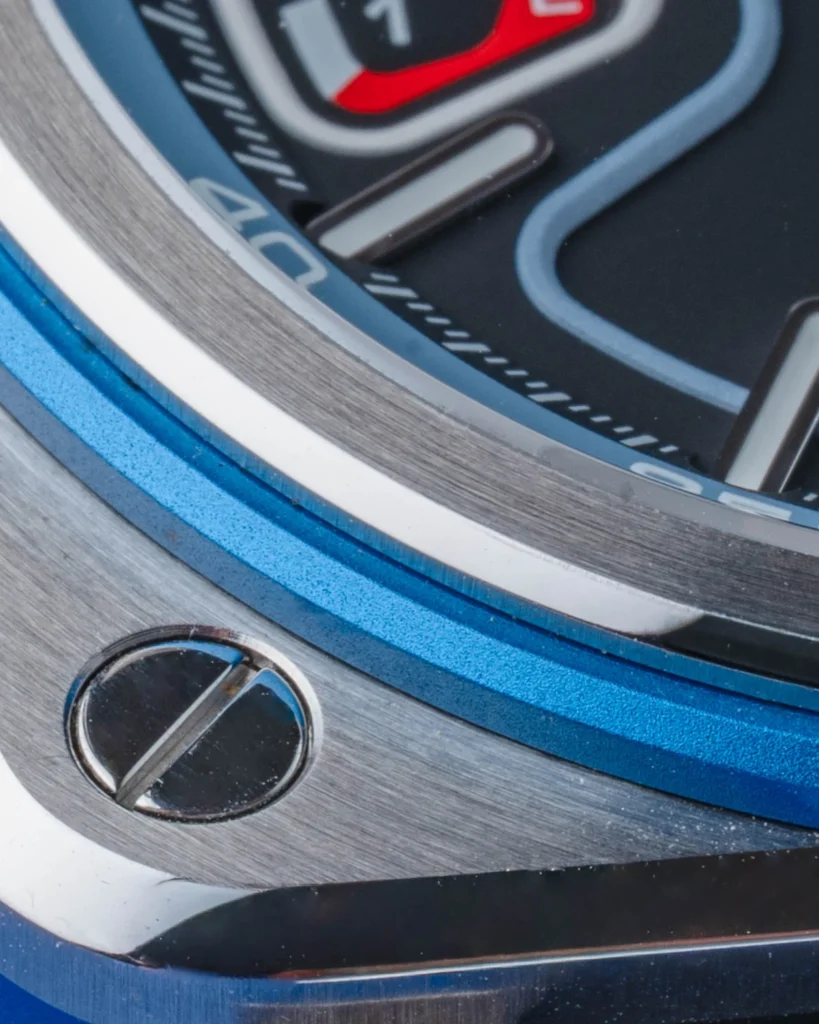
The BR-X3 Patrouille de France maintains the familiar 41mm footprint, with a thickness of 13.3mm. It features a multi-part case construction, secured by high-tension bolts at each corner—a design cue that mirrors the structural integrity of an aircraft fuselage.
What sets this edition apart are the "bolt tubes" and the lower bezel, which are rendered in a distinct light blue. This shade is not arbitrary; it is a direct match to the livery of the Alpha Jets and the flight suits worn by the pilots. The result is a color-coordinated aesthetic that feels intentional rather than cosmetic.

The Movement
At the heart of the timepiece lies the Bell & Ross BR-CAL.323. Developed in collaboration with the renowned movement manufacturer Kenissi, this caliber is a workhorse.
- Power Reserve: 70 hours, ensuring the watch remains accurate throughout a long weekend of rest.
- Frequency: 28,800 vibrations per hour (vph).
- Certification: COSC-certified, guaranteeing an accuracy of -4/+6 seconds per day.
Dial and Legibility
Despite the complexity of the display, legibility remains paramount. The dial features the classic B&R capsule markers and a bold "12" numeral. A notable addition is the retro-grade fuel tank power reserve indicator, which is as functional as it is aesthetic, providing a clear visual representation of remaining energy. The seconds hand features a lumed tip shaped like the silhouette of the Alpha Jet—a small, whimsical touch that adds character without compromising the professional nature of the watch.

Official Perspectives and Operational Reality
During a recent encounter with the aviators of the Patrouille de France, the conversation turned quickly from marketing to the reality of the gear. Captain Thomas, a member of the flight team, was adamant about the watch’s role in their operations.
"People often assume we wear these because we are paid to," he remarked during a briefing. "But when you are in the air, pulling high Gs, you don’t think about brand deals. You think about whether your equipment will hold up. The watch I wear is the same one I rely on to track my timing during maneuvers. When I ejected last year, I didn’t worry about my watch. When I looked at my wrist on the ground, it hadn’t missed a beat. That is the definition of a pilot’s watch."

This perspective shifts the conversation from price points to reliability. For the pilot, the watch is an extension of the cockpit instrumentation. For the collector, it represents a piece of genuine aeronautical history.
Implications for the Future of Limited Editions
The launch of the BR-X3 Patrouille de France raises an interesting question about the nature of luxury collaborations. If a collaboration is purely a licensing deal, the value proposition is based on the brand equity of the IP owner (e.g., NASA or a film studio). If a collaboration is based on genuine field-testing and operational synergy, the value proposition is based on performance.

The Cost of Performance
The BR-X3 Patrouille de France is priced at $8,100 USD. This represents a roughly 12.5% premium over the standard base model. While some may scoff at the price increase for what essentially amounts to a color change and an insignia, the implications are clear: the value here is not just in the hardware, but in the exclusivity and the narrative of the partnership.
Limited to 250 pieces, this watch is not designed for the mass market. It is designed for those who appreciate the intersection of high-speed aviation and high-precision horology.

Design Integrity
The design succeeds because it remains restrained. By keeping the modifications to the color of the bolt tubes, the dial insignia, and the caseback engraving, Bell & Ross has ensured that the watch remains a functional tool. The caseback, which features a sapphire crystal printed with a ring of jets and specific mission text, offers a private, personal detail for the wearer—something that acknowledges the history of the piece without shouting it from the dial.
Conclusion: A Successful Synthesis
The Bell & Ross BR-X3 Patrouille de France is a rare example of a collaboration that earns its keep. It does not rely on the fame of the Patrouille de France to sell itself; instead, it uses the partnership to underscore the extreme capability of the BR-X3 platform.

For the collector, it offers a tangible connection to the world of elite flight. For the pilot, it remains a reliable instrument capable of withstanding the most violent forces a human can endure in a cockpit. As the brand moves forward, the success of this model suggests that the future of horological collaborations lies in the depth of the relationship rather than the breadth of the logo.
Whether you are drawn to the aesthetic of the Alpha Jet blue or the technical prowess of the Kenissi-manufactured movement, the BR-X3 Patrouille de France is a compelling piece of engineering. It is, quite simply, a watch that does not just look like it belongs in the sky—it has been there, survived the fall, and is ready for the next flight.