Thunder Gold Corp. [TSXV: TGOL; OTCQB: TGOLF; FRA: Z25] is making significant strides in the development of its flagship Tower Mountain Gold property, located strategically 40 kilometres west of Thunder Bay, Ontario. The company recently released encouraging assay results from its ongoing infill drilling campaign at the Bench Target, signaling a potential upgrade in resource classification and offering a clearer window into the project’s geological consistency.
As the mining industry watches the Abitibi and broader Canadian gold belts with heightened interest, Thunder Gold’s systematic approach to the 2,500-hectare Tower Mountain site provides a case study in methodical exploration and resource definition.
Main Facts: Consistency and Resource Conversion
The core of the recent announcement centers on drill hole TM26-218, which has demonstrated the high degree of geological homogeneity that the Tower Mountain property is becoming known for. The hole intersected continuous gold mineralization over a substantial interval of 298.5 metres, averaging 0.409 g/t gold. Crucially, the hole did not simply taper off; it terminated in a 36.0-metre zone grading 0.715 g/t gold, suggesting that mineralization remains open and robust at depth and along the periphery of the current drill grid.
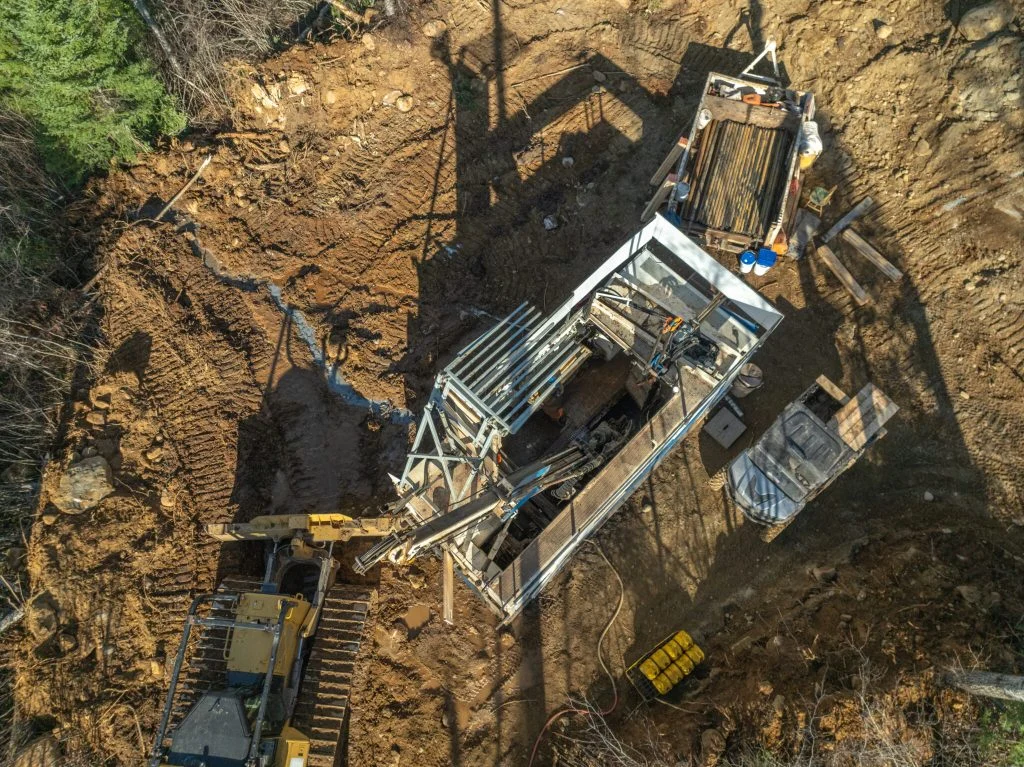
This drilling is part of a targeted campaign designed to convert "inferred" resource blocks into the more reliable "indicated" resource classification. By increasing the drill density within the Bench-Ellen (B-E) trend, Thunder Gold aims to tighten the geological model and reduce the margin of error in its long-term project planning.
Chronology of Development
The current exploration success follows a pivotal moment for the company earlier in 2026. On January 26, 2026, Thunder Gold released a formal mineral resource estimate (MRE) that solidified the project’s stature. The MRE highlighted an indicated resource of 34.5 million tonnes averaging 0.46 g/t gold, representing 514,000 ounces of gold. Complementing this is a massive inferred resource base of 211.1 million tonnes at 0.45 g/t gold, totaling 3.05 million ounces.
The path from that January milestone to the present has been defined by a transition from broad-scale exploration to focused infill drilling. Throughout the spring and summer of 2026, the company deployed its drill teams to the B-E trend, specifically targeting the gaps between previous high-potential holes like TM26-2010 and TM26-214. By strategically placing TM26-218 between these points, the company has effectively "stitched" together its geological data, creating a more cohesive picture of the mineralized corridor.
Supporting Data and Geological Insights
The geology of the Tower Mountain property is characterized by its scale and its consistent, if modest, grade profile. Unlike high-grade vein-hosted deposits that can be notoriously difficult to model due to "nugget effects," the Bench Target at Tower Mountain exhibits a remarkably stable grade distribution.
Key Technical Highlights:
- Mineralization Style: The mineralization is largely homogenous, typically varying between 0.10 g/t and 3.00 g/t gold. Values rarely exceed 5.0 g/t, but the sheer volume of mineralized rock provides the foundation for the property’s multi-million-ounce potential.
- The B-E Trend: The Bench-Ellen trend serves as the primary engine for the project’s resource growth. Current drilling has confirmed that mineralization extends from the contact zones deep into the heart of the target area.
- Step-Out Success: TM26-218 represents a 100-metre step-out hole. Its success in replicating the mineralization patterns of its neighbors (TM26-2010, which graded 0.554 g/t over 661.5 metres, and TM26-214, which graded 0.307 g/t over 409.5 metres) serves as a validation of the company’s geological interpretation.
- Waste Rock Exploration: Not all drilling has been focused solely on the main trend. Exploration hole TM26-215, which targeted waste rock zones southwest of the B-E contact, returned 7.5 metres of 0.737 g/t gold. While modest, this indicates that the system may be wider than previously mapped, offering future potential for volume expansion.
Official Responses and Strategic Vision
Wes Hanson, President and CEO of Thunder Gold, has been vocal about the implications of these results. "All seven infill holes completed to date have targeted inferred resource blocks with the objective of converting them to the indicated resource classification," Hanson stated.
Perhaps the most significant takeaway from Hanson’s recent commentary is the observation regarding modeled versus actual grades. "Actual grades are trending higher than modeled grades," he noted, "supporting the opportunity to increase the average grade of the resource through continued drilling."
This sentiment underscores a common challenge in junior mining: the conservatism of initial resource models. If the actual drilling continues to outperform the model, the economic viability of the project—specifically its potential to support a large-scale open-pit operation—could shift significantly. Furthermore, Hanson highlighted that the current lack of drill density has left some "barren, late intrusive dikes" within the B-E trend poorly understood. He believes that the ongoing infill campaign will not only define the gold-bearing zones but also better map these barren zones, allowing for a more accurate and efficient pit design in the future.
Implications for the Future: Toward a PEA
The strategic goal for Thunder Gold is clear: to establish a comprehensive, bankable resource that justifies an initial scoping study, also known as a Preliminary Economic Assessment (PEA), in 2027.
The proximity of the Tower Mountain property to Thunder Bay is a major competitive advantage. Access to established public infrastructure—including power, roads, and a skilled labor pool—significantly lowers the capital expenditure (CAPEX) hurdles that often plague remote mining projects.
Why the 2027 Timeline Matters:
- Project De-risking: By upgrading the resource classification, Thunder Gold is effectively lowering the risk profile for potential institutional investors and industry partners.
- Infrastructure Leverage: Being 40 kilometres from an industrial hub means the logistics of potential development are far more favorable than those of fly-in, fly-out operations in northern reaches of Ontario.
- Open Pit Potential: The fact that 100% of the currently estimated resources are contained within an optimized open pit is a significant value proposition. Open-pit operations, generally characterized by lower costs and higher throughput, are the industry standard for low-to-moderate grade deposits of this magnitude.
Market Context and Investor Considerations
As of the most recent market data, Thunder Gold’s stock has experienced modest volatility, reflecting the broader cyclical nature of the junior mining sector. While shares have seen recent fluctuations, the focus remains firmly on the technical execution of the drill program.
Investors should note that the company is currently in a phase of heavy capital deployment. Drilling, assaying, and technical modeling are expensive endeavors. However, for a junior explorer, the "currency" is the quality and quantity of the gold in the ground. By systematically converting inferred ounces into indicated ones, Thunder Gold is creating tangible value, regardless of short-term price movements.
Looking ahead, the market will likely await the next batch of assays from the B-E trend. Should the trend of "actual grades exceeding modeled grades" continue, it would provide a strong catalyst for a re-rating of the company’s valuation as it approaches the 2027 target for its preliminary economic study.
In conclusion, Thunder Gold Corp. is demonstrating that the Tower Mountain property is not just a massive, low-grade curiosity, but a structured, consistent, and potentially profitable asset. With a clear roadmap toward a 2027 PEA and a drilling strategy that is yielding predictable, high-quality results, the company is positioning itself as a compelling player in the Canadian gold landscape.
Disclaimer: Resource World Magazine Inc. has prepared this editorial for general information purposes only and should not be considered a solicitation to buy or sell securities in the companies discussed herein. The information provided has been derived from sources believed to be reliable but cannot be guaranteed. This editorial does not take into account the readers’ investment criteria, expertise, financial condition, or financial goals. Recipients should rely on their own due diligence and seek their own professional advice before investing.