
London, September 14, 2026 — The hallowed halls of the British Museum, usually a site of quiet contemplation regarding human history, became a theater of modern political friction this past Saturday. As the institution celebrates the opening of its high-profile exhibition of the Bayeux Tapestry—a medieval masterpiece depicting the Norman Conquest—it finds itself under siege by protesters demanding an immediate overhaul of its corporate sponsorship policies and ethical standards.
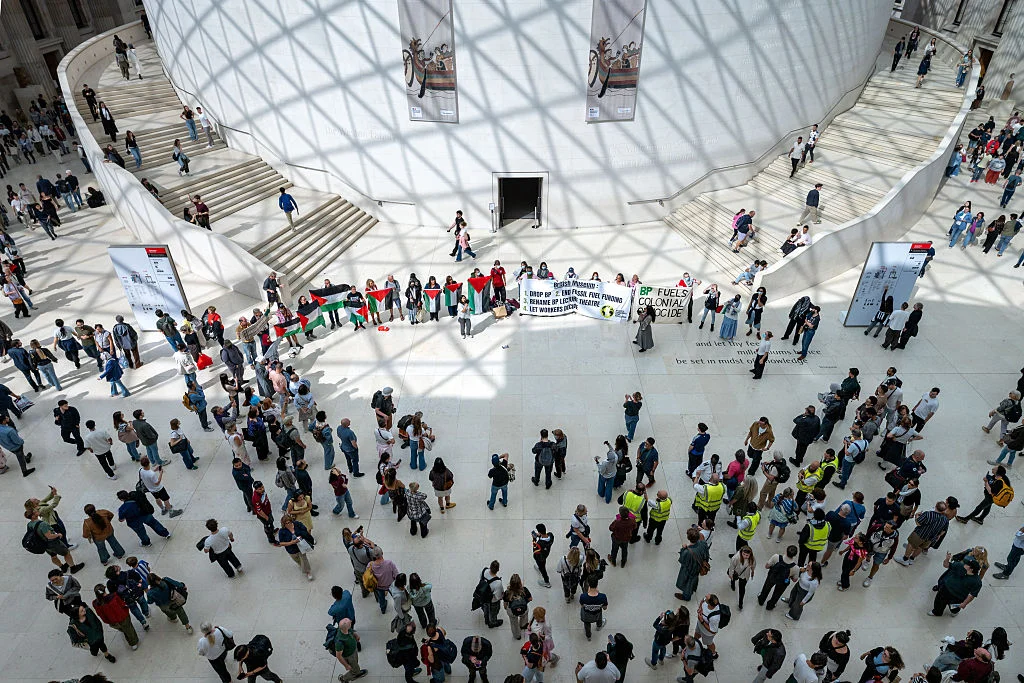
The protest, organized by the activist collective Energy Embargo for Palestine, turned the museum’s iconic Great Hall into a space of vocal dissent. The demonstration serves as a flashpoint in a growing movement to decouple major cultural institutions from fossil fuel giants and entities linked to geopolitical conflict.
Main Facts: A Convergence of Conflict
The catalyst for Saturday’s disruption was a two-pronged critique of the museum’s financial entanglements. Activists targeted two specific relationships: the institution’s long-standing, controversial partnership with British Petroleum (BP) and its recent collaboration with Belarusian billionaire Igor Tulchinsky.
Last week, an investigative report by Middle East Eye brought to light that Tulchinsky, a financier and art patron, contributed $6.8 million to facilitate the transport and exhibition of the Bayeux Tapestry from France to London. However, the report also alleged that Tulchinsky has provided funding for a community center in Efrat, a settlement in the occupied West Bank. Because Efrat is considered an illegal settlement under international law, and specifically because the entity is currently under United Kingdom sanctions, the revelation has sparked a firestorm of criticism regarding the museum’s due diligence and ethical vetting processes.
The protesters, joined by groups including A Space for Us Now and Camden Friends of Palestine, unfurled what they dubbed "the people’s tapestry." This collaborative textile work, composed of stitched-together images and slogans, featured pointed messages such as "Stop Fueling Genocide" and "Welfare, Not Warfare."
Chronology of Events
To understand the current impasse, one must look at the timeline of events that led to this weekend’s confrontation:
- Late August 2026: The British Museum begins the highly publicized installation of the Bayeux Tapestry, a loan that represents one of the most significant diplomatic and historical achievements for the museum in recent years.
- Early September 2026: Middle East Eye publishes an expose detailing the financial contributions of Igor Tulchinsky to the exhibition and his documented financial ties to Efrat, an Israeli settlement in the occupied West Bank.
- September 10, 2026: Energy Embargo for Palestine coordinates a direct action in the Great Hall, utilizing the tapestry’s debut as a platform to highlight the museum’s ethical contradictions.
- September 12, 2026: Public discourse intensifies across social media platforms, with activists framing the museum’s management as being "out of step" with the cultural sector and the public.
- September 14, 2026: The museum continues to face pressure as calls for the resignation of key board members and a formal internal inquiry into sponsorship vetting begin to gain traction.
Supporting Data: The Ethics of Cultural Funding
The British Museum is currently the only major cultural institution in London that continues to maintain a significant sponsorship relationship with BP. While other pillars of the UK’s "Museum Mile"—such as the Tate and the National Portrait Gallery—have severed ties with fossil fuel companies in response to years of climate activism, the British Museum has remained an outlier.
The issue of the $6.8 million funding for the Bayeux Tapestry is particularly complex. In the world of museum administration, "gift agreements" are often shrouded in confidentiality. However, the intersection of private wealth and state-sanctioned geopolitical controversy creates a unique liability. Under current UK regulations, interacting with entities under sanctions or those directly involved in disputed territories can pose legal risks, but the "reputational risk" is what has activists most energized.
Energy Embargo for Palestine argues that the museum is prioritizing its bottom line over its "duty of care" to the public. They point to the fact that while the museum claims to be a neutral educational space, its financial dependency on entities like BP—and individuals like Tulchinsky—renders its neutrality an illusion.
Official Responses and Internal Pressures
To date, the British Museum has maintained a cautious silence, providing standard boilerplate responses to media inquiries regarding its sponsorship vetting processes. A spokesperson for the museum declined to comment directly on the allegations regarding Igor Tulchinsky, citing privacy agreements and ongoing exhibition management.
However, internal murmurs suggest that the institution is struggling. Sources close to the museum’s staff report a growing divide between the curatorial teams—who are focused on the historical preservation and educational value of the tapestry—and the executive board, which is under intense pressure to secure funding in an era of dwindling government grants.
The activists’ demands are specific and structural:
- Immediate Severance: End all funding relationships with BP and other fossil fuel conglomerates.
- Renaming: The BP Lecture Theater must be renamed to reflect the museum’s supposed commitment to a sustainable future.
- Ethical Oversight: Establish a staff-led ethics committee with the power to veto partnerships that conflict with the museum’s stated values.
- Due Diligence Reform: Implementation of a transparent vetting process for all high-value donors, ensuring no funds are derived from, or support, companies or projects associated with human rights violations or illegal settlements.
Implications: The Future of Cultural Patronage
The confrontation at the British Museum is symptomatic of a wider crisis in the arts and heritage sector. For decades, institutions relied on the "philanthropic shield," where large donations from corporations or wealthy individuals provided the necessary capital for major exhibitions. The implicit deal was that the donor would receive prestige in exchange for their support, and the museum would receive the funds required to operate.
That social contract is now effectively broken. Younger audiences and activists are increasingly scrutinizing the "blood money" behind the exhibits. The implication for the British Museum is severe: if it refuses to adapt, it risks losing its legitimacy as a public institution. If it does adapt, it faces a significant funding deficit that the current government, already stretched by fiscal constraints, may be unable to cover.
Furthermore, the "people’s tapestry" protest suggests a shift in tactics. Rather than merely picketing outside, activists are now creating their own "counter-exhibits" within the museum’s walls, forcing the institution to engage with the politics of its own space. By turning the museum’s architecture against itself, activists are successfully transforming the institution into a site of active political negotiation.
As the Bayeux Tapestry exhibition continues its run, the British Museum finds itself in a precarious position. The protest on Saturday was likely not an isolated event but a preview of a sustained campaign. Whether the museum’s leadership chooses to pivot toward a more transparent and ethically rigid governance model or doubles down on its current path remains the defining question of the institution’s modern era.
For the protesters, the goal is clear: to ensure that the history housed within the museum is not built upon the destruction of the present. As Energy Embargo for Palestine noted in their statement: "The interests of the British Museum management are in stark opposition to its workers, people across the culture sector, and the general public." Until that gap is bridged, the silence of the museum’s galleries will be frequently interrupted by the voices of those demanding change.