
Introduction: The Invisible Shield Protecting Global Trade
In the vast, ungoverned stretches of the world’s oceans, where the reach of national law enforcement often fades into the horizon, a specialized nerve center operates around the clock to safeguard the lifeblood of the global economy: maritime shipping. Since its inception in 1991, the International Maritime Bureau (IMB) Piracy Reporting Centre (PRC) has functioned as the definitive global watchdog against piracy and armed robbery at sea.
Operating as a 24-hour, single point of contact, the PRC is more than just a registry of crimes; it is an active response mechanism. In an era where supply chains are increasingly fragile and geopolitical tensions are rising, the work of the IMB PRC has never been more critical. By bridging the gap between distressed vessels and regional authorities, the Centre serves as the thin blue line protecting seafarers and the trillions of dollars in cargo that transit the maritime corridors every year.
The Genesis of the IMB PRC: A Chronology of Maritime Vigilance
To understand the necessity of the IMB PRC, one must look at the evolution of maritime crime. In the late 20th century, as global trade volumes surged, so too did the sophistication and frequency of attacks on merchant vessels.
1991: The Establishment
Recognizing that the maritime industry lacked a centralized, non-governmental mechanism to track and report incidents, the International Chamber of Commerce (ICC) International Maritime Bureau launched the PRC. The goal was simple yet ambitious: to provide a centralized database and a rapid response hub that transcended national jurisdictions.
The 2000s: The Somali Surge
The early 2000s saw a paradigm shift in piracy, most notably with the emergence of the Somali piracy crisis. The IMB PRC became the primary conduit for distress signals, coordinating with the fledgling international naval coalitions to track "mother ships" and provide real-time alerts to merchant vessels traversing the Gulf of Aden and the Indian Ocean.
2010–2020: The Globalization of Risk
As international pressure effectively curtailed Somali piracy, the threat landscape shifted toward the Gulf of Guinea and the Singapore Strait. The PRC adapted by integrating satellite tracking and real-time electronic alert systems, proving that the reporting center was capable of evolving alongside the agile tactics of modern pirates.
2025: Current State of Play
Today, the PRC acts as a sophisticated information-sharing platform. It does not merely record data; it analyzes patterns to issue “Warning Broadcasts” and email alerts, effectively creating a "safety net" that allows captains to deviate from dangerous waters before an encounter even occurs.
Supporting Data: The Anatomy of Modern Piracy
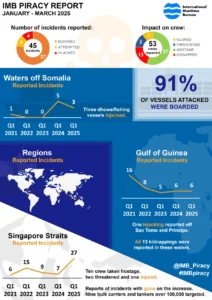
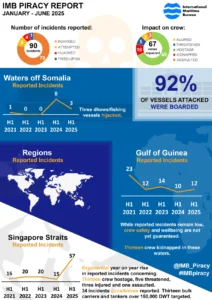
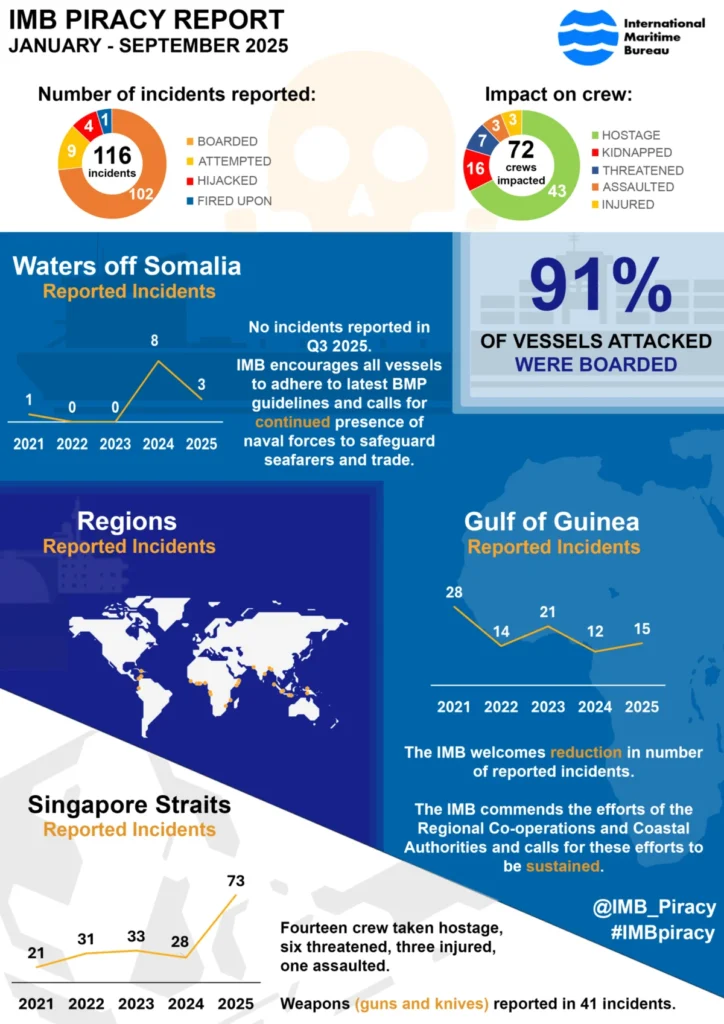
The data curated by the IMB PRC is the gold standard for maritime risk assessment. Their periodic reports—including the recently released January to September 2025 Piracy and Armed Robbery Against Ships report—provide granular insights into the mechanics of maritime crime.
Geographic Hotspots and Trends
While the nature of piracy varies by region, the PRC’s data highlights recurring trends:
- The Singapore Strait: Continues to be a flashpoint for low-level armed robbery against ships underway. The PRC emphasizes that while these incidents are often categorized as "low-level," they pose a significant threat to crew safety and vessel navigation.
- The Gulf of Guinea: Historically a high-risk area for kidnapping for ransom, the PRC’s recent data suggests that coordinated reporting has empowered regional navies to increase their presence, leading to a shift in how pirates operate—often moving further offshore to avoid detection.
- The Americas and Southeast Asia: Regional fluctuations remain, with the PRC tracking increased activity in anchorage areas where vessels are most vulnerable while stationary.
The Power of Reporting
A critical insight provided by the IMB is the “Reporting Gap.” The Bureau consistently notes that for every reported incident, there are likely several others that go undocumented due to fear of increased insurance premiums or operational delays. The IMB PRC actively encourages shipmasters to shatter this silence. By reporting every incident—no matter how minor—owners provide the quantitative proof required to lobby governments for increased naval patrols, enhanced coast guard resources, and better intelligence sharing.
Official Responses and Strategic Collaboration
The IMB PRC does not act in a vacuum. Its effectiveness is predicated on a web of collaboration with national governments, the International Maritime Organization (IMO), and private security stakeholders.
The Role of Advocacy
Michael Howlett, Director of the ICC International Maritime Bureau, has been a vocal advocate for a standardized global response to maritime crime. Under his leadership, the PRC has deepened its engagement with the maritime industry to ensure that security is not viewed as an optional overhead but as a core component of operational integrity.
"The work of the IMB PRC is fundamentally about the protection of human life," Howlett notes. "By ensuring that every distress call is acted upon and every incident is documented, we provide the necessary evidence to hold states accountable for the security of their territorial waters."
Inter-Agency Coordination
When the PRC receives a report of an attack, the protocol is instantaneous:
- Verification: The PRC confirms the status of the vessel.
- Notification: Local authorities and regional maritime security centers are notified immediately.
- Broadcasting: The incident is disseminated to other vessels in the vicinity via the IMB’s alert system, effectively turning the merchant fleet into a collective, eyes-on-the-water surveillance network.
Implications for Global Trade and Crew Safety
The implications of the IMB PRC’s work extend far beyond the immediate prevention of a robbery.
Economic Stability
Piracy is a tax on global trade. When a vessel is attacked, insurance premiums spike, rerouting costs are incurred, and the risk of supply chain disruption increases. By providing the intelligence that allows for safer passage, the PRC contributes directly to the stability of the global supply chain, ensuring that essential goods, energy, and raw materials reach their destinations without the "piracy premium."
The Human Element
Often overlooked in the broader discussion of logistics are the seafarers themselves. Being boarded by armed individuals is a traumatic experience that carries long-term psychological consequences. The IMB PRC’s commitment to early warning and coordination is, at its heart, a humanitarian mission to ensure that seafarers return home to their families safely.
The Future of Maritime Security
As technology evolves, so too do the threats. Cyber-piracy, the use of drones to scout vessels, and the increasing sophistication of small-craft boarding techniques require the IMB PRC to stay ahead of the curve. The organization is currently pivoting toward more advanced data analytics, using predictive modeling to warn vessels of high-risk "corridors" before they even enter a region.
Conclusion: A Call to Action for the Maritime Community
The security of our oceans is a shared responsibility. The IMB Piracy Reporting Centre stands as the central pillar of this defense, but its efficacy is ultimately determined by the participation of the shipping industry.
Shipowners and masters are the frontline witnesses. By maintaining a culture of transparent reporting, the maritime community ensures that the IMB PRC remains equipped with the data necessary to influence policy, direct naval resources, and ultimately deter those who seek to profit from maritime chaos.
To remain informed and to contribute to the global effort in securing our seas, industry stakeholders are encouraged to download the January to September 2025 Piracy and Armed Robbery Against Ships report at the ICC-CCS website.
For those requiring immediate support or wishing to report an incident, the IMB PRC remains available 24/7.
Contact Information:
- Organization: ICC International Maritime Bureau
- Director: Michael Howlett
- Telephone: +44 207 423 6960
- Email: [email protected]
In an uncertain world, the IMB Piracy Reporting Centre remains a beacon of reliability—a testament to what can be achieved when the global maritime community unites under a common goal of safety, security, and the rule of law on the high seas.