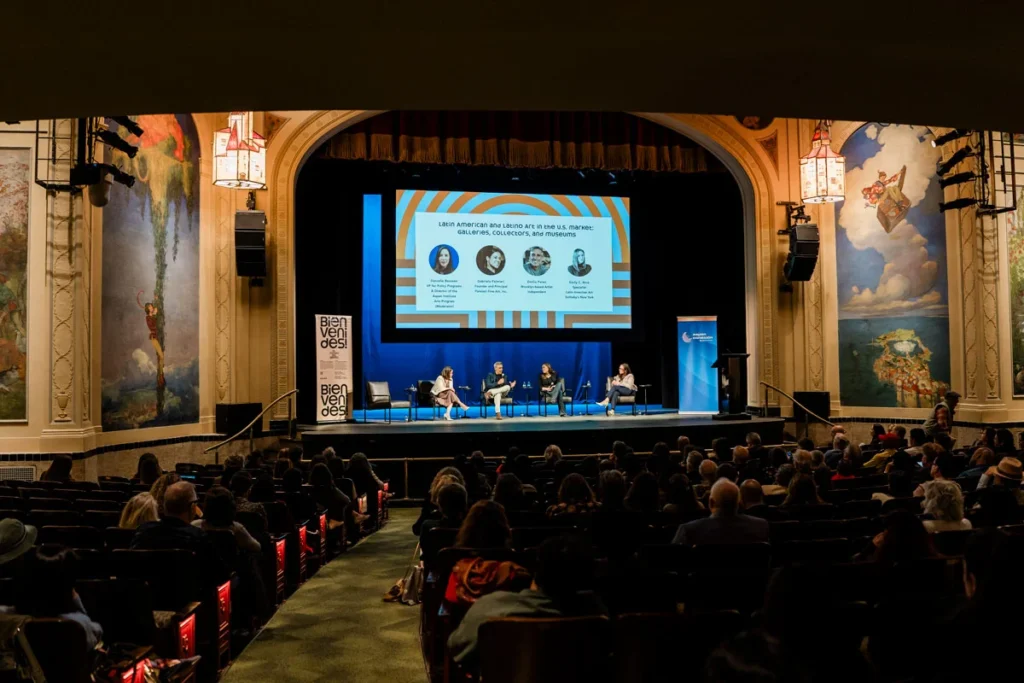
This past spring, the hallowed halls of El Museo del Barrio in New York City became the epicenter of a critical dialogue regarding the future of the American art landscape. The half-day symposium, titled “The Rise of the U.S. Latino Art Market: Lessons from Latin America,” brought together a powerhouse cohort of artists, museum directors, collectors, and market strategists to address a fundamental question: How can the current surge in visibility for Latinx art be translated into durable, structural, and equitable market success?
The event, which featured ARTnews as the official media sponsor, was conceived and organized by Aspen Conexión—the influential division of the Aspen Institute formerly known as “Latinos & Society.” The symposium underscored the notion that Latinx influence is not merely a domestic narrative but a hemispheric force shaping the global economy, culture, and financial systems.
The Mandate for Structural Change
The symposium opened with a clear-eyed assessment of the current state of affairs. El Museo board chair Karla Harwich characterized the growing recognition of U.S. Latinx artists as a “profound cultural shift,” yet she was quick to temper the optimism with a necessary call to action. “There is still significant work to be done to ensure that this influence is matched by sustained institutional, equitable market investment, and long-term infrastructure,” Harwich noted.
This sentiment was echoed by Pilar Frank O’Leary, executive director of Aspen Conexión, who framed the current moment as “the Bad Bunny era”—a shorthand for the unprecedented reach of Latino culture in the global mainstream. However, the event’s guiding philosophy, as articulated by El Museo’s executive director Patrick Charpenel, remained centered on the challenge of longevity: “At El Museo del Barrio, we think deeply about how to translate cultural moments into structural change. What does it take to move from moments of visibility to lasting recognition?”
Chronology of a Growing Market
To answer these questions, organizers urged the audience to look south. Diego Deleersnyder, managing director of Aspen Conexión, noted that the rise of Latin American art over the past two decades was not a stroke of serendipity; it was the result of decades of “intentional” construction involving galleries, collectors, and fairs. In contrast, the U.S. Latinx market, he argued, is currently navigating an “earlier chapter of that story.”
Market Success as a Blueprint
The symposium featured a compelling case study by Diego Costa Peuser, founder of the Pinta Group. Peuser, who has been instrumental in organizing art weeks across Latin America and the U.S., detailed the mechanics of building an art ecosystem from the ground up. His strategy involves a hyper-localized approach, such as the Pinta fairs in Santo Domingo and Panama City, which aim to foster specific regional identities that eventually feed into the international market. “The growth of Latin American art does not occur spontaneously,” Peuser emphasized. “It is the product of sustained work.”
Auction Records and Institutional Shifts
During the first panel, moderated by the Aspen Institute’s Danielle Baussan, expert voices like adviser Gabriela Palmieri and Sotheby’s specialist Emily C. Nice highlighted the undeniable momentum in the secondary market. Palmieri pointed to the staggering trajectory of Leonora Carrington’s market, which saw her auction record jump from $3.3 million in 2022 to $25.8 million in 2024.

This market enthusiasm is increasingly matched by institutional prestige. Palmieri noted the repositioning of Wifredo Lam’s The Jungle (1942–43) at the Museum of Modern Art—moving from a peripheral hallway location to a central, triumphant position in the artist’s retrospective. Emily C. Nice provided further evidence, citing the record-breaking $54.7 million sale of Frida Kahlo’s El Sueño (La cama) at Sotheby’s in 2025. “Context is key, placement is seminal, and excitement is real,” Palmieri concluded.
The Artist’s Perspective: Beyond the Label
While market data provides a backbone for growth, the artist’s experience remains a nuanced reality. Emilio Perez, a contemporary painter whose work is currently featured in the Buffalo AKG survey Let Us Gather in a Flourishing Way, offered a poignant counter-perspective to the focus on labels.
“Given my background, of course, I’m always going to be Latino—that’s who I see when I look in the mirror,” Perez shared. However, he cautioned that when it comes to the reception of art, labels can occasionally act as a constraint. He advocated for a focus on the work itself and the importance of professional persistence. “For any artist, the important thing is showing up every day, and when those opportunities happen, when those doors open, you have to walk through them.”
Decolonizing the System: Visibility vs. Invisibility
The afternoon’s second panel, “Decolonizing the Art System,” shifted the focus from the auction block to the museum gallery. Moderated by the author, this session featured Silvia Cubiñá (Bass Museum), Irene Gelfman (Pinta Group), Patricia Hanna (Jorge M. Pérez Collection), and Susanna V. Temkin (El Museo del Barrio).
The Role of Private and Public Collections
Patricia Hanna highlighted the paradox of modern collecting: “We talk a lot about the market, sales, record sales, and these works entering collections, but these works need to be seen.” She noted that the Jorge M. Pérez Collection addresses this through El Espacio 23, which stages annual exhibitions designed to insert Latinx artists into a global discourse.
Susanna V. Temkin reinforced this by pointing to the success of La Trienal at El Museo. “It was only after being a part of exhibitions here that I realized what a platform El Museo in particular can be for the visibility of Latin American and Latino artists,” Temkin noted, adding that institutional validation often leads to immediate acquisitions by other major museums.
The Problem with Unfair Comparisons
Silvia Cubiñá provided a necessary reality check regarding the "lessons from Latin America" framework. She noted that comparing the Latin American market to the U.S. Latinx market is structurally difficult due to scale. “The population size is tenfold,” she observed, noting that each Latin American country possesses its own established ecosystem of museums and galleries. She argued that while we can learn from these models, the U.S. must develop its own specific infrastructure, a mission that El Museo del Barrio has pioneered for decades.

Implications for the Future: A Call to Action
The symposium reached its emotional and intellectual zenith with a keynote address by E. Carmen Ramos, chief curatorial and conservation officer of the National Gallery of Art. Ramos brought a lifetime of curatorial experience to the stage, grounding her remarks in the belief that “equal opportunity, curiosity, pride, and joy” are the catalysts for future progress.
However, she did not shy away from the hard truths. “Our field, while undoubtedly better than in the not-too-distant past, still fails to fully recognize the realities facing many Latinx artists and institutions,” Ramos stated. She explicitly called out the “profound underrepresentation” of Latinx figures in leadership roles and the tendency for their contributions to be “widely overlooked.”
Ramos emphasized that the solution requires a coalition. Curators cannot do it alone; they need the partnership of galleries, collectors, and critics. “The stories we revisited, the artists we uplifted, the institutions we recognized—all reminders that progress is never incidental,” she concluded. “It is built over the long haul through conviction, collaboration, and the courage to imagine something better.”
Conclusion: The Path Ahead
As the symposium concluded, the mood was one of cautious optimism. Aspen Conexión’s Diego Deleersnyder summarized the day’s findings by acknowledging that the “talent is here” and the “economic momentum is significant.”
The event served as a testament to the idea that the U.S. Latinx art world is at a pivotal junction. By moving beyond the initial excitement of “moments” and focusing on the unglamorous, long-term work of building institutions, fostering collectors, and ensuring the accurate historical documentation of these artists, the sector stands to redefine the American canon. As the attendees filed out of the Teatro space, the consensus was clear: the conversation had only just begun. The challenge now lies in ensuring that these discussions translate into the permanent, equitable, and vibrant infrastructure that the next generation of Latinx artists demands.