Introduction: The Invisible Shield of Global Trade
In the vast, ungoverned stretches of the world’s oceans, where sovereignty often blurs into international waters, the safety of mariners and the security of global supply chains rely on a complex network of vigilance. Central to this defense architecture is the International Chamber of Commerce (ICC) International Maritime Bureau (IMB) Piracy Reporting Centre (PRC).
Since its inception in 1991, the PRC has evolved from a nascent monitoring initiative into the global maritime industry’s primary nerve center for incident reporting and emergency coordination. As more than 80% of global trade is transported by sea, the stability of maritime corridors is not merely a regional concern but a fundamental pillar of the global economy. This article explores the mechanics, the data-driven methodology, and the enduring necessity of the IMB PRC in the modern era of maritime threat management.
The Genesis and Evolution of the PRC (1991–Present)
A Response to Rising Tide
The late 1980s and early 1990s witnessed a sharp, alarming uptick in maritime piracy, particularly in Southeast Asia and parts of the Indian Ocean. With piracy evolving from sporadic theft into sophisticated, organized criminal enterprises, the international shipping community recognized that isolated reporting was insufficient.
In 1991, the ICC established the IMB Piracy Reporting Centre in Kuala Lumpur, Malaysia. The objective was simple but ambitious: to provide a centralized, 24-hour, 365-day-a-year point of contact for ships experiencing distress. By creating a unified portal for reporting, the IMB transformed individual grievances into actionable intelligence.
Operational Methodology
The PRC functions as a proactive intermediary. When a shipmaster reports a suspicious approach, an attempted boarding, or an active pirate attack, the PRC triggers a multi-layered response:
- Immediate Verification: The PRC confirms the status of the vessel and the nature of the threat.
- Alert Broadcasts: Utilizing satellite communications and digital networks, the PRC issues warnings to all vessels in the vicinity, creating an "early warning" buffer that allows other crews to heighten security postures.
- Agency Coordination: The PRC acts as a liaison, relaying information to relevant regional maritime security agencies, coast guards, and navies. This rapid information flow is often the difference between a successful intervention and a tragic outcome.
Chronology of Maritime Threat Management
The history of the PRC is a timeline of adaptation.
- 1991–2000: The Southeast Asian Focus. During its first decade, the PRC’s primary mission was navigating the complex jurisdictional waters of the Malacca and Singapore Straits.
- 2001–2012: The Somali Crisis. This era defined the modern PRC. As piracy off the Horn of Africa reached epidemic proportions, the PRC became the primary data clearinghouse for global naval task forces (including EUNAVFOR and Combined Maritime Forces). The data gathered during this period was instrumental in the implementation of the Best Management Practices (BMP), which effectively neutralized the Somali piracy threat.
- 2013–2020: The Rise of the Gulf of Guinea. The center shifted its focus to West Africa, where piracy transitioned from simple theft to violent kidnapping-for-ransom operations. The PRC’s reporting proved vital in pressuring regional governments to enhance their legislative frameworks.
- 2021–Present: The Digital and Hybrid Era. Today, the PRC monitors not just physical threats, but the nexus of maritime crime with geopolitical instability, cyber threats to port infrastructure, and the resurgence of small-scale maritime robbery in under-policed coastal zones.
Supporting Data: The Power of Intelligence
The IMB PRC does more than respond to emergencies; it documents the "pulse" of maritime crime. Every incident reported—whether a minor pilferage while at anchor or a high-seas hijacking—is meticulously cataloged.
Why Data Matters
The data compiled by the PRC is the foundation for all maritime security policy. By analyzing trends, the PRC can identify "hotspots." For instance, if data shows a spike in attempted boardings off the coast of a specific country during night hours, the IMB publishes these findings. This allows shipping companies to adjust their route planning, harden their vessels with razor wire or water cannons, and brief their crews accordingly.
The 2025 Reporting Cycle
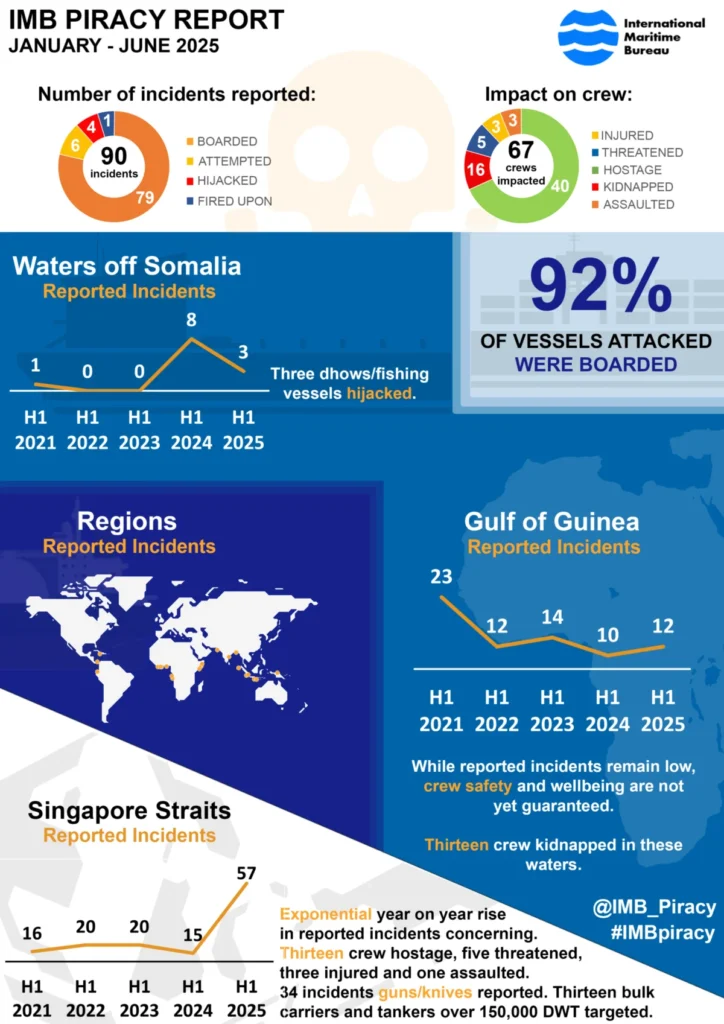
The latest Piracy and Armed Robbery Against Ships report, covering January to June 2025, serves as a crucial snapshot of the current threat landscape. These reports are more than mere statistics; they are the evidence base used by the International Maritime Organization (IMO) and individual governments to justify the allocation of patrol assets and naval resources.
(Interested parties can access the full report via the ICC-CCS portal.)
Official Responses and Strategic Implications
The "Reporting Gap" Challenge
Despite the efficiency of the PRC, a significant challenge remains: the "reporting gap." Many shipmasters, under pressure from commercial interests or fearing delays and bureaucratic entanglement, often fail to report "near-misses" or suspected incidents.
The IMB has repeatedly emphasized that reporting is not a burden; it is a duty. Without an accurate record of attempted incidents, authorities cannot justify the deployment of security resources. If a region appears "safe" on paper because incidents go unreported, patrols are withdrawn, leaving the area vulnerable to an escalation in violence.
Implications for Global Trade
The economic implications of maritime insecurity are profound. When piracy increases, insurance premiums for vessels entering those corridors skyrocket. These costs are ultimately passed down the supply chain, inflating the price of consumer goods, fuel, and raw materials. By providing the intelligence necessary to prevent attacks, the IMB PRC acts as a stabilizer for global commodity prices.
Cooperation with Law Enforcement
The PRC’s relationship with law enforcement is symbiotic. The Bureau does not have its own police force, but it provides the "connective tissue" that allows diverse international agencies to speak the same language. By standardizing the format of incident reporting, the PRC ensures that a report filed by a captain in the Gulf of Guinea is as useful to an Interpol investigator as it is to a local coast guard officer.
Looking Ahead: The Future of Maritime Security
As we move deeper into the 21st century, the nature of piracy is changing. The integration of Unmanned Aerial Vehicles (UAVs) for reconnaissance by criminal groups, the use of cyber-attacks to disable shipboard security systems, and the intersection of maritime crime with transnational terrorism require a new level of vigilance.
The IMB Piracy Reporting Centre remains committed to this evolution. By leveraging modern communication technologies and fostering deeper cooperation between the public and private sectors, the Bureau is ensuring that the "high seas" remain a domain of trade rather than a theater of conflict.
A Call to Action for Stakeholders
The success of the PRC is inherently dependent on the participation of the maritime community. Shipowners, masters, and security officers are the "eyes and ears" of the ocean. The IMB urges all stakeholders to:
- Report Every Incident: Even if the event seems minor, the data is essential.
- Utilize IMB Resources: Regularly consult the PRC reports to stay informed of regional security threats.
- Engage in Proactive Security: Invest in crew training and vessel hardening, utilizing the guidance provided by the IMB and other international maritime bodies.
Contact Information
For those requiring assistance, seeking to report an incident, or interested in deep-dive data analysis, the IMB Piracy Reporting Centre remains available 24/7.
Michael Howlett
Director, ICC International Maritime Bureau
Tel: +44 207 423 6960
Email: [email protected]
The work of the IMB PRC is a testament to the fact that while the ocean is vast and often lawless, it is not beyond the reach of collective action and human vigilance. As the world continues to rely on the blue economy, the IMB will remain the silent, steady sentinel standing between the mariner and the threat of piracy.
Disclaimer: This article is intended for informational purposes. For the latest maritime security updates and to request the 2025 Jan-June Piracy and Armed Robbery Against Ships report, please visit the official ICC-CCS website.