Introduction: The Sentinel of the Oceans
In the vast, interconnected network of global trade, the maritime domain remains the circulatory system of the modern economy. Over 80% of global trade is transported by sea, making the safety of shipping lanes a matter of international economic stability. However, the open ocean is also a theater for persistent, evolving threats. Standing at the nexus of this challenge is the International Maritime Bureau (IMB) Piracy Reporting Centre (PRC).
Since its inception in 1991, the IMB PRC has evolved from a nascent monitoring initiative into the world’s most critical 24-hour nerve center for reporting and mitigating piracy and armed robbery. By bridging the gap between distressed vessels and regional authorities, the Centre serves as a vital safeguard for seafarers and the global supply chain. As maritime criminal methodologies grow increasingly sophisticated, the role of the IMB PRC has never been more consequential.
The Evolution of the IMB PRC: A Chronology of Resilience
To understand the significance of the IMB PRC, one must look at the historical context of maritime insecurity.
The Early Years (1991–2000)
In the late 20th century, piracy was often viewed as a regional nuisance rather than a systemic threat. However, as trade volumes surged, so did the frequency of attacks. In 1991, the International Chamber of Commerce’s (ICC) International Maritime Bureau established the PRC in response to a spike in incidents in the Southeast Asian corridor. This marked the first time a centralized, private-sector-led entity was dedicated to documenting and coordinating responses to maritime crime.
The Era of Somali Piracy (2005–2012)
The mid-2000s saw the emergence of the Somali piracy crisis, which captured global headlines as massive commercial tankers were hijacked for ransom. During this period, the IMB PRC proved its mettle. It became the primary node for relaying critical information to naval task forces and shipping companies. The data collected by the Centre during these years provided the intelligence necessary for the development of "Best Management Practices" (BMP), which fundamentally changed how ships defend themselves against boarding.
The Modern Frontier (2013–Present)
In the current era, the threat profile has shifted. While the Somali threat was suppressed by naval presence, new hotspots have emerged in the Gulf of Guinea, the Singapore Strait, and parts of Latin America. The IMB PRC has pivoted to provide real-time digital alerts, integrating satellite tracking and rapid communication protocols to ensure that warning broadcasts reach vessels in high-risk zones within minutes of a reported sighting.
Supporting Data: Understanding the Landscape of Modern Piracy
The IMB PRC’s efficacy is built upon its rigorous data collection. By maintaining an exhaustive, incident-by-incident database, the Centre provides the maritime industry and international policy-makers with a granular view of the state of global piracy.
The 2025 Snapshot
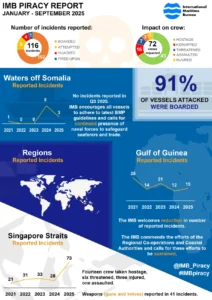
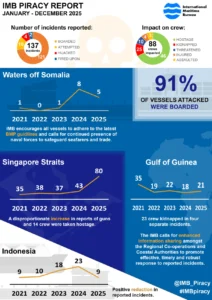
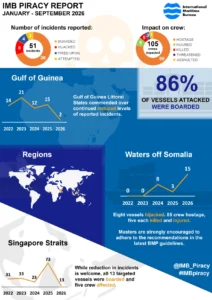
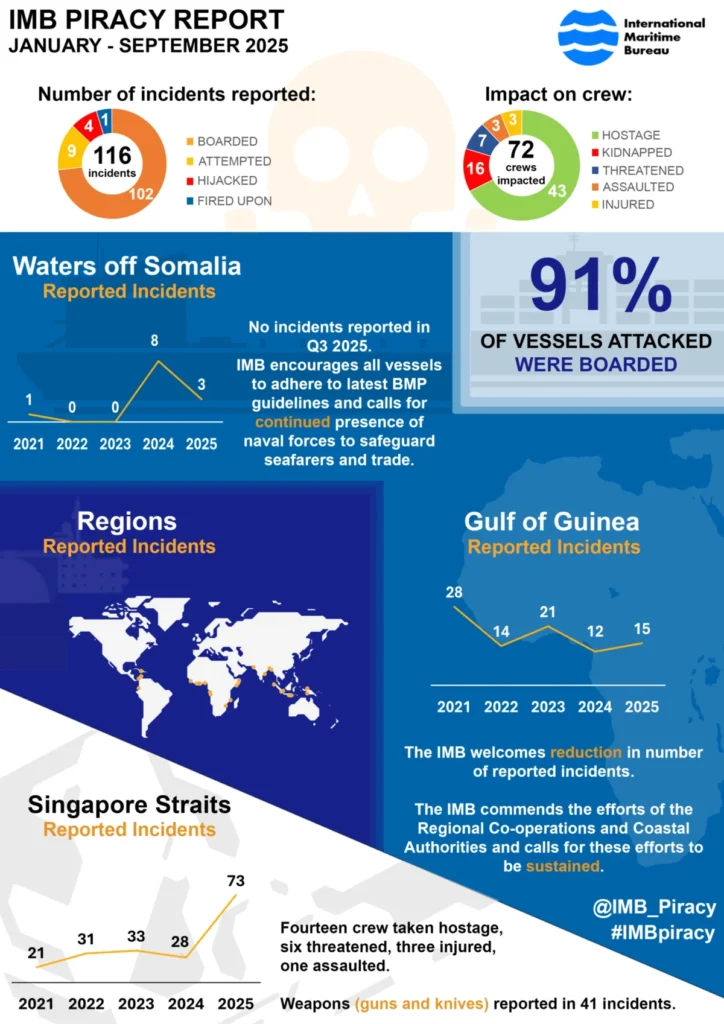
The most recent report—covering the period from January to September 2025—highlights the persistent nature of these threats. According to the data, piracy is no longer just about high-seas hijacking; it is increasingly characterized by opportunistic armed robbery while vessels are at anchor or underway in busy territorial waters.
Key data points from the 2025 reporting period include:
- The Proliferation of Armed Robbery: A rise in low-level, high-frequency incidents involving knives and machetes, particularly in regions where economic instability creates a vacuum of law enforcement.
- Geographic Shifts: While some traditional hotspots have seen a decline due to increased regional patrols, new "soft targets" have emerged in previously quiet corridors.
- Reporting Rates: The IMB emphasizes that the number of reported incidents is likely only a fraction of the total, as many minor robberies go unreported due to fears of bureaucratic delays or increased insurance premiums.
This data serves as a barometer for maritime safety. By analyzing these trends, the IMB PRC provides insurers, shipping companies, and governments with the intelligence required to adjust their risk assessments and route planning.
Official Responses and Strategic Coordination
The IMB PRC does not operate in a vacuum. Its core strength lies in its ability to facilitate communication between the private sector and public authorities. When a ship reports an incident to the PRC, the Centre triggers a multi-layered response protocol:
- Immediate Validation: The PRC verifies the incident and assesses the level of threat.
- Broadcasting and Alerting: Through its global network, the Centre issues immediate "Warning Broadcasts" to vessels in the vicinity and alerts maritime security centers and coast guards in the relevant region.
- Coordination: The PRC acts as a liaison, ensuring that local law enforcement and, where necessary, international naval assets are provided with the exact coordinates and description of the perpetrators.
Michael Howlett, Director of the ICC International Maritime Bureau, has consistently advocated for a more proactive stance. "Reporting is not just an administrative duty; it is a defensive act," Howlett notes. "Every incident reported to the PRC is a data point that justifies the allocation of security resources. Without that data, authorities remain blind to the evolving patterns of criminal activity."
The Centre’s work has garnered support from the International Maritime Organization (IMO) and various naval coalitions, which utilize the IMB’s real-time alerts to position assets in high-risk areas.
Implications: The High Cost of Silence
The implications of piracy extend far beyond the immediate trauma experienced by crews. A single successful hijacking can lead to massive disruptions in global logistics, rising insurance premiums, and the potential for environmental disasters if a vessel is left adrift or grounded during an attack.
Economic and Humanitarian Impacts
The human cost is often the most overlooked. Seafarers are the "invisible heroes" of the global supply chain, and being subjected to the threat of kidnapping or violence causes long-term psychological distress. When piracy incidents rise, the cost of maritime insurance for vessels transiting these areas skyrockets, a cost that is ultimately passed down to consumers.
The Call for Transparency
The IMB PRC urges all shipmasters to prioritize transparency. There is a persistent temptation to withhold reports to avoid "stigmatizing" a vessel or complicating port operations. However, the IMB argues that this culture of silence only empowers criminal syndicates. By reporting all incidents, owners ensure that the global maritime community is kept informed, allowing for collective security measures that protect the entire industry.
Looking Forward: The Future of Maritime Security
As the shipping industry moves toward increased digitalization and autonomous vessels, the nature of piracy will continue to change. The IMB PRC is currently exploring how Artificial Intelligence and advanced satellite surveillance can be integrated into its reporting framework to provide even faster, more accurate threat intelligence.
However, technology is only part of the equation. The human element—the commitment of masters to report, the dedication of the PRC staff to analyze, and the resolve of international authorities to act—remains the bedrock of maritime security.
Conclusion: A Call to Action
The January to September 2025 Piracy and Armed Robbery Against Ships report stands as a testament to the ongoing challenges faced by those who keep our world supplied. It is a vital document for any stakeholder in the maritime industry, serving as both a historical record and a forward-looking guide for risk management.
The IMB Piracy Reporting Centre continues to stand as the global watchdog of the seas. For shipowners, captains, and maritime stakeholders, the message is clear: the safety of our oceans depends on the vigilance of those who traverse them. By engaging with the IMB PRC, the industry can ensure that the high seas remain open, safe, and secure for the global commerce that binds us all.
For more information, please contact:
Michael Howlett
Director, ICC International Maritime Bureau
Tel: +44 207 423 6960
Email: [email protected]
To review the full analysis of recent maritime trends, download the January to September 2025 Piracy and Armed Robbery Against Ships report via the official ICC-CCS portal.