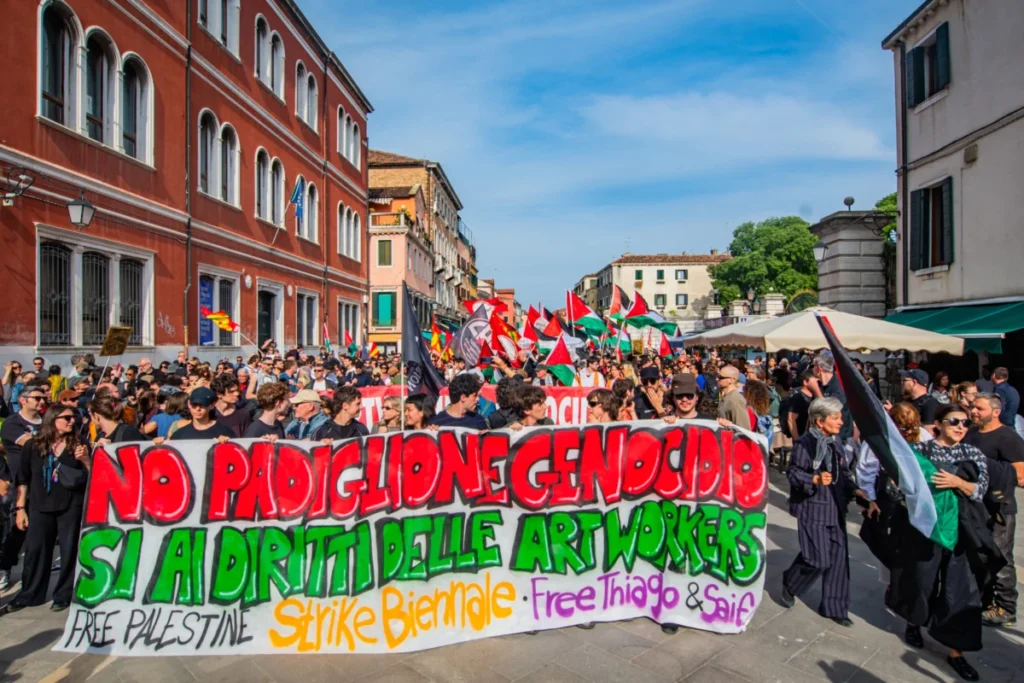
The prestigious Venice Biennale, long considered the "Olympics of the art world," has been transformed into a theater of profound political confrontation. In a move unprecedented in the event’s 129-year history, the international art community witnessed a sweeping, coordinated strike this week, as thousands of protestors and participating artists descended upon the Venetian thoroughfares to denounce the presence of Israel at the exhibition. The protest, which effectively paralyzed large swaths of the Biennale, saw 27 of the 100 national pavilions shutter their doors in a high-stakes display of solidarity with Palestine.
The Anatomy of the Strike
The protest was not a spontaneous outburst but a highly organized, international effort spearheaded by the Art Not Genocide Alliance (ANGA). Working in concert with Italian activist collectives—including Biennalocene, Mi Riconosci?, Sale Docks, and Vogliamo Tutt’altro—the alliance successfully executed a 24-hour strike that crippled the Biennale’s operations.
The list of participating countries whose pavilions closed—either fully or partially—is extensive and reflects a growing global divide within the cultural sector. According to reports from Artnews and the New York Times, the affected pavilions included those of Austria, Belgium, Egypt, Japan, the Netherlands, South Korea, Cyprus, Ecuador, Estonia, Finland, France, Great Britain, Iceland, Lebanon, Luxembourg, Poland, Portugal, Switzerland, Turkey, and Ukraine.
At many of these sites, the silence was symbolic. Austria’s pavilion, for instance, displayed a sign clarifying that individual team members had chosen to participate in the labor action. Other pavilions were draped in signage reading, "We Stand with Palestine," transforming the architectural landmarks of the Giardini and Arsenale into sites of political dissent.
Chronology of the Escalation
The tensions surrounding this year’s Biennale did not emerge in a vacuum; they are the culmination of a "stormy" several months marked by intense lobbying and public outcry.

- Pre-Opening Phase: Since early 2026, artists, curators, and cultural workers have repeatedly petitioned the Biennale board to exclude both Israel and Russia, citing, respectively, the sustained military operations in Gaza and the ongoing war in Ukraine. Calls for the exclusion of the United States were also voiced by various factions, citing the country’s perceived role in global military interventions.
- May 5th: The preview opening of the Biennale was immediately met with protests. The dissident Russian collective Pussy Riot was among the first to make a visible stand, signaling that the event would be a platform for confrontation rather than mere aesthetic contemplation.
- The Jury Crisis: The situation reached a breaking point when an international prize jury, handpicked by curator Koyo Kouoh, announced they would not consider for the prestigious Golden Lions any artists or pavilions representing nations whose leaders faced accusations of crimes against humanity by the International Criminal Court. In a stunning turn of events, the entire jury resigned en masse just days after this declaration, throwing the award process into chaos.
- The Day of Action: On the day of the strike, the atmosphere in Venice turned volatile. While the main exhibition, curated by Kouoh and titled "In Minor Keys," initially remained open, the mood shifted rapidly. By the afternoon, the Arsenale—a key venue—was shut tight as riot police were deployed to manage the growing crowds.
The Israeli Pavilion and Security Tensions
While many nations chose to close their pavilions in protest, the Israeli pavilion itself remained closed for the opening of an exhibition featuring work by Belu-Simion Fainaru. The scene outside the pavilion was emblematic of the event’s broader instability: armed police officers stood guard, at one point clashing with demonstrators. This physical manifestation of the conflict underscores the difficulty of maintaining a "neutral" space for art in the shadow of active warfare.
Official Responses and the Rhetoric of Division
The ideological rift between the Biennale’s leadership and the protesting collective is stark. Biennale president Pietroangelo Buttafuoco issued a statement earlier this week, asserting that the event must remain a sanctuary for international dialogue. "The Biennale should be a place where the world comes together," Buttafuoco stated, arguing that the event should be inclusive and free from the pressures of censorship, regardless of the political climate of the nations involved.
Conversely, the organizers of the strike framed their actions as a moral imperative rather than an act of censorship. In a joint statement, the coalition of activist groups declared: "No artist or cultural worker should be asked to share a platform with a state perpetrating genocide." This framing shifts the discourse from "artistic freedom" to "complicity," effectively forcing every participating nation to take a public stance.
Implications for the Global Art Market
The Venice Biennale is not merely a cultural event; it is a massive economic engine for the global art market. The disruption caused by this strike carries significant long-term implications.
1. The Death of Neutrality
For decades, the Biennale has operated on the premise that art transcends the borders and policies of the nation-state. This week’s events suggest that such a premise is no longer tenable in the eyes of the current generation of artists. The "nation-pavilion" model, a relic of the 19th-century nationalist spirit, is being interrogated by those who see it as an endorsement of state policy.

2. A Precedent for Future Protests
By successfully shuttering over a quarter of the pavilions, ANGA has set a precedent. Future iterations of the Biennale, and perhaps other global art fairs, will now be seen as potential battlegrounds. Institutions will be forced to develop more robust crisis-management strategies, and the selection process for participating countries may come under unprecedented scrutiny.
3. The Future of the Golden Lions
The mass resignation of the prize jury signals a profound crisis of legitimacy. When the arbiters of artistic excellence refuse to engage with the political realities of the nations they are judging, the awards themselves risk becoming irrelevant. The Biennale will now have to address how to reconcile the prestige of the Golden Lions with the demands of the international community for accountability.
4. Cultural Diplomacy vs. Boycott
The Italian Culture Minister’s earlier boycott of the event due to Russia’s presence served as an early warning that the Biennale was losing its status as a diplomatic "safe harbor." When state actors begin boycotting their own events, and artists begin striking against their host nations, the very infrastructure of cultural diplomacy begins to fray.
Conclusion: A Turning Point
As the 24-hour strike concludes, the Venice Biennale finds itself at a crossroads. The images of boarded-up pavilions, police lines in the Arsenale, and empty galleries serve as a powerful indictment of the status quo. While the Biennale will continue, the events of this week have irrevocably altered its character. It is no longer possible to walk through the Giardini without acknowledging the weight of the politics that govern the world outside. The question remains whether the Biennale will evolve into a more politically engaged forum or if it will continue to struggle under the weight of the very geopolitical tensions it once claimed to transcend. For now, the art world remains in a state of reflection, grappling with the uncomfortable truth that in a time of global crisis, silence—even in a gallery—is often a choice.