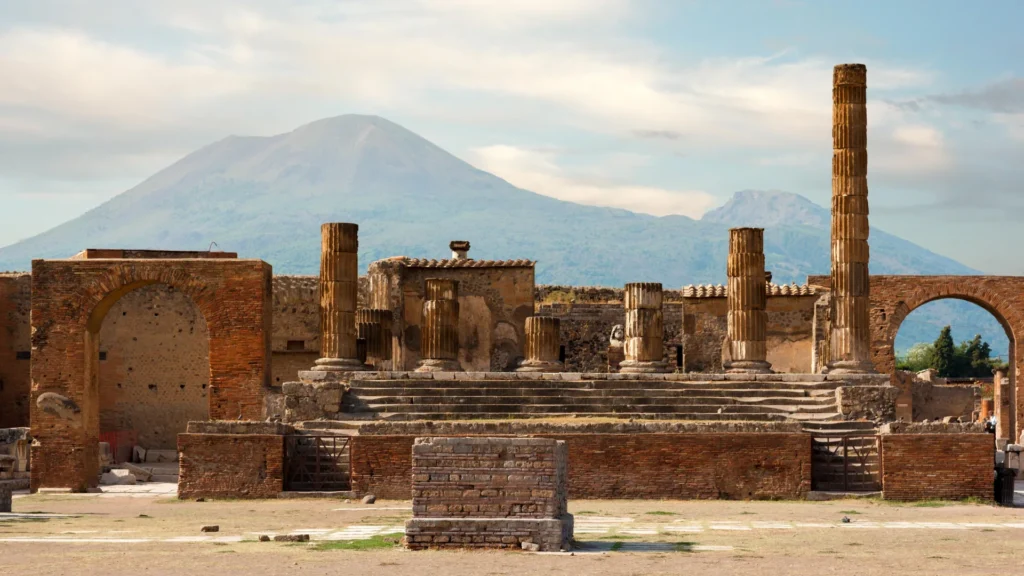
Nearly two millennia ago, the skies over the Bay of Naples turned to ash. Pliny the Younger, observing the cataclysm from across the water, chronicled the fury of Mount Vesuvius as it entombed the Roman cities of Pompeii and Herculaneum. While his letters served as a poignant lament for his uncle, Pliny the Elder, and a record of human tragedy, they have recently taken on a new, scientific significance.
In a landmark study published in Science Advances, researchers from the Berkeley Geochronology Center (BGC), UC Berkeley, and the University of Padua have utilized the historical record of this ancient eruption to recalibrate one of the most vital tools in geology: argon-argon dating. By anchoring their radioactive measurements against the precise historical timeframe provided by Pliny’s observations, the team has achieved a level of precision that promises to reshape our understanding of everything from prehistoric mass extinctions to the risk assessments of modern, active volcanoes.
The Convergence of History and Hard Science
At the heart of the study is a desire to harmonize the "clocks" used to measure the deep past. Geologists, paleontologists, and archaeologists rely on various radioactive decay methods to date the history of the Earth, yet these methods occasionally produce conflicting results. The argon-argon technique—which measures the decay of potassium-40 into argon-40—is a cornerstone of this field. However, to be truly accurate, it requires a "gold standard" calibration point.
"If you want to put together the eruptive history of a volcano in relatively recent time, precision and accuracy really count," explains Paul Renne, study leader and director of the Berkeley Geochronology Center. "The study shows that you can achieve that kind of highly useful precision and accuracy into the historical realm."
By using the 79 CE eruption as a benchmark, the team has successfully reduced the uncertainty in argon-argon dating to less than 1%, a milestone researchers have been chasing for decades.
A Chronology of Discovery: From Oplontis to the Lab
The road to this breakthrough began long before the recent publication. In 1998, co-author Andrea Marzoli of the University of Padua collected pristine samples of sanidine—a potassium-rich volcanic mineral—from Oplontis, a Roman site buried by the Vesuvius eruption. These samples were unique because they originated from the earliest phase of the eruption.
In the complex plumbing of a stratovolcano, magma is not a uniform slurry. As it sits in the chamber, elements sort themselves by density and solubility. Potassium, being highly soluble, tends to concentrate in the upper layers of the magma chamber, meaning it is among the first material expelled when a volcano erupts. Consequently, the pumice found at the base of the Vesuvius deposits contains the most reliable potassium signatures for dating.
Despite the obvious potential of these samples, they remained in storage for nearly three decades. It was only recently that a team of Berkeley graduate students—Caroline Hasler, Anthony Fuentes, and Andy Tholt—working with postdoctoral fellow Jack Carter, recognized that the evolution of mass spectrometry and neutron irradiation techniques allowed for a much higher degree of resolution than the initial 1997 analysis of Vesuvius samples.
The team subjected these samples to rigorous testing, placing the eruption at 1,938 ± 13 years before their 2025 analysis. When compared to the historical record—1,946 years old—the results demonstrated a staggering 0.4% accuracy and 0.7% precision.
Supporting Data: Refinement through Rigor
To establish the eruption as a valid benchmark, the team had to address a lingering historical controversy. Some scholars have argued that the eruption occurred later than the traditional August 24 date, citing a coin found in the ruins of Pompeii that they believed could only have been minted in September.
Graduate student Caroline Hasler undertook a deep dive into numismatic records, comparing the controversial coin to other Roman currency from the same era. Her analysis concluded that the coin was likely minted before September, effectively silencing the argument for a later date and providing a stable two-month window of uncertainty for the geological calibration.
This historical constraint allowed the researchers to recalibrate the half-life of potassium-40, the core variable in the argon-argon equation. The team derived a new half-life value of 12.044 billion years (± 0.088 billion), which is twice as precise as the previous value, which had been derived largely from theoretical nuclear physics rather than empirical geologic observation.
Official Responses and Methodology
The success of the project relied on a "concerted effort" of modern technology and refined statistical modeling. Bill Cassata, a co-author on the study, was instrumental in developing the analytical strategy.
The methodology hinges on the process of neutron irradiation. By exposing rock samples to neutrons, researchers convert the non-radioactive potassium-39 into argon-39. By then measuring the ratio of argon-40 (the product of radioactive decay) to the newly created argon-39, scientists can determine the age of the sample.
"They came up with a Bayesian scheme—published in 2025—to intercalibrate these two most important geochronometers that we have, which have not been giving us consistent results over the years," Renne noted, referring to the reconciliation of argon-argon dating with the uranium-lead method.
The integration of these methods represents a significant shift toward a unified geological timeline. Rather than treating dating methods as isolated silos, the Berkeley team is advocating for a Bayesian approach that combines raw observations from multiple radioactive decay systems to create a more robust and self-consistent model of Earth’s history.
Broader Implications for Science and Society
The implications of this research extend far beyond the history of Roman Italy. By tightening the precision of these "radioactive clocks," geologists can now establish causality with much greater confidence.
Mapping Extinction Events
Renne’s previous work utilized these same dating techniques to link a meteor impact to the extinction of the dinosaurs 66 million years ago. By proving that the impact and massive volcanic eruptions in India occurred within a narrow window of time, the team bolstered the theory of a "one-two punch" that decimated the Cretaceous biosphere. With even greater precision, scientists can now analyze whether other major extinction events in the fossil record align with rapid geological or celestial triggers.
Assessing Volcanic Hazard
For modern society, the most pressing application is risk assessment. Volcanoes such as those near Mexico City, Naples, and the Indonesian region of Yogyakarta remain active threats to millions of people. Understanding the "eruptive tempo" of these volcanoes—how frequently they erupt and what patterns precede a major event—requires precise dating of past deposits. Improved calibration allows researchers to create more accurate hazard maps, providing urban planners and emergency responders with better data to prepare for future disasters.
A Unifying Standard
Perhaps most ambitiously, the team hopes that the improved argon-argon method will serve as a foundational anchor for radiocarbon dating. While radiocarbon is the gold standard for organic materials under 55,000 years old, it is subject to fluctuations in atmospheric carbon. By using argon-argon as an independent, rock-based calibration tool, researchers can correct for these fluctuations, effectively creating a more synchronized timeline for the entirety of human history and the late Pleistocene.
As Renne concluded, the goal is to "unify as many geologic dating methods as we can." By looking back at the ashes of Pompeii, scientists have not only honored the record left by Pliny the Younger but have also secured a more reliable window into the deep, turbulent history of the planet we call home. Through the union of ancient chronicles and the precise measurement of radioactive decay, we are closer than ever to mapping the exact tempo of Earth’s evolution.