Executive Summary: A Significant Step-Out
Yukon Metals Corp. (CSE: YMC, FSE: E770, OTCQB: YMMCF) has announced encouraging assay results from hole BR26-007, the inaugural drill hole of its 2026 exploration campaign at the Birch Copper-Gold Project. Located 65 kilometres northeast of Burwash Landing in the Yukon, the project is rapidly emerging as a high-potential exploration target.
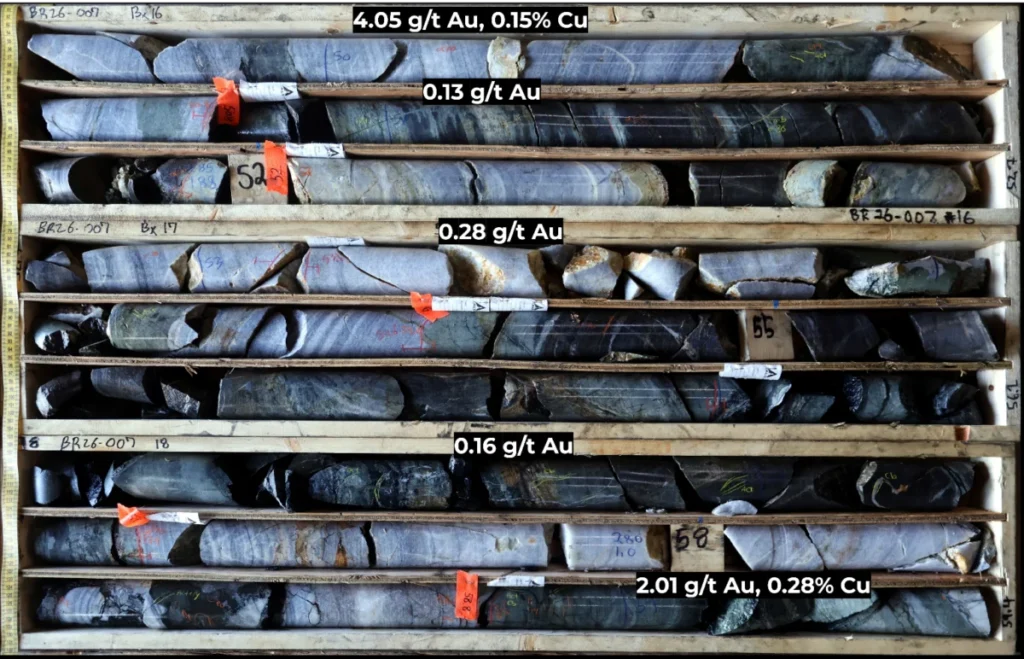
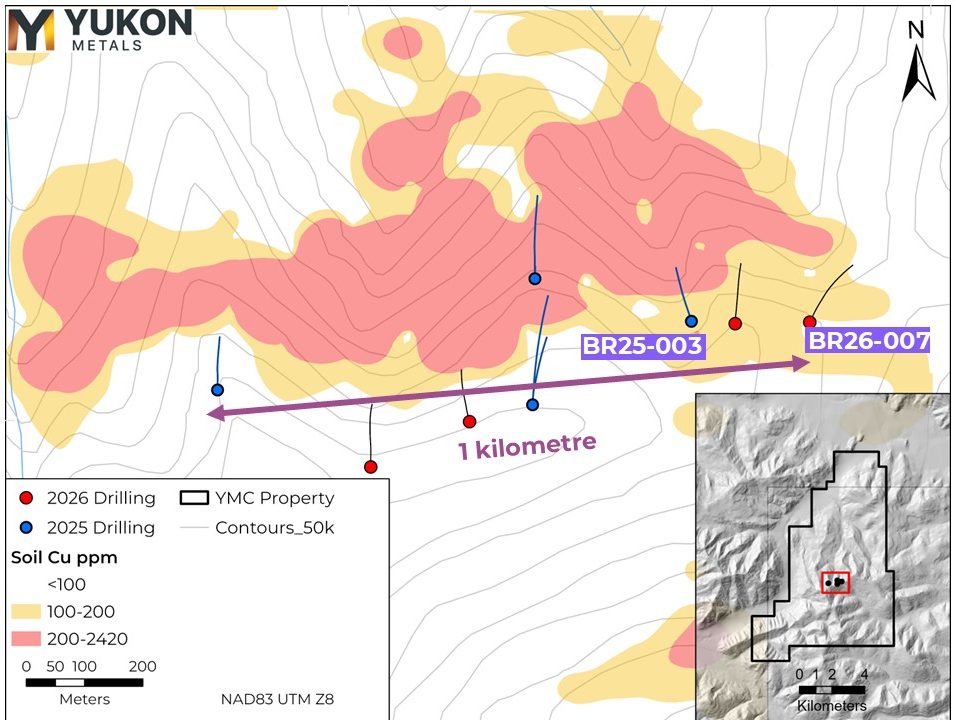
The latest drill hole was positioned as a 200-metre step-out to the east of the previous year’s key hole, BR25-003. The results successfully intersected multiple near-surface skarn horizons, including a standout interval of 23.5 metres grading 0.48 grams per tonne (g/t) gold, 0.11% copper, and 1.47 g/t silver. This intercept has effectively extended the confirmed strike length of the mineralized skarn system to approximately one kilometre, validating the company’s geological model and providing a clear trajectory for future exploration.
Chronology of Exploration: From Surface Anomaly to Systemic Growth
The journey to the current discovery at Birch began with the identification of a significant, 1.4-kilometre-long gold-copper soil anomaly. This initial geochemical indicator, coupled with the presence of carbonate-bearing stratigraphy and intrusive rocks, provided the foundation for the company’s 2025 inaugural drill program.
The 2025 Foundation
During the 2025 season, Yukon Metals completed 1,687 metres of diamond drilling across six holes. This program was instrumental in confirming that the skarn system is hosted within interlayered schist and marble, frequently cross-cut by intrusive dykes. Hole BR25-003, which acted as the anchor for the eastern portion of the 2025 program, intersected 47.4 metres grading 0.43 g/t gold, establishing the initial potential of the eastern zone.
The 2026 Campaign
Building on this success, the 2026 program involved approximately 2,600 metres of diamond drilling, further supported by 12.7 line-kilometres of induced polarization (IP) geophysical surveying. Hole BR26-007 represents the first batch of data from this more aggressive campaign. By stepping out 200 metres from the 2025 boundary, the company has proven that the mineralization is not isolated but continues to follow the geological trend, significantly increasing the volumetric potential of the project.
Technical Analysis and Supporting Data
The geological architecture of the Birch project is defined by a complex interplay between intrusive bodies and carbonate-rich sedimentary units. The assay results from BR26-007 provide granular detail into how these systems interact to host economic mineralization.
Highlights of the Assay Results
The data from BR26-007 highlights both shallow, bulk-tonnage potential and localized high-grade zones:
- Near-Surface Mineralization: A 7.5-metre interval starting at 7.0 metres depth returned 0.16 g/t Au, 0.04% Cu, and 1.78 g/t Ag.
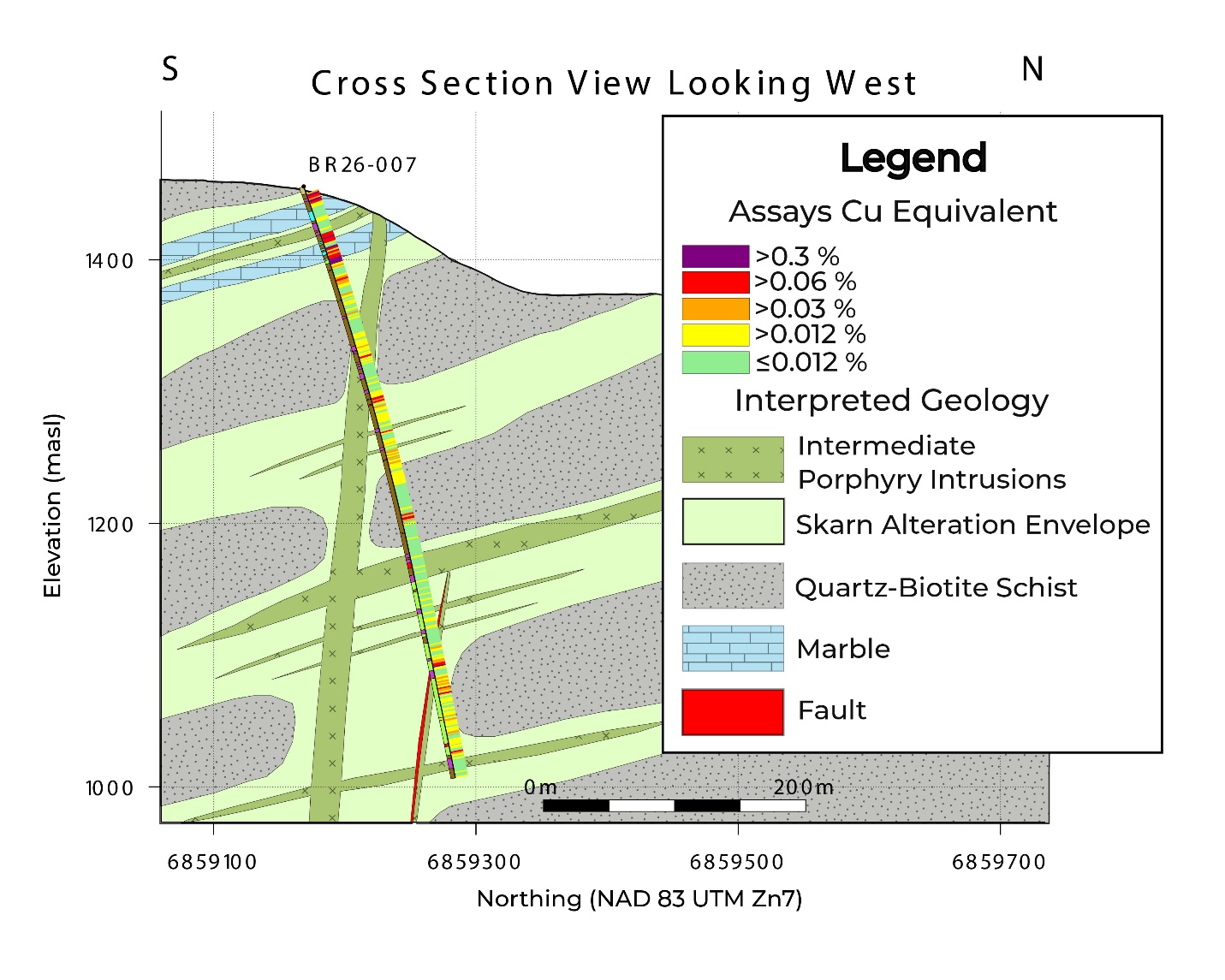
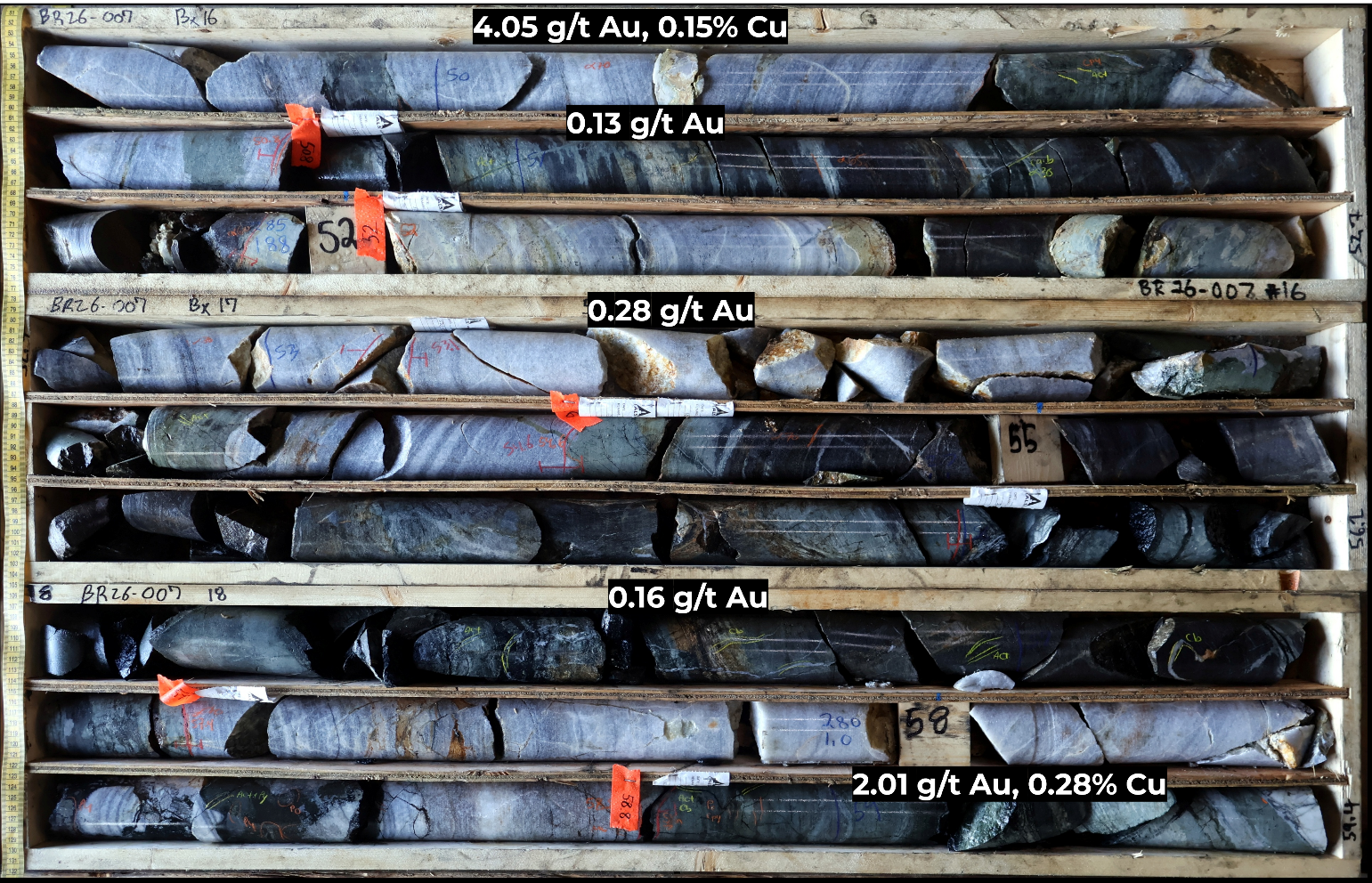
- Main Skarn Horizon: A 23.5-metre interval starting at 39.5 metres depth returned 0.48 g/t Au, 0.11% Cu, and 1.47 g/t Ag. Within this, a higher-grade core of 13.5 metres graded 0.71 g/t Au and 0.17% Cu.
- High-Grade Structural Hit: Perhaps the most intriguing result was the deep intercept at 261.0 metres, which yielded 0.8 metres grading 12.1 g/t Au. This intercept is associated with a logged fault zone, suggesting that structural controls play a critical, perhaps under-recognized, role in the distribution of high-grade gold at Birch.
The Role of Intrusive Emplacement
Throughout the drilling of BR26-007, geologists observed numerous porphyritic intermediate intrusive dykes. The correlation between these dykes and the skarn mineralization is strong; the company notes that mineralization is frequently concentrated along the margins of granodiorite and feldspar-porphyry dykes. This observation supports the interpretation that the intrusive emplacement was the primary driver for the skarn alteration and the subsequent introduction of copper and gold.
Official Responses and Strategic Outlook
"We are pleased that BR26-007 has extended the drilled footprint at Birch to approximately 1 kilometre in length, demonstrating that near-surface skarn gold and copper mineralization continues east along strike," stated Jim Coates, CEO of Yukon Metals.
Coates emphasized that while the shallow skarn horizons are currently the primary focus for resource definition, the deeper, high-grade gold intercept provides a new and exciting vector for exploration. The company is currently in the process of integrating these results with the broader 2026 dataset, which includes the recent IP survey and mapping of an intrusive body located two kilometres to the south. This "big picture" approach is designed to refine the geological model and prioritize targets for the next phase of work.
Implications for the Yukon Mining District
The success at Birch is not an isolated event; it fits into a broader narrative of renewed interest in the Yukon’s mineral potential.
Geopolitical and Geological Stability
The Yukon territory is increasingly recognized as a tier-one jurisdiction for mineral exploration. With a progressive permitting regime and a history of major discoveries—most notably the nearby successes of companies like Snowline Gold Corp.—the region has become a magnet for investment. The local workforce, steeped in a culture of exploration and environmental stewardship, provides a reliable human capital foundation for projects like Birch.
Potential for District-Scale Development
The Birch project is a 7,000-hectare land package. By confirming that the mineralized system extends over a kilometre in strike length and exhibits both skarn-style and potentially structural-controlled high-grade mineralization, Yukon Metals is demonstrating that Birch has the scale required to potentially evolve into a district-scale opportunity. The combination of gold, copper, and silver, along with the potential for epithermal and porphyry-style systems, provides the project with the diversity often sought by major mining entities.
Future Exploration and Methodology
The company maintains a rigorous standard for its exploration activities. All diamond drill core from the 2026 program is logged, photographed, and split for assaying, with a strict 10% QA/QC protocol involving certified standards, blanks, and duplicates. Samples are processed by SGS Canada Inc. using advanced fire assay and four-acid digestion methods, ensuring that the results provided to the market are of the highest industry standard.
As the company awaits the remaining assays from its 2,600-metre 2026 program, the focus remains on:
- System Integration: Combining the new drill data with the IP survey results to create a 3D model of the subsurface.
- Target Refinement: Assessing the two-kilometre-south intrusive body to see if it acts as the "heat engine" for the skarn system observed at the main drill site.
- Community Engagement: Continuing the company’s strategy of fostering sustainable growth and inclusivity within the local Yukon communities.
Conclusion
Yukon Metals Corp. has successfully demonstrated the continuity of the skarn system at the Birch project. By expanding the footprint to one kilometre and identifying both consistent near-surface mineralization and high-grade structural gold, the company has validated its geological model. As exploration continues and more assays are released, the industry will be watching closely to see if Birch can confirm its status as one of the most promising new copper-gold assets in the Yukon territory. With strong management, a solid treasury, and a systematic approach to exploration, Yukon Metals is well-positioned to drive value for its shareholders and contribute to the rich mining history of the region.