Boucheron and Christie’s Unveil Landmark Retrospective in New York, Celebrating 170 Years of Audacity and Craft
By
•
October 15, 2026
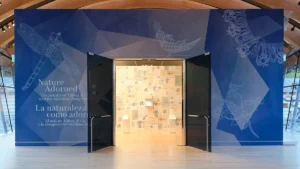
NEW YORK — In an ambitious cultural showcase linking the historic salons of Paris to the epicenter of the American luxury market, French high jewelry house Boucheron has partnered with Christie’s to present Boucheron: In Focus, a Monograph of a Visionary. Staged within Christie’s Rockefeller Center galleries in Manhattan, the ten-day exhibition brings together masterworks from the maison’s historic archives, private loans, and ground-breaking contemporary creations, tracing a lineage of design innovation that stretches from the Second French Empire to the frontiers of 21st-century material science.
The retrospective serves as a significant cultural statement in Boucheron’s long-term expansion into the United States, following the opening of its North American flagship on Manhattan’s Madison Avenue two years prior. Designed to engage both seasoned collectors and a burgeoning audience of design aficionados, the exhibition underscores Boucheron’s unique identity as the oldest continuous jewelry house on Paris’s Place Vendôme—and one that continues to challenge the conventional boundaries of high jewelry.
Chronology: Nearly 170 Years of Avant-Garde High Jewelry
Boucheron’s historical narrative is defined by a succession of technical firsts, architectural shifts, and pioneering material explorations that parallel the evolution of modern decorative arts.
1858: Frédéric Boucheron establishes the maison at Galerie de Valois, Palais-Royal
1879: Development and patenting of the clasp-free Question Mark necklace
1888: Creation of the historic Mrs. Mackay ruby and diamond collar
1893: Relocation to 26 Place Vendôme, pioneering the square's jewelry district
1924: Crafting of the Art Deco bandeau diamond tiara for Lady Harcourt
2011: Appointment of Claire Choisne as Creative Director, inaugurating Carte Blanche
2024: Opening of the Madison Avenue flagship boutique in New York City
2026: "Boucheron: In Focus, a Monograph of a Visionary" opens at Christie’s New York
The Place Vendôme Pioneer
Frédéric Boucheron, the son of a draper, founded the maison in 1858, operating out of the Galerie de Valois in Paris’s Palais-Royal. Drawing upon his family’s textile background, Boucheron approached precious metals and gemstones with an unprecedented fluidity, treating gold and platinum like lace, ribbon, and pleated silk.
In 1879, the founder introduced an invention that transformed feminine adornment: the Point d’Interrogation (Question Mark) necklace. Engineered with an internal flexible blade spring, the asymmetrical jewel wrapped effortlessly around the wearer’s neck without requiring a clasp, granting women the autonomy to don and remove high jewelry unassisted by domestic staff.
Recognizing the changing geography of Parisian commerce and architecture, Boucheron became the first high jeweler to establish a boutique on the Place Vendôme in 1893. Choosing the corner mansion at 26 Place Vendôme—the former residence of the Countess de Castiglione—Frédéric Boucheron selected the sunniest corner of the square, where natural light poured through expansive windows, illuminating the natural scintillation of his gemstones.
Gilded Age Magnates and Aristocratic Allure
Throughout the late 19th and early 20th centuries, Boucheron was sought out by international royalty, imperial courts, and industrial titans. Among its most prolific American clients was Marie-Louise Mackay, wife of silver magnate John William Mackay. In 1888, the maison crafted a celebrated laurel wreath collar necklace for Mrs. Mackay, combining seven cushion-cut Burmese rubies with cascades of old mine- and old European-cut diamonds.
The interwar period witnessed Boucheron transition seamlessly into the streamlined geometry of Art Deco. A defining artifact of this era was the 1924 diamond tiara commissioned for Lady Harcourt, an evocative bandeau-style design balancing stylized foliate motifs with interlocking scrolls, executed in platinum and brilliant-cut diamonds.
The Modern Renaissance and Contemporary Vision
Following its acquisition by the luxury conglomerate Kering (formerly PPR), the maison embarked on a creative reinvigoration under Creative Director Claire Choisne, appointed in 2011, and Chief Executive Officer Hélène Poulit-Duquesne, who joined in 2015.
Together, they introduced the biannual collection schedule: an archival-focused Histoire de Style line launched in January, followed by the radical, conceptual Carte Blanche collection in July. By deploying non-traditional substances—ranging from aerogel and industrial ceramics to scan-mapped real flower petals and borosilicate glass—Choisne reestablished Boucheron as an avant-garde laboratory within the traditional confines of high jewelry.
Curatorial Blueprint: Archival Splendors and Technical Feats
Departing from a standard chronological display, Boucheron: In Focus unfolds across a suite of darkened galleries configured around four core themes: Architecture, Nature, History, and Innovation.
Central to the exhibition’s historical wing are pieces representing the late 19th and early 20th centuries—an era considered by specialists to be the high-water mark of French jewelry fabrication.
Lady Harcourt’s 1924 Tiara: Reacquired by Boucheron at auction to enrich its permanent archive, the piece epitomizes the post-war flapper aesthetic. Its low-profile, bandeau architecture was conceived to sit across the forehead or integrate into the cropped hairstyles popularized during the Roaring Twenties.
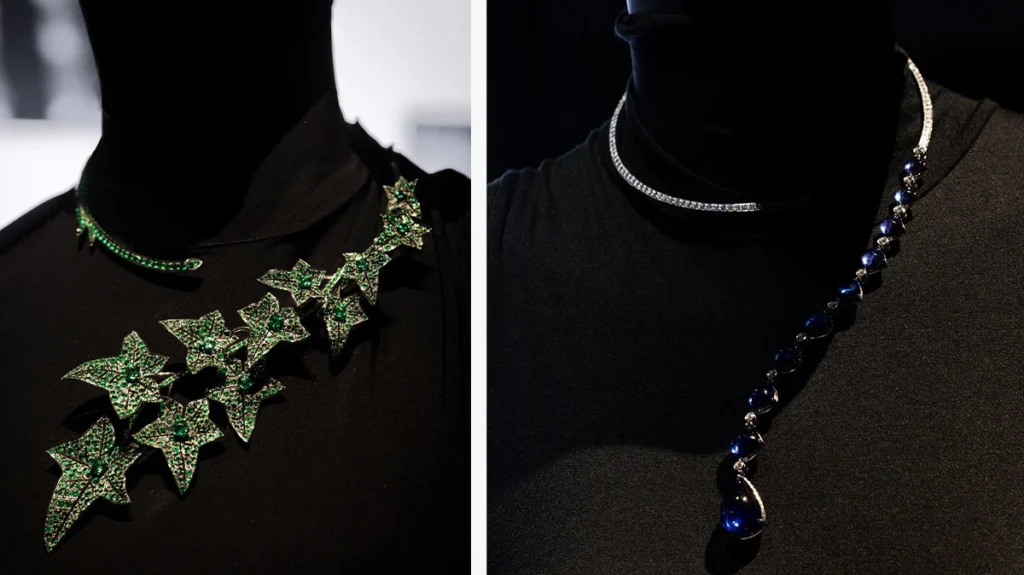
The Mrs. Mackay Necklace (1888): Featuring seven deep-red cushion-cut rubies mounted within an articulated diamond laurel motif, the necklace underscores the extraordinary purchasing power of the American Gilded Age and Frédéric Boucheron’s mastery of proportion.
Archival Question Mark Necklaces: Several iterations of the iconic clasp-free design are on display, from late-19th-century diamond-and-pearl variations to modern reinterpretations paved entirely in vivid green emeralds.
The Carte Blanche Laboratories: "Impermanence" and "Human Nature"
Demonstrating the maison’s current work, the exhibition dedicates separate installations to its latest Carte Blanche collections, including pieces that remain available for commercial acquisition.
Collection
Core Concept
Innovative Materials Used
Notable Design Elements
Impermanence
Capturing fleeting organic life frozen at the moment of decay
Borosilicate glass, high-tech ceramics, diamonds, white gold
Sculptural, crystalline flowers that appear preserved in ice; transformable structural jewels
Human Nature
Shared structural silhouettes contrasted across distinct material realities
Industrial ceramics, rare hardstones, alternative composites
Five unified sets repeating identical bib-necklace and two-finger ring profiles via divergent material techniques
Composition Series
Intersection of kinetic sculpture, Pop Art, and functional adornment
Modular table sculptures (e.g., Composition No. 2 and No. 3) that decouple into rings, brooches, and pendants
Executive Insights: Craftsmanship, Innovation, and American Expansion
The New York exhibition represents a deliberate effort by Boucheron’s executive leadership to establish a definitive, nuanced public identity within the North American market, an arena historically dominated by legacy American and rival European jewelers.
"We have to tell our story," stated Hélène Poulit-Duquesne, Chief Executive Officer of Boucheron. "And I would love people to come out of this exhibition understanding how deep our history is and the fact that we really have two threads: one is of historical craftsmanship spanning nearly 170 years, and the other is that we’re super innovative."
Poulit-Duquesne characterized the rare assembly of historical loans and complex archival jewels as "the height of the art—the top of the pyramid." She noted that the periods of Frédéric Boucheron’s direct stewardship between the late 19th and early 20th centuries continue to command the highest appreciation among institutional and private collectors.
Addressing the maison’s modern creative trajectory under Claire Choisne, Poulit-Duquesne highlighted the unconstrained latitude granted to the creative studio for the Carte Blanche series:
"Claire has total freedom. The clients drawn to these works are more similar to contemporary art buyers. They come for creativity, conceptual rigor, and an aesthetic expression that transcends conventional preciousness."
Through this curatorial strategy, Boucheron presents its contemporary, material-forward pieces not as anomalies, but as the logical evolution of Frédéric Boucheron’s early technical experiments with rock crystal, chased steel, and clasp-free articulation.
Market Implications: Reshaping the American High Jewelry Landscape
Boucheron’s high-profile staging at Christie’s New York signals broader structural shifts within the global luxury goods and fine jewelry markets.
       Global High Jewelry Landscape & Strategy
  ┌──────────────────────────────────────────────────┐
  │  1. Transatlantic Expansion                      │
  │     • Deepening physical presence beyond Paris   │
  │     • Flagship support via major retrospectives  │
  ├──────────────────────────────────────────────────┤
  │  2. Curatorial Partnerships                      │
  │     • Collaboration with auction houses          │
  │     • Blurring lines: museum exhibit vs. retail  │
  ├──────────────────────────────────────────────────┤
  │  3. Evolution of Collector Demographics          │
  │     • Attracting contemporary art collectors     │
  │     • Elevating unconventional, high-tech media  │
  └──────────────────────────────────────────────────┘
The Strategic Value of Institutional Retrospectives
As competition intensifies among global luxury groups, standalone retail spaces are often insufficient to capture the ultra-high-net-worth jewelry market. Partnering with a premier auction house like Christie’s allows Boucheron to position its historical narrative within an authoritative, museum-quality setting.
By engaging Christie’s international clientele directly, the maison achieves a dual objective: bolstering the secondary auction valuations of its 19th- and 20th-century historical pieces while building provenance and cultural validation for its modern, highly experimental Carte Blanche releases.
Cultivating the Art-Collector Demographic
High jewelry has increasingly diverged into two distinct market sectors: traditional investment-grade pieces driven strictly by gemological metrics (such as diamond carat weight and color saturation), and conceptually driven, narrative jewels prized for design, scarcity, and craftsmanship.
Boucheron’s focus on non-traditional substances—exemplified by borosilicate glass in Impermanence and composite materials in Human Nature—actively decouples the perceived value of high jewelry from raw stone weight. In doing so, the maison aligns itself with the contemporary art market, attracting collectors who value design audacity and technical mastery alongside pure material value.
Amplifying North American Presence
Historically, Boucheron maintained a disproportionately large footprint in Europe, the Middle East, and Asia compared to North America. The opening of its Madison Avenue flagship in New York signaled a focused commitment to balance this geographic footprint.
Boucheron: In Focus, a Monograph of a Visionary operates as a cultural anchor for this ongoing retail rollout. By demonstrating that its historic clients included American icons like Mrs. Mackay alongside European royalty, Boucheron reinforces an enduring historic tie to the United States. Coupled with contemporary designs that push into the future of craftsmanship, the maison is well positioned to carve out a distinctive, high-growth niche within the American luxury landscape.