
The intersection of fine art and high-stakes diplomacy has long been a theater for soft power, yet rarely has that theater been as volatile as it is today. In embassies and federal institutions across the globe, a sweeping ideological realignment is currently underway, manifesting most visibly through the removal and public disparagement of contemporary artworks. At the heart of this cultural flashpoint is a painting by world-renowned artist Kehinde Wiley—the man who famously rendered President Barack Obama’s official portrait—whose work at the U.S. Embassy in the Dominican Republic has become the latest battleground in a widening war over American identity.
The Genesis of the Controversy: From Aesthetics to Ideology
The controversy surrounding Wiley’s 2013 painting, Young Artists After Siamesas 1960, reached a fever pitch last week following a podcast appearance by Erin Scavino, the director of Art in Embassies. During a candid conversation with former White House Press Secretary Sean Spicer, Scavino dismissed the piece as “aesthetically terrifying.” This characterization, while seemingly a critique of form, signaled a broader, more systemic shift in how the current administration views the role of federal art collections.
The discourse turned from aesthetic critique to political polemic with the emergence of a previously unearthed radio interview from April, as reported by The New York Times. In the broadcast, U.S. Ambassador to the Dominican Republic, Leah Campos, offered a starkly different, and arguably more inflammatory, assessment of the same painting. Speaking in Spanish, Ambassador Campos described the work as a “huge painting of a picnic in a park with flowers and some lesbians.”
Beyond the reductive nature of the description, Campos’s rhetoric ventured into the political, suggesting that the presence of the work was a deliberate attempt by the Biden administration to export “that ideology here to the Dominican people.” This statement ignores the historical record: the painting was commissioned in 2013 under the Obama administration, long before the current political climate centered on such intense scrutiny of cultural artifacts.
Chronology of a Cultural Purge
To understand the scope of these events, one must look at the timeline of the systematic removal of art that does not align with the current administration’s vision of “American patriotism.”
- 2013: The U.S. Department of State commissions Kehinde Wiley’s Young Artists After Siamesas 1960 for the U.S. Embassy in the Dominican Republic as part of the Art in Embassies program, a long-standing initiative designed to foster cross-cultural dialogue.
- 2019: American sculptor Joel Shapiro gifts a monumental, 24-foot-tall sculpture titled Blue to the John F. Kennedy Center for the Performing Arts, a cornerstone of American cultural life in Washington, D.C.
- April 2026: Ambassador Leah Campos, in a Spanish-language radio interview, publicly labels the Wiley painting a “lesbian picnic” and characterizes it as an imposition of foreign ideology.
- August 2026: In a viral social media post, Ambassador Campos announces the removal of the Wiley painting, replacing it with an image of the American flag set to the soundtrack of Twisted Sister’s “We’re Not Gonna Take It,” framing the swap as an act of patriotic restoration.
- September 2026: The removal of Joel Shapiro’s Blue from the Kennedy Center begins, following a directive from a board recently reconstituted with Trump-aligned appointees.
The Artist’s Rebuttal: Reclamation Through Commerce
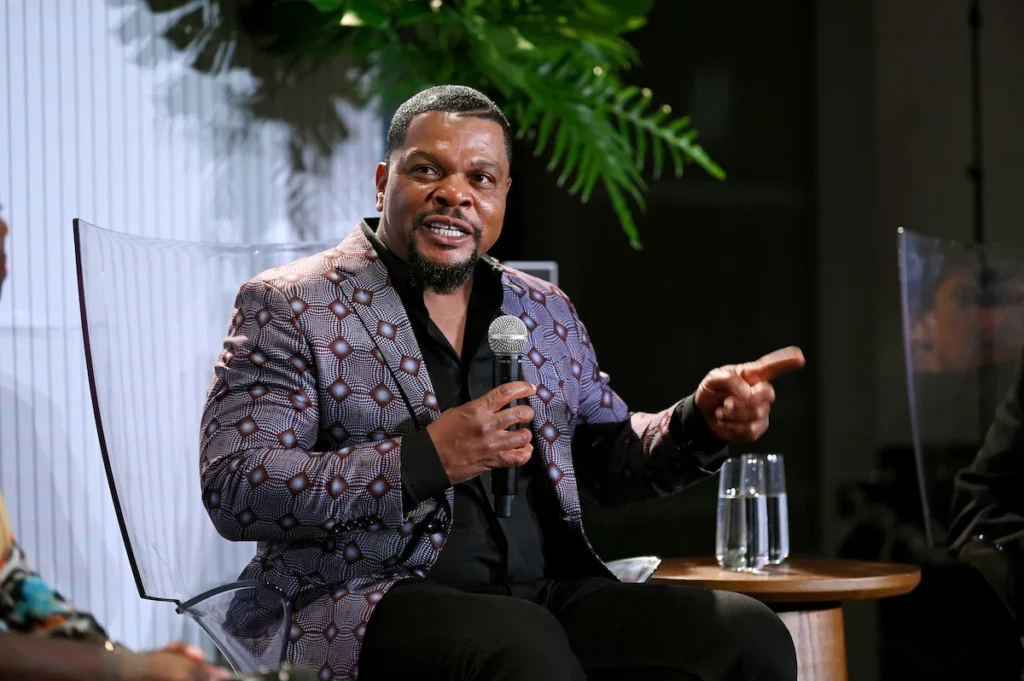
While the political establishment has utilized rhetoric to marginalize his work, Kehinde Wiley has chosen a different path—one that blends high-concept protest with grassroots engagement. Eschewing a formal press release or a traditional legal retort, Wiley turned to his e-commerce platform on Instagram.
The artist released a limited-edition black T-shirt, retailing for $120, emblazoned with the phrase “aesthetically terrifying.” By taking the very words intended to denigrate his work and turning them into a badge of defiance, Wiley has executed a masterclass in narrative control. His accompanying statement serves as a manifesto for the contemporary artist: “A response. A reclamation. A reminder that art has never needed permission to be beautiful, provocative, or powerful.”
This move highlights a growing trend among artists: bypassing traditional gatekeepers to communicate directly with an audience that often views the current administrative purge of the arts as an act of intellectual censorship.
The Shift in Federal Cultural Policy
The administration’s stated mission, as articulated by Ambassador Campos, is to curate spaces that reflect “American patriotism and the beauty of our great country.” However, critics argue that this shift is less about beauty and more about the erasure of the pluralistic narrative that has defined American cultural exports for decades.
This is not an isolated incident confined to overseas outposts. The internal transformation of the John F. Kennedy Center for the Performing Arts serves as a domestic analog to the events in the Dominican Republic. The dismantling of Joel Shapiro’s Blue is widely viewed by the art community as a targeted strike against an institution that has historically stood as a bastion of artistic independence.
In December, the board of the Kennedy Center, now chaired by figures aligned with the Trump administration, moved to formally rename portions of the building and inscribe the President’s name on the facade. This action has triggered a complex and ongoing legal struggle, pitting the federal court system against the board’s perceived mandate to "rebrand" national landmarks.
Implications: The Erosion of Soft Power
The broader implications of these events are profound. The Art in Embassies program was established with the understanding that art serves as a bridge, allowing for nuances of identity and culture that formal diplomatic cables cannot convey. By narrowing the definition of “acceptable” art to symbols of overt nationalism, the administration risks damaging the very soft power that the U.S. has spent decades cultivating.
Cultural diplomacy relies on the assumption that a nation is confident enough to showcase a diverse range of artistic voices. When an ambassador describes a painting by one of the most significant portraitists of the 21st century as an “ideological imposition,” it signals to host countries that the U.S. is withdrawing from the international conversation of modern art.
Furthermore, the legal and ethical questions surrounding the removal of donated works—such as the Shapiro sculpture—raise concerns regarding the sanctity of private gifts to public institutions. If donors believe their contributions can be discarded at the whim of a political administration, the pipeline of private support for federal cultural institutions may dry up, leaving these spaces hollowed out and entirely dependent on state-approved imagery.
Conclusion: A Nation Divided by Its Own Reflection
The friction surrounding Kehinde Wiley’s work is not merely about a single painting; it is a symptom of a deep-seated struggle over what it means to be American in the 21st century. The current administration’s efforts to curate a monochromatic aesthetic landscape are meeting resistance from artists, curators, and legal entities who see these actions as a regression.
As the legal battles over the Kennedy Center continue and the global diplomatic community watches the fallout in the Dominican Republic, the question remains: Can an institution survive if it rejects the very complexity it was built to celebrate? For now, Wiley’s “aesthetically terrifying” T-shirts serve as a wearable protest, a symbol of an art world that refuses to be silenced by the shifting winds of political favor. The battle for the soul of American cultural diplomacy is far from over, and the canvas, it seems, is still being painted.