

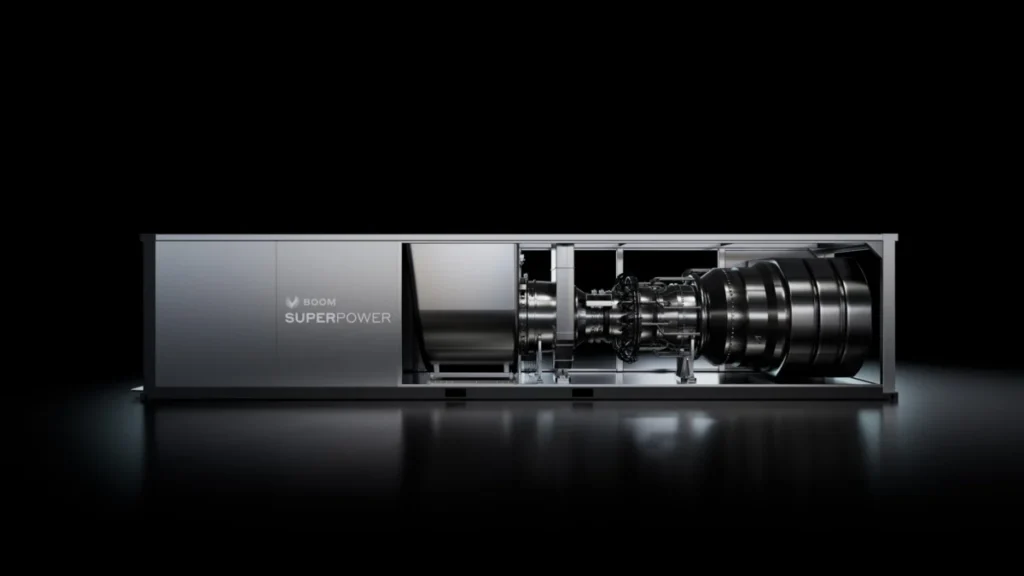
In a high-stakes pivot that underscores the volatile intersection of artificial intelligence infrastructure and energy innovation, Denver-based AI data center giant Crusoe has officially terminated its partnership with aerospace innovator Boom Supersonic. The deal, which was initially hailed as a revolutionary marriage of aviation technology and stationary power generation, would have seen Crusoe invest $1.25 billion into 29 of Boom’s “Superpower” natural gas-fired turbines.
The dissolution of this agreement marks a significant shift in the strategic roadmap for both companies. For Crusoe, which recently secured a staggering $3.9 billion in capital, the move reflects a pivot toward a more diversified and flexible energy procurement strategy. For Boom Supersonic, the loss of its marquee launch customer represents a sobering hurdle in its quest to leverage stationary power generation as a funding engine for its ambitious Overture supersonic passenger jet program.
The Genesis of an Ambitious Partnership
To understand the weight of this separation, one must look back at the origins of both entities. Crusoe, founded in 2018, originally gained notoriety for its innovative method of monetizing "stranded" natural gas—excess energy from oil fields that would otherwise be flared—to power bitcoin mining operations. Over the last several years, the company has successfully pivoted into the backbone of the AI boom, constructing massive, high-efficiency data centers that provide the essential compute resources for industry giants like OpenAI and Oracle.
Boom Supersonic, meanwhile, has been laser-focused on bringing supersonic flight back to the commercial sector. However, the development of the "Symphony" engine for its Overture aircraft is an capital-intensive endeavor. In an effort to diversify revenue streams and accelerate R&D, the company launched a spin-off business last year to market the "Superpower" turbine. By leveraging roughly 80% of the architecture used in the aviation-grade Symphony engine, Boom aimed to provide high-efficiency, stationary natural gas power to the burgeoning data center market.
The partnership was presented as a perfect synergy: Crusoe needed massive, reliable, and localized power for its "AI factories," and Boom needed a high-volume buyer to validate its engine technology and generate early-stage cash flow to subsidize the development of the Overture jet.
A Chronology of the Deal’s Demise
The partnership’s trajectory moved from high-profile announcement to quiet dissolution over the span of roughly 18 months.
- Late 2025: Boom Supersonic raises $300 million specifically earmarked to commercialize its stationary turbine business, with Crusoe positioned as the anchor customer.
- The Commitment: Crusoe signs a binding agreement to procure 29 units of the 42-megawatt Superpower turbines, with a total contract value of $1.25 billion. Initial deliveries were slated to commence in 2027.
- September 2026: Crusoe closes a massive $3.9 billion funding round, significantly expanding its financial bandwidth and capacity to build out infrastructure at scale.
- September 2027: The companies confirm the termination of the partnership.
The news broke via an update on X (formerly Twitter) from Boom Supersonic CEO Blake Scholl. In his post, Scholl confirmed that the companies were no longer moving forward with the turbine launch, noting that the decision was driven by changing needs in Crusoe’s power mix.
The Evolution of AI Infrastructure Requirements
The primary reason for the split, according to both parties, is a fundamental shift in how Crusoe manages its energy portfolio. As Crusoe has moved from powering small, modular crypto-mining rigs to managing gigawatt-scale AI campuses—such as its massive facility in Abilene, Texas—the requirements for power stability, sustainability, and grid integration have evolved.
Crusoe’s spokesperson, Andrew Schmitt, emphasized that the company is taking a "power-up" approach to its infrastructure. "We build AI factories from the power up, and we’re bringing new campuses online across the country, powered by innovative energy sources," Schmitt noted. "As our portfolio grows, we stay flexible, choosing the energy solutions that are right for each site as its needs evolve."
Industry analysts suggest that the shift away from a singular reliance on gas turbines reflects a broader trend among major data center operators. With the rise of "green" mandates and the increasing cost of grid interconnection, companies are now looking to blend a variety of sources—wind, solar, battery storage, and direct grid connectivity—rather than committing to a single proprietary technology years in advance.

Implications for Boom Supersonic’s "Superpower" Business
While the loss of a $1.25 billion contract is objectively a setback, Boom Supersonic is attempting to reframe the narrative. In his public comments, Blake Scholl maintained a diplomatic and forward-looking posture, noting that Boom is currently in the process of delivering approximately 250 megawatts of Superpower capacity to other, unnamed customers in the coming year.
The company’s targets remain aggressive, with a goal of reaching 1 gigawatt of power delivery by 2028. For Boom, the stationary power business is not just a secondary venture; it is a critical financial pillar. The profits generated from the sale of these turbines were intended to act as a hedge against the high risks and long development timelines of the aviation industry.
The challenge now for Boom is to prove that the Superpower turbine can stand on its own merits without the early, massive validation that a customer like Crusoe provided. If the company can successfully fulfill its current pipeline of orders, it may still achieve its goal of subsidizing the Overture jet. However, the departure of its launch partner will undoubtedly invite scrutiny from investors regarding the scalability and market demand for aerospace-derived turbine technology in a stationary context.
The Broader Impact on the AI Energy Crunch
The separation of these two companies highlights the growing pains of the AI industry. As demand for computing power skyrockets, the bottleneck has shifted from chips to electricity.
Crusoe’s current energy strategy provides a window into the future of data center design. In Abilene, the company relies on the grid for primary power, using gas turbines as a secondary or backup measure. This "hybrid" model is becoming the gold standard for large-scale operators who cannot afford the downtime associated with relying on a single, unproven, or experimental power source.
Furthermore, the scale of Crusoe’s operations—building massive campuses for the likes of Microsoft, OpenAI, and Oracle—means that the company’s procurement decisions have national significance. When a company of this size walks away from a $1.25 billion deal, it sends a signal to the entire energy-tech sector: in the race to power the AI future, agility and proven reliability are more valuable than innovative, yet unproven, vertical integration.
Conclusion: A Future of "Long-Term" Possibilities
Despite the abrupt end to the partnership, both parties have signaled that the bridge has not been burned. Scholl’s public comments on X, which included praise for Crusoe’s recent success and an invitation to "team up if/when turbines become part of their primary power mix," suggest a desire to maintain a professional relationship.
For the industry, the lesson is clear: the roadmap for AI-driven energy solutions is being rewritten in real-time. As Crusoe continues to scale its AI factory footprint, the company will likely continue to experiment with various energy configurations, and the door remains open for advanced turbine technology to play a role in that mix—provided it can meet the rigorous demands of modern, high-density data centers.
For now, the separation stands as a stark reminder of the complexity of the "AI power struggle." As the demand for electricity grows, companies will continue to pivot, experiment, and sometimes fail, in their attempt to bridge the gap between the power plants of the past and the digital infrastructure of the future. The $3.9 billion Crusoe has raised is a testament to the fact that the company has the resources to remain at the center of that evolution, whether or not it chooses to do so with a supersonic partner.



