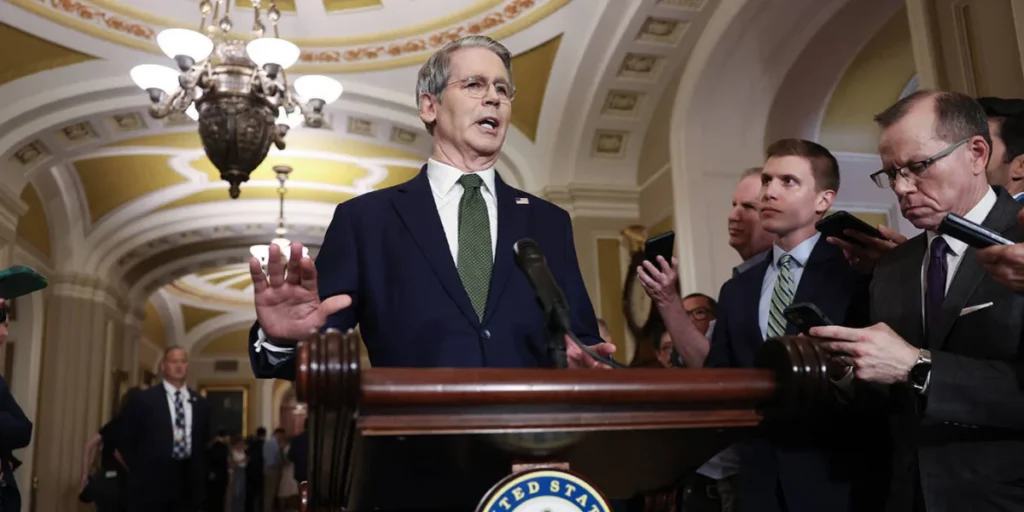
By Kenneth Rogoff
August 25, 2026
The United States, long considered the bedrock of global financial stability, is currently navigating a fiscal landscape defined by unprecedented volatility and structural fragility. With the federal deficit hovering near 6% of GDP and the national debt surging past the staggering $40 trillion mark, the American fiscal position has transitioned from a manageable concern to a precarious reality. Recent maneuvers by Treasury Secretary Scott Bessent suggest an administration increasingly at odds with the unforgiving realities of the bond market, raising fundamental questions about the sustainability of current U.S. economic policy.
The Main Facts: A Debt-Driven Dilemma
The primary tension currently gripping Washington centers on the U.S. government’s inability to reconcile aggressive fiscal spending with the cooling appetite of global investors. For decades, the "exorbitant privilege" of the U.S. dollar allowed the federal government to issue debt at low interest rates with little consequence. However, that era is ending.
The current fiscal trajectory is characterized by:
- A Deficit-to-GDP Ratio of 6%: This level of deficit spending during a period of relative peace and economic expansion is historically abnormal, placing significant upward pressure on inflation and interest rates.
- The $40 Trillion Milestone: Crossing this threshold has shifted the narrative from theoretical debt concerns to practical solvency anxieties. The interest expense alone now threatens to crowd out essential government services.
- The Bond Market Confrontation: Secretary Bessent’s attempts to influence long-term yields through rhetorical intervention rather than fiscal discipline have failed to convince institutional investors, leading to a breakdown in communication between the Treasury and the market.
Chronology of a Fiscal Slippage
The current crisis did not emerge overnight; it is the culmination of years of legislative inaction and a shift in global monetary dynamics.
- 2023–2024: The post-pandemic inflationary spike forced the Federal Reserve to aggressively hike interest rates, significantly increasing the cost of servicing the national debt. During this period, the administration maintained high spending levels, banking on a "soft landing" that never fully materialized in the fiscal sphere.
- Early 2026: As global interest rates began a sustained climb, the U.S. Treasury faced a series of disappointing bond auctions. The "term premium"—the extra yield investors demand for holding long-term debt—began to rise sharply.
- Mid-2026: Treasury Secretary Scott Bessent assumed his post with the goal of stabilizing markets. However, his strategy of "talking down" yields—essentially trying to strong-arm bond traders into accepting lower returns—backfired.
- August 2026: The current moment represents a point of inflection. With the deficit remaining stubbornly high and bond yields showing no signs of cooling, the Treasury is facing a crisis of credibility. Market participants are no longer taking government assurances at face value, leading to the current state of "fiscal panic" in the halls of the Treasury.
Supporting Data: The Mechanics of the Crisis
To understand why the bond market is currently in revolt, one must look at the divergence between fiscal policy and market expectations.
The Interest Rate Trap
For years, I have argued that the era of "low-for-long" interest rates was a temporary anomaly, not a permanent feature of the modern economy. The data now supports this: global long-term interest rates are rising in tandem with the U.S. debt load. When the Treasury issues debt, it must offer yields that compensate investors for the risk of future inflation and the risk of further debt issuance. As the total volume of debt increases, the "risk premium" required by the market rises.
The Debt-to-GDP Divergence
While nominal GDP has grown, the growth rate of the national debt has significantly outpaced it. According to current projections, if the deficit remains at 6% of GDP, the interest burden will consume an ever-increasing percentage of federal tax revenue. This creates a "debt spiral" scenario: the government must issue more debt to pay the interest on the debt it already has.
Global Liquidity and Foreign Appetite
The U.S. has traditionally relied on foreign central banks and institutional investors to purchase its debt. However, with geopolitical tensions rising and many nations looking to diversify their reserves away from the U.S. dollar, the buyer base for Treasury securities is shrinking. This loss of demand, coupled with increased supply, is the mathematical reason for the spike in long-term yields.
Official Responses: A Strategy of Denial?
The response from the Treasury Department has been characterized by a mix of obfuscation and confrontation. Secretary Bessent has consistently maintained that the U.S. fiscal position remains "fundamentally sound," a statement that has increasingly alienated market analysts.
Sources within the Treasury suggest that the administration is preparing a new set of "market-calming measures," which may include subtle shifts in the maturity structure of new debt issuance. However, these are viewed by many economists as mere window dressing. Critics within the Federal Reserve have privately expressed concern that the Treasury is failing to acknowledge the "structural deficit"—the portion of the deficit that exists even when the economy is at full employment.
Furthermore, the lack of a clear bipartisan plan to address the entitlement programs that drive long-term debt has left the Treasury with limited options. By failing to engage in a substantive dialogue about fiscal reform, the Treasury is effectively betting that the bond market will eventually "give in." History, however, rarely favors the government in such a contest.
Implications: The High Cost of Credibility
The repercussions of this fiscal instability extend far beyond the Treasury Department.
Economic Stagnation
High interest rates, driven by fiscal imprudence, serve as a tax on the entire economy. Businesses find it more expensive to borrow for capital investment, and mortgage rates remain prohibitive for the average American family. The "fiscal dominance" of the debt is effectively hampering the Fed’s ability to conduct monetary policy, as any move to hike rates to combat inflation further exacerbates the federal interest burden.
Loss of Global Hegemony
The U.S. dollar’s status as the world’s reserve currency is predicated on the belief that the U.S. government is the safest borrower in the world. If that belief is shaken, the geopolitical implications are profound. A weakening dollar could lead to higher import prices, fueling further inflation and diminishing the standard of living for the American middle class.
The Credibility Deficit
Perhaps the most damaging outcome is the erosion of trust. When a Treasury Secretary loses their credibility, the market becomes more volatile and less predictable. Investors begin to "price in" the risk of policy errors. If Secretary Bessent continues to attempt to strong-arm the market rather than addressing the underlying math, the Treasury risks triggering a self-fulfilling prophecy of higher rates and lower demand.
Conclusion: A Call for Reality
The U.S. fiscal position is not beyond repair, but it requires a level of political courage that has been absent for years. Addressing a 6% deficit requires difficult choices: entitlement reform, tax restructuring, or a fundamental reassessment of spending priorities.
Continuing to ignore the bond market is no longer a viable strategy. The Treasury is running out of time to pivot toward a more sustainable fiscal path. If the administration continues to view the bond market as an adversary to be bullied rather than a partner to be convinced, the "first signs of panic" we are seeing today could easily turn into a full-scale systemic crisis. The markets are speaking; it is time for the Treasury to start listening.