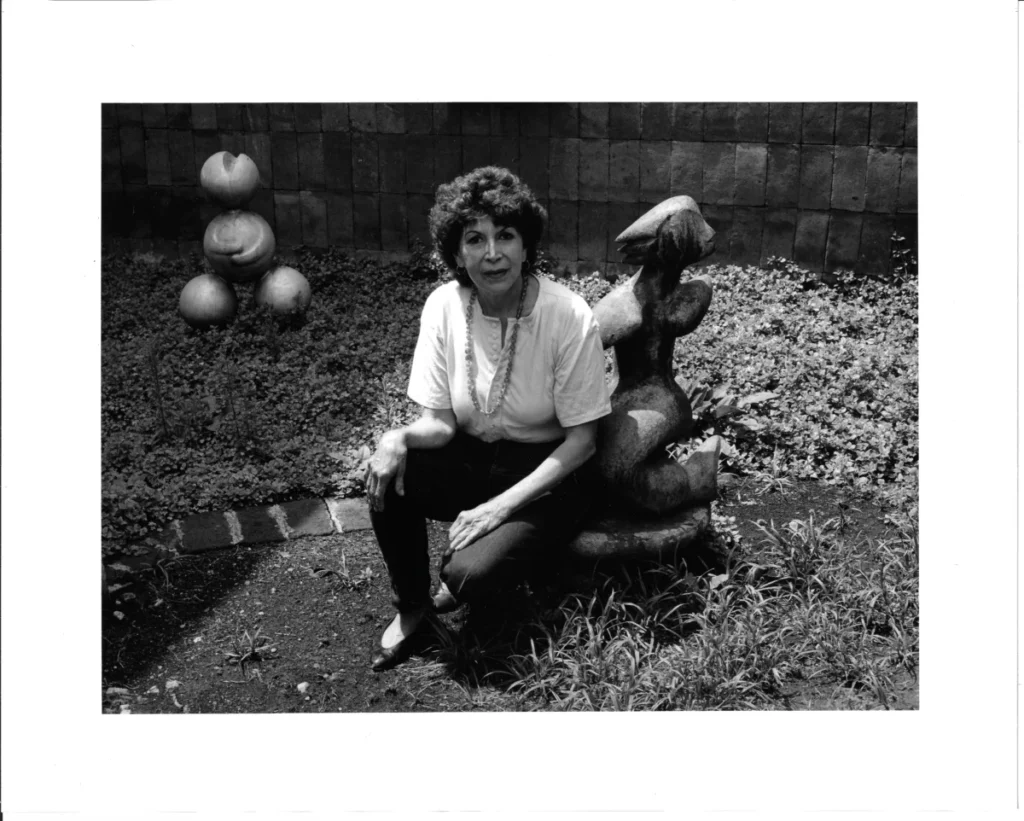
On September 1, the Mexican art world lost a titan whose life spanned a century of profound cultural evolution. Geles Cabrera, celebrated as the first professional female sculptor in Mexico and a vital figure in the Generación de la Ruptura (Breakaway Generation), passed away at the age of 100. Her departure marks the end of an era, closing a chapter for an artist who did not merely observe the history of Mexican art—she fought to redefine it, carving out a space for herself and her peers in a landscape often hostile to women.
Known for her deeply tactile, voluptuous, and abstracted explorations of the human form, Cabrera’s work bridged the gap between pre-Hispanic heritage and the experimental avant-garde. As the National Institute of Fine Arts and Literature (INBAL) noted in a previous tribute, she was a "tireless promoter" of the arts, a mentor to generations, and an unrelenting force of nature who shaped the contemporary Mexican art scene with her own hands.
A Life in Chronology: Seven Decades of Defiance
Born Ángeles María Cabrera Alvarado in 1926, Geles Cabrera’s path was paved by a unique intersection of archaeology and artistic lineage. Her father, a civil engineer tasked with oversight of major urban building projects in Mexico City, was frequently involved in the excavation of pre-Hispanic artifacts. The young Cabrera grew up surrounded by the remnants of ancient civilizations, their raw, earth-bound power embedding itself into her creative consciousness.
Her formal education began in the 1940s at the prestigious San Carlos Academy. However, her artistic vocabulary was not limited to the studio; she was also a trained dancer, performing with Alfonso Pallares’s experimental troupe. This dual interest in the plastic arts and movement provided the kinetic energy that would define her sculpture—figures that appeared to pulse with life, merging the grace of the dancer with the solidity of the monolith.
The Path to Professionalism
- 1949: A pivotal year. At just 22, Cabrera achieved a historic milestone, becoming the first Mexican sculptor to hold a solo exhibition at the Mont-Orendáin Gallery.
- 1949 (The Founding): Alongside 52 other artists, she helped establish the Salón de la Plástica Mexicana, a collective dedicated to promoting modern Mexican art.
- 1966: Cabrera opened the Museo Escultórico in Coyoacán. It was a radical, independent, artist-run space that operated until 2006, funded largely by her own salary as an art teacher. It offered free admission and provided a platform for her contemporaries.
- 2018: A landmark retrospective, Geles Cabrera: Mexico’s First Female Sculptor, was held at the Museo Experimental El Eco, finally bringing her long-overlooked contributions to the forefront of national discourse.
- 2023: She received the Medal for Fine Arts, the highest honor for lifetime achievement in the arts in Mexico.
The Artistic Vision: Stone, Breath, and Body
Cabrera’s work is perhaps best recognized for its rejection of the polished, clinical aesthetic that dominated much of 20th-century sculpture. While her peers in the muralist movement were often preoccupied with nationalist, political, or propagandistic motifs, Cabrera turned inward, exploring the sensuality and structural complexity of the human figure.
Her signature medium was recinto—a porous, volcanic stone indigenous to the Mexican landscape. The choice was deliberate. "I left them like that on purpose," she explained in a 2018 interview with artist Pedro Reyes. "I don’t like to polish them. That is why I barely ever worked with marble."
By choosing to leave the volcanic stone raw, she allowed the material to dictate the narrative. Her figures—merged couples, dancing torsos, and fertility symbols—possess an elemental quality, appearing as if they had been unearthed from the earth rather than crafted by human hands. This tactile quality was intentional; she wanted her work to be touched, to be felt, and to exist in physical dialogue with the viewer.
Breaking Barriers: A Feminist Perspective
Cabrera’s career was defined by a constant, uphill battle against a deeply entrenched, patriarchal art establishment. In the mid-20th century, sculpture was widely considered a "man’s medium," and the institutional doors of Mexico were firmly locked against women.
"They wouldn’t let women in. It was so hard to achieve anything," she reflected in 2018. She remained painfully aware of the systemic sexism that governed her success—or lack thereof—for decades. She frequently noted that while the state invested heavily in museums for her male counterparts, she was left to sustain her own practice and her own museum through personal sacrifice and teaching wages.

Her legacy is not merely the sculptures she left behind, but the precedent she set. By forming collectives like the GUCADIGOSE avant-garde group—alongside figures like Angela Gurría and Mathias Goeritz—she ensured that she was not an isolated anomaly, but a participant in the broader shift toward modernism. She was a mother of five who refused to let the domestic sphere define the limits of her ambition, proving that a woman could navigate the complexities of life and the rigors of the studio simultaneously.
Official Responses and Institutional Recognition
The response to her passing has been one of universal reverence. The OMR Gallery in Mexico City, which represented the artist, issued a poignant statement: "She was both an artist and her own muse. She didn’t wait for the world to make a place for her—she shaped it with her own hands."
The recognition, however, arrived late. It was only in the final years of her life that major institutions began to calibrate their historical records to include her significance. The 2022 exhibition at the Americas Society in New York served as a turning point, marking her first solo show in the United States. This was followed by a major retrospective at the Museo del Palacio de Bellas Artes in 2025, which finally situated her work within the canon of Mexican modernism.
These accolades, while belated, represent a growing awareness within the art world of the need to re-examine history through a more inclusive lens. Her life serves as a stark reminder that many female artists have spent their careers laboring in the shadows of institutional neglect, only to be rediscovered when they are well into their sunset years.
Implications: The Legacy of a Pioneer
The life of Geles Cabrera holds profound implications for the current and future state of art history. First, it highlights the danger of the "lone genius" narrative. By documenting the barriers she faced, we can better understand how the history of art is not just a record of creativity, but a record of gatekeeping.
Second, her work challenges the traditional hierarchy of materials. By favoring volcanic recinto over the "noble" marble, she elevated the indigenous, the raw, and the tactile to a level of high art. She taught us that sculpture need not be cold or distant to be profound; it can be porous, rough, and deeply connected to the geography from which it was born.
Finally, her death forces a reckoning with how we treat our living legends. For many observers, her late-life success was bittersweet. It raises the question: how many other "Geles Cabreras" are currently working in obscurity, waiting for the institutions to realize that their voice is an essential component of our collective history?
Geles Cabrera did not ask for permission to be a sculptor. She did not wait for the museums to invite her in. She built her own world—a world of stone and spirit—and in doing so, she became the foundation upon which future generations of Mexican women can stand. As we look back on her century-long life, we see not just the story of an artist, but the story of a pioneer who, in every sense, left her mark on the world.