In a landmark shift that signals the maturation of artificial intelligence within the financial sector, Binance, the world’s largest cryptocurrency exchange by trading volume, has officially launched Agent OS. This new platform serves as a bridge between the high-speed, volatile world of crypto markets and the burgeoning field of autonomous AI agents. With over 300 million registered users, Binance is moving beyond simple algorithmic trading, allowing sophisticated AI models to analyze, strategize, and execute financial transactions on behalf of its users.
The move represents a paradigm shift: we are transitioning from an era where humans use software tools to an era where autonomous AI agents act as financial agents, making real-time decisions with real money.
The Architecture of Agent OS: Bridging AI and Finance
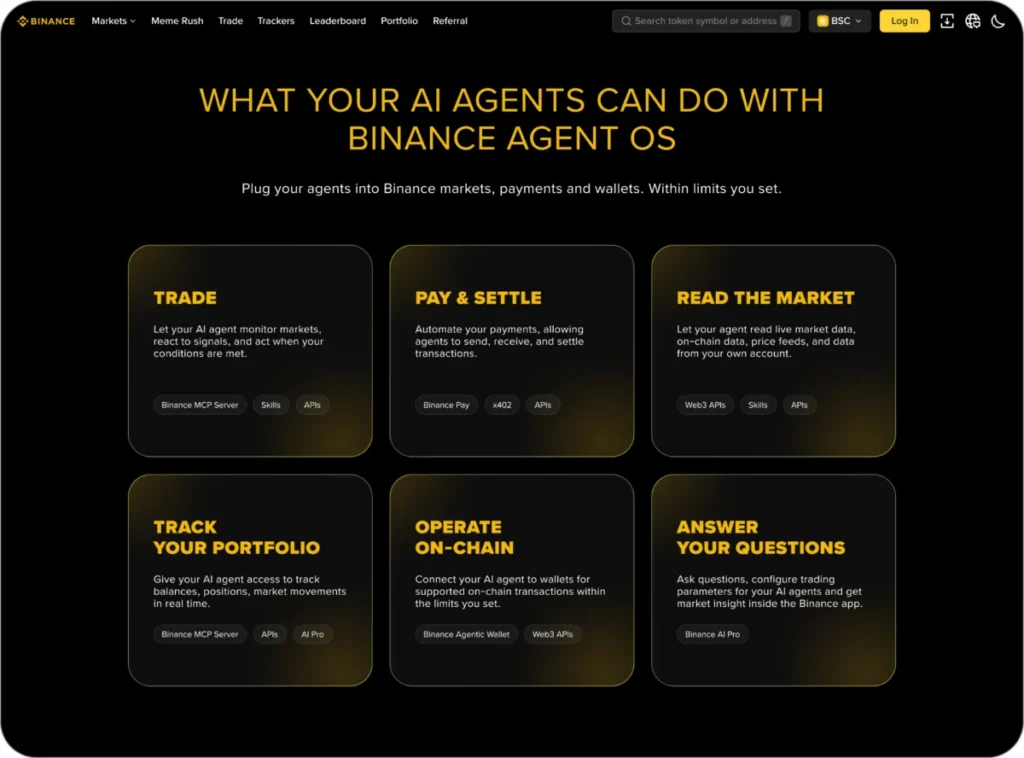
Agent OS is not merely a trading bot; it is a comprehensive infrastructure layer designed to connect AI applications directly to Binance’s financial ecosystem. By providing a secure, standardized gateway, the platform allows developers to integrate AI agents—powered by models like OpenAI’s ChatGPT and Codex, Anthropic’s Claude Code, and development tools like Cursor—into the crypto trading environment.
Core Components
The platform integrates several critical Binance services, including:
- Binance APIs: Providing the foundational data and execution hooks.
- Binance Wallet Agentic Hub: The central nervous system for managing AI-driven asset movement.
- x402 Transaction Verification: A specialized API designed to facilitate payments and verify the integrity of agentic actions.
- Model Context Protocol (MCP) Support: By adopting MCP, Binance ensures that its data structures are compatible with the latest AI standards, allowing agents to ingest market context with minimal friction.
By consolidating these services, Agent OS creates a "sandbox" environment where agents can perform market research, risk analysis, monitor price signals, and execute complex strategies—such as arbitrage or automated portfolio rebalancing—without manual intervention.
A Chronology of the Agentic Shift
The integration of AI into finance has been accelerating rapidly over the last 18 months, reflecting a broader trend in the tech industry: the move from "Chat-GPT style" conversational interfaces to "Agentic" workflows capable of performing multi-step actions.
- Early 2024: The industry begins to experiment with LLM-based trading scripts. However, these lacked standardized security protocols, leading to significant risks for early adopters.
- March 2024: Kraken makes a bold move by launching an open-source command-line tool with a built-in MCP server, allowing agents to execute spot and futures trades.
- June 2024: Coinbase unveils "Coinbase for Agents," creating a direct pipeline between AI models and user accounts, emphasizing financial workflows.
- Mid-2024: OKX follows suit, enabling agentic trading via an open-source MCP toolkit, cementing the industry-wide push toward agent-native finance.
- August 2026 (Present): Binance launches Agent OS, signaling that the "Agentic Era" of crypto has reached institutional scale.
Security and Risk Management: The "Sandbox" Philosophy
As AI agents gain the power to move capital, the primary concern for regulators and users alike is the "black box" nature of AI decision-making. Binance has opted for a decentralized security model, placing the burden of oversight directly on the user.
Granular Access Control
Jeff Li, Vice President of Product at Binance, emphasizes that the platform is designed with a "safety-first" mindset. "Instead of total freedom, we put the power in users’ hands to give them the granular access control of what they can do through the agent," Li noted.
The primary defense mechanism is the Sub-Account System. Users can create specialized sub-accounts specifically for their AI agents. These accounts serve as isolated sandboxes:
- Default Restrictions: Withdrawals are blocked by default, ensuring that even if an agent is compromised, it cannot drain the primary account’s assets.
- Custom Permissions: Users can configure whether an agent requires human approval for every trade or if it has the autonomy to execute within pre-set parameters.
- Capital Capping: While Binance does not impose a hard "loss limit" for exchange trading, the user dictates the risk by transferring only the intended amount into the sub-account. The funds in the sub-account represent the maximum exposure.
The "Black Box" Challenge
A significant limitation acknowledged by the company is that Binance cannot "see" the reasoning behind an agent’s trade. Because the decision-making logic occurs on the user’s local hardware or within their selected AI application, the exchange acts as an execution engine, not a judge of intent.
"We really cannot see the reasoning of what the user’s action is," Li admitted. This places a premium on user-side security, as Binance’s visibility is limited to the resulting trading activity, not the thought process that triggered it.
Supporting Data: Transaction Limits and Infrastructure
While exchange trading has flexible limits determined by the user, Binance has implemented strict guardrails for interactions involving decentralized finance (DeFi) and external payments via the Agentic Wallet:
| Feature | Default Daily Limit |
|---|---|
| Regular Swaps | $50,000 |
| DeFi Transactions | $100,000 |
| x402 Payments | $20 |
These limits act as circuit breakers. By capping external payments and DeFi interactions, Binance mitigates the risk of "prompt-injection" attacks—a scenario where a malicious third party manipulates an AI agent into sending funds to an unauthorized wallet.
Implications for the Future of Finance
The launch of Agent OS marks a turning point in the evolution of the digital economy. Several key implications emerge from this development:

1. The Death of the "Manual Trader"
For professional and semi-professional traders, the manual execution of trades is becoming a bottleneck. Agent OS suggests a future where a trader acts as a "Portfolio Architect," designing high-level strategies that an AI executes 24/7. This could lead to a massive increase in market liquidity and efficiency, but it also raises concerns about "flash crashes" caused by runaway AI agents interacting with one another.
2. Standardization of Agentic Finance
By supporting the Model Context Protocol (MCP), Binance is helping to set a standard for how agents talk to financial institutions. This is crucial for interoperability. As more exchanges adopt MCP, we may see a future where an agent can manage assets across multiple platforms simultaneously, creating a truly unified, AI-driven financial experience.
3. The Shift in Cybersecurity
The cybersecurity landscape is moving away from protecting passwords and toward protecting "Prompts" and "Agent Permissions." If an AI agent’s instructions are hijacked, the damage could be instantaneous. The industry will likely see a surge in demand for "AI Firewalls" and auditing tools that can monitor agent behavior for signs of manipulation or erratic patterns.
4. Regulatory Scrutiny
Regulators are watching closely. While the current setup puts the responsibility on the user, the SEC and other global bodies are likely to demand more transparency regarding how these agents are trained and whether their "reasoning" could inadvertently lead to market manipulation. Binance’s use of existing anti-money laundering (AML) and risk-control policies for these sub-accounts is a preemptive strike, but the debate over "AI accountability" is only just beginning.
Conclusion
Binance’s Agent OS is more than just a new feature; it is an infrastructure play that acknowledges the inevitable marriage of artificial intelligence and capital. By providing the tools for developers to build agent-native financial applications, Binance is positioning itself at the center of the next generation of trading.
However, the success of this initiative will depend on the users’ ability to manage the risks of the "Agentic Era." As Jeff Li noted, this is merely the "first step." The path forward will involve a delicate balance between fostering innovation and ensuring that the autonomous systems of tomorrow do not outpace the safety mechanisms of today. For now, the keys to the kingdom are being handed over to the agents—provided the users have set the locks firmly in place.