Introduction: The Unseen Battle for Maritime Safety
In the vast, blue expanse of the world’s oceans, where 90% of global trade is conducted, the threat of maritime piracy remains a persistent and evolving challenge. Behind the scenes of this global logistical artery, the ICC International Maritime Bureau (IMB) Piracy Reporting Centre (PRC) has stood as a silent, unwavering sentinel for over three decades. Since its inception in 1991, the PRC has transformed from a simple reporting desk into a sophisticated, 24-hour nerve center that acts as the primary firewall against armed robbery and piracy on the high seas.
As international supply chains become increasingly digitized and interconnected, the data and rapid-response capabilities provided by the PRC have become more critical than ever. By bridging the gap between vulnerable seafarers and regional maritime authorities, the Centre ensures that the chaos of an attack is met with the order of professional intervention.
The Main Facts: A 24/7 Shield for Global Trade
The IMB Piracy Reporting Centre functions as the world’s only independent, 24-hour manned focal point for the reporting of maritime crime. Its operational mandate is twofold: immediate tactical response and long-term strategic intelligence.
Tactical Response
When a vessel is under threat—whether from sophisticated pirate skiffs or opportunistic armed robbers—every second counts. The PRC acts as a conduit for distress signals, immediately liaising with local law enforcement, navies, and coast guards. By issuing urgent warning broadcasts and email alerts, the Centre creates a protective bubble around ships in high-risk areas, allowing captains to adjust their routes or heighten their security measures before an incident occurs.
Intelligence Gathering
The PRC is the global authority on maritime crime statistics. By maintaining an exhaustive database of actual, attempted, and suspected incidents, the Centre provides the maritime industry, governments, and international bodies with the empirical evidence needed to allocate resources effectively. This data-driven approach shifts the narrative from reactive fear to proactive policy-making.
Chronology: A History of Evolution (1991–2024)
The Early Years (1991–2000): Establishing the Baseline
In the early 1990s, the international community lacked a unified mechanism for tracking maritime crime. The IMB recognized this critical gap and established the PRC to provide a centralized point of contact. This period was defined by the initial mapping of "hotspots" in the Malacca Straits and the South China Sea, proving that piracy was not merely a local nuisance but a transnational threat to global commerce.
The Era of Somali Piracy (2001–2012): Scaling for Crisis
The early 21st century saw a surge in Somali piracy, characterized by the hijacking of large commercial vessels for multi-million dollar ransoms. The PRC evolved into a critical intelligence hub, working alongside international naval coalitions (such as EUNAVFOR and Combined Maritime Forces). This era solidified the PRC’s reputation as a vital partner for the shipping industry, as the centre’s data became the basis for the "High Risk Area" (HRA) designations that guided naval patrol patterns.
The Modern Frontier (2013–2024): Cyber, Technology, and Persistent Risk
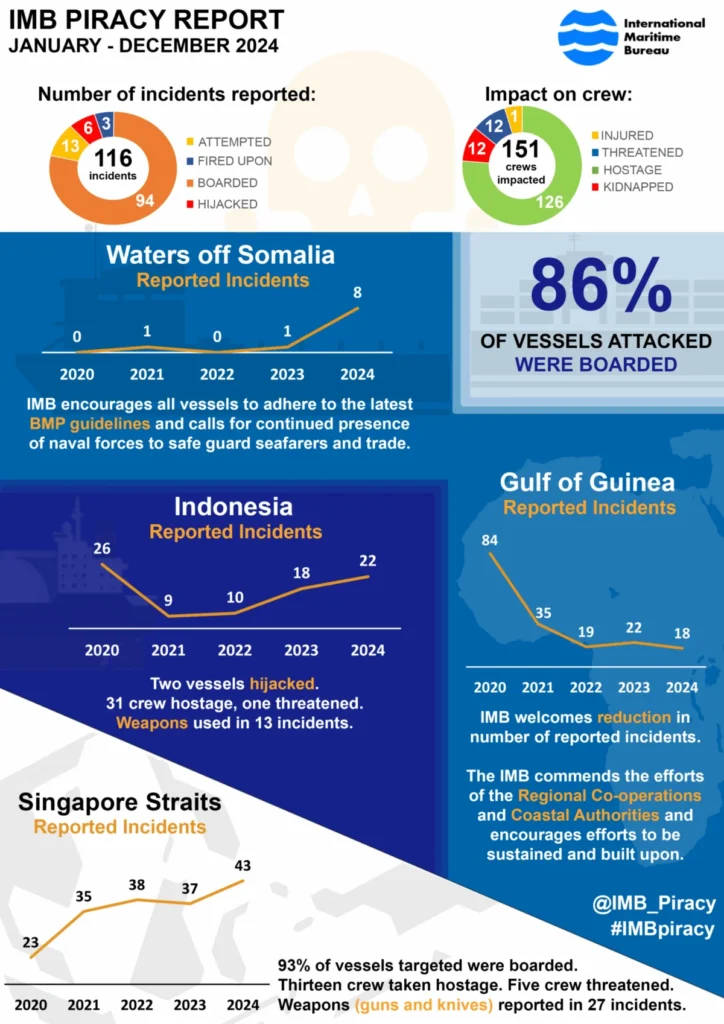
In recent years, the nature of piracy has shifted toward opportunistic armed robbery in the Gulf of Guinea and the Singapore Straits. The PRC has adapted by integrating advanced communication technologies and cybersecurity protocols to monitor incidents in real-time. The publication of the annual Piracy and Armed Robbery Against Ships report has become the industry benchmark, providing granular detail on the methodology and frequency of maritime attacks.
Supporting Data: The Anatomy of Modern Maritime Risk
The effectiveness of the IMB Piracy Reporting Centre is best reflected in the empirical data it collects. According to the most recent findings, piracy is rarely a random event; it follows patterns of economic instability and regional governance gaps.
Incident Categorization
The PRC categorizes incidents into three primary tiers:
- Actual Incidents: Successful boardings, kidnappings, or hijackings that result in theft or violence against the crew.
- Attempted Incidents: Instances where perpetrators are deterred by the vessel’s hardening measures, such as razor wire, water cannons, or vigilant crew watch.
- Suspicious Activity: Sightings of unidentified craft, unusual vessel behavior, or intelligence that points toward a potential threat.
The Value of Reporting
Many incidents go unreported due to a perceived lack of consequences or fear of rising insurance premiums. The IMB explicitly pushes back against this trend. By reporting, shipmasters ensure that their incident is included in the global record. This is the only way to compel regional governments to deploy patrol vessels and ensure that law enforcement agencies prioritize the safety of shipping lanes. The 2024 report, now available for professional analysis, details the correlation between increased reporting and a measurable decrease in successful boardings in specific corridors.
Official Responses: Strengthening the Legal and Operational Framework
The International Chamber of Commerce (ICC) and the IMB maintain that maritime security is a shared responsibility. The PRC’s director, Michael Howlett, has repeatedly emphasized that while technology and private security measures are essential, they are only a supplement to state-led law enforcement.
Collaboration with International Bodies
The PRC works in close concert with the International Maritime Organization (IMO) to align its findings with global regulatory standards. Through the provision of accurate, verified data, the Centre assists the IMO in developing the legal frameworks necessary to prosecute pirates in international courts.
Empowering the Seafarer
A core pillar of the PRC’s mission is the protection of the individual seafarer. Beyond the logistics of ship safety, the Centre emphasizes the human element—the psychological and physical toll that piracy takes on crews. By fostering a culture of transparency and proactive reporting, the PRC empowers masters to take command of their security posture, rather than feeling like victims of circumstances beyond their control.
Implications: The Future of Maritime Security
As the global economy faces ongoing challenges, from supply chain volatility to geopolitical tensions, the role of the IMB Piracy Reporting Centre is set to expand in significance.
The Shift Toward Digital Security
As ships become "smarter," they also become more vulnerable to cyber-intrusions that can facilitate physical piracy. The PRC is currently evaluating how it can integrate cyber-threat intelligence into its traditional reporting structure, ensuring that the maritime industry remains one step ahead of sophisticated criminal organizations.
The Importance of Global Cooperation
The implications of the PRC’s work reach far beyond the shipping industry. Maritime security is inextricably linked to global inflation; when ships are forced to detour or pay higher insurance premiums due to piracy, the cost of goods for the end consumer increases. Therefore, the PRC acts as a silent guardian of the global economy. By maintaining constant pressure on governments to secure their territorial waters, the IMB protects the affordability and availability of goods worldwide.
Call to Action for Shipowners
The IMB urges all shipmasters and owners to adopt a rigorous reporting culture. Complacency is the greatest ally of the pirate. By ensuring that every incident—no matter how minor—is documented, the maritime industry creates a comprehensive intelligence picture that makes the oceans less hospitable for criminals.
For those looking to deepen their understanding of the current threat landscape, the 2024 Piracy and Armed Robbery Against Ships report serves as a vital resource. It provides the necessary context to navigate modern maritime risks with confidence.
Contact Information
For further inquiries, to report an incident, or to discuss how the IMB can assist your organization in navigating maritime security, please reach out to the leadership team:
Michael Howlett
Director, ICC International Maritime Bureau
Tel: +44 207 423 6960
Email: [email protected]
Web: https://icc-ccs.org/request-piracy-report/
Final Thoughts: A Commitment to Vigilance
The ocean is a vast, unforgiving environment, but it is not lawless. Through the dedicated work of the IMB Piracy Reporting Centre, the maritime community has developed a system of defense that relies on cooperation, intelligence, and unwavering vigilance. As we look toward the future, the PRC remains committed to the principle that every seafarer has the right to a safe voyage, and every vessel deserves to travel without fear. By supporting the PRC’s mission, we are not just protecting cargo; we are upholding the integrity of global trade and the safety of the men and women who keep the world moving.