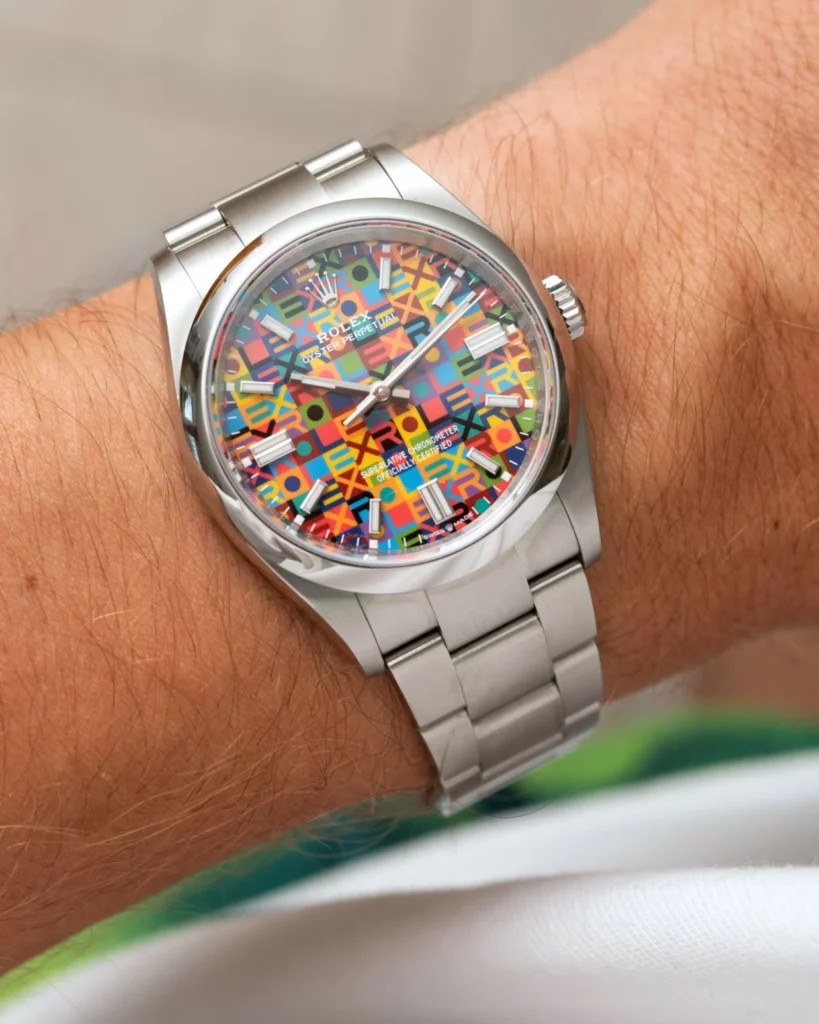
In an era where the luxury watch industry is increasingly criticized for "quietly quitting" on the finer details—offering diminishing returns in craftsmanship while prices continue to climb—the Rolex Oyster Perpetual 36 (Reference 126000) with the new-for-2026 "Jubilee" dial stands as a paradoxical achievement. It is simultaneously a testament to the brand’s unmatched industrial capability and a reminder of the "poverty-spec" complaints that often plague the entry-level segment of high horology. Priced at $6,750, this watch serves as a definitive case study in the tension between mass-market automation and the pursuit of artisanal excellence.

The Evolution of an Entry-Level Icon
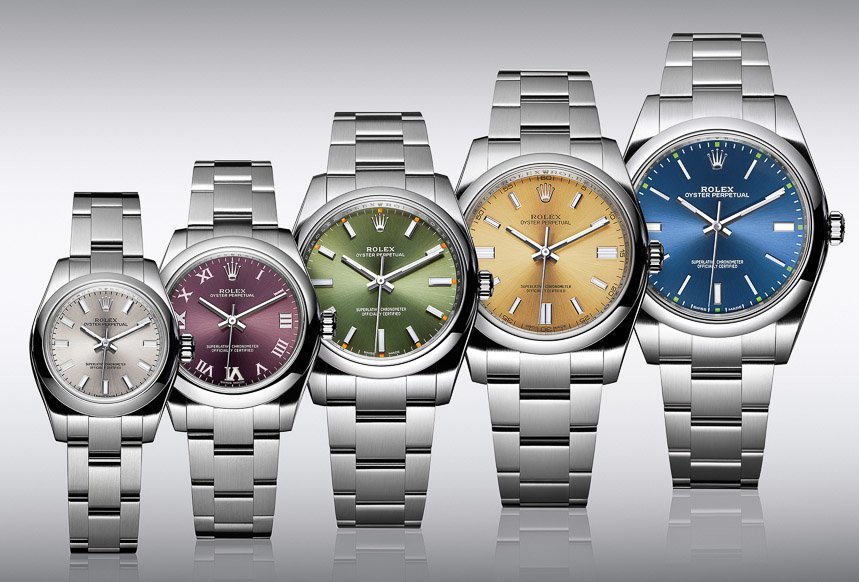
The Oyster Perpetual collection holds a unique position in the Rolex catalog. Named after the brand’s foundational waterproof "Oyster" case (celebrating its centennial in 2026) and the "Perpetual" self-winding system that debuted in 1931, the line has historically functioned as the brand’s gateway.

For much of the 2010s, however, the collection suffered from an identity crisis. The models released around 2015 were often criticized for a "held-back" design language. Many of the colorful dials from that era felt uninspired, featuring mismatched hour markers and base colors that lacked cohesion. They failed to capture the imagination, serving as a placeholder rather than a destination.

Everything changed in 2020. Rolex undertook a comprehensive redesign, adjusting proportions and replacing underwhelming aesthetics with bold, high-contrast, and design-oriented dials. The "Celebration" dial of 2023 was a turning point, but the 2026 "Jubilee" dial—an iteration of the legendary "Rolex motif" or "computer dial" originally popular in the 1980s—represents a technical leap that even industry veterans find difficult to reconcile with a $6,750 price point.

The Engineering Challenge: A Decade in the Making
The Jubilee dial is not merely a aesthetic choice; it is a manufacturing marathon. Unlike previous iterations of the motif dial, which relied on deep-etching or guilloché-like techniques to render the "R-O-L-E-X" pattern, the 2026 version is achieved through high-precision pad printing.

The complexity is staggering. The dial features 10 distinct colors, each of which must be printed with absolute registration. According to insider insights, each color is applied two to three times to achieve the desired saturation, resulting in roughly 25 to 30 individual printing sessions per dial. Between each pass, the work-in-progress components are placed in an oven to manage drying times, ensuring that the alignment of the letters remains within infinitesimal tolerances.
If any single print layer is misaligned by even a fraction of a millimeter, the entire pattern becomes a chaotic, muddy mess. The fact that Rolex has managed to scale this to series production is a feat that many rival manufactures would deem impossible. While the brand is famously tight-lipped about their specific production secrets, it is estimated that each individual dial requires roughly ten days to complete—a figure that underscores the sheer industrial commitment to what is technically an "entry-level" product.

Prototype vs. Production: The Reality of Automation
During Watches & Wonders Geneva 2026, initial prototypes of the Jubilee dial were scrutinized by the press. Under a macro lens, these early pieces showed signs of struggle: minor paint bleeds, slight misalignments at the intersection of the "squares" holding the letters, and evidence of multiple attempts at printing a single character.

However, the final production models tell a different story. The difference is "night and day." The production units are eerily perfect, suggesting that while prototypes may have been hand-refined by master artisans to gauge feasibility, the final series pieces are the result of a highly automated, hyper-precise process. This is the "Rolex edge": the ability to take a process that is essentially artisanal and translate it into a reliable, scalable, and perfect mechanical output. It reinforces the notion that while other brands may boast about hand-finishing, Rolex has mastered the art of industrial perfection.

Mechanical Prowess: The Caliber 3230
Beyond the dial, the watch is powered by the Caliber 3230, a movement that remains the gold standard for no-date, three-hand watches. The movement operates with a sense of refinement that is often taken for granted. In daily operation, the user experiences a lack of "crown wobble" when setting the time—a common frustration in other brands where pushing the crown back in shifts the minute hand.

The 3230 features:

- A 70-hour power reserve, providing significant weekend-proof utility.
- Paraflex shock absorbers, enhancing the movement’s durability in real-world conditions.
- -2/+2 seconds daily accuracy, surpassing even the stringent COSC standards.
- The Chronergy escapement, Rolex’s high-efficiency mechanism that optimizes power transmission.
For the owner, this manifests as a watch that simply works, every time, with a tactile quality to the winding and setting process that feels robust and engineered for a lifetime of service.

Implications for the Luxury Market
Despite the brilliance of the dial and the mechanical integrity of the movement, the Oyster Perpetual 36 is not without its flaws. There is an ongoing debate regarding the "poverty-spec" feel of the case and bracelet. The clasp, for example, is a single-security Oysterclasp rather than the more robust, double-security Oysterlock found on professional models. Additionally, some users have pointed out that the crown alignment is not consistent when fully screwed down, and there are sharp edges on the underside of the lugs that lack the final polish one might expect at this price point.

These omissions serve as a reminder that the Oyster Perpetual is, fundamentally, a tool watch. It lacks the fluted bezel, the date complication, and the see-through caseback that define more expensive Rolex tiers. However, this is precisely where the "Jubilee" dial changes the value proposition. By adding such a high-effort, high-complexity component to a "basic" watch, Rolex has elevated the entire experience. It forces the consumer to ask: Is the value in the case finishing, or is it in the 25-print-run dial that takes ten days to create?

Conclusion: A Beacon of Hope
The Rolex Oyster Perpetual 36 with the Jubilee dial is a fascinating study in contrast. It acknowledges the industry-wide trend of cutting corners, yet it simultaneously proves that extreme, multi-layered craftsmanship is still possible at scale.

For the collector, this watch offers a rare glimpse into the future of luxury watchmaking. It suggests that the future isn’t necessarily about "more hand-finishing," but about "more intelligent engineering." While the watch may be criticized for its utilitarian clasp or lack of "jewelry" finishes on the case, the dial serves as a defiant statement: Rolex is still the king of the dial. As long as the brand continues to push the boundaries of what can be printed on a circular piece of brass, they will likely remain the only entity in the industry capable of pulling off such a feat, ensuring that the "entry-level" Rolex remains anything but entry-level in its complexity.