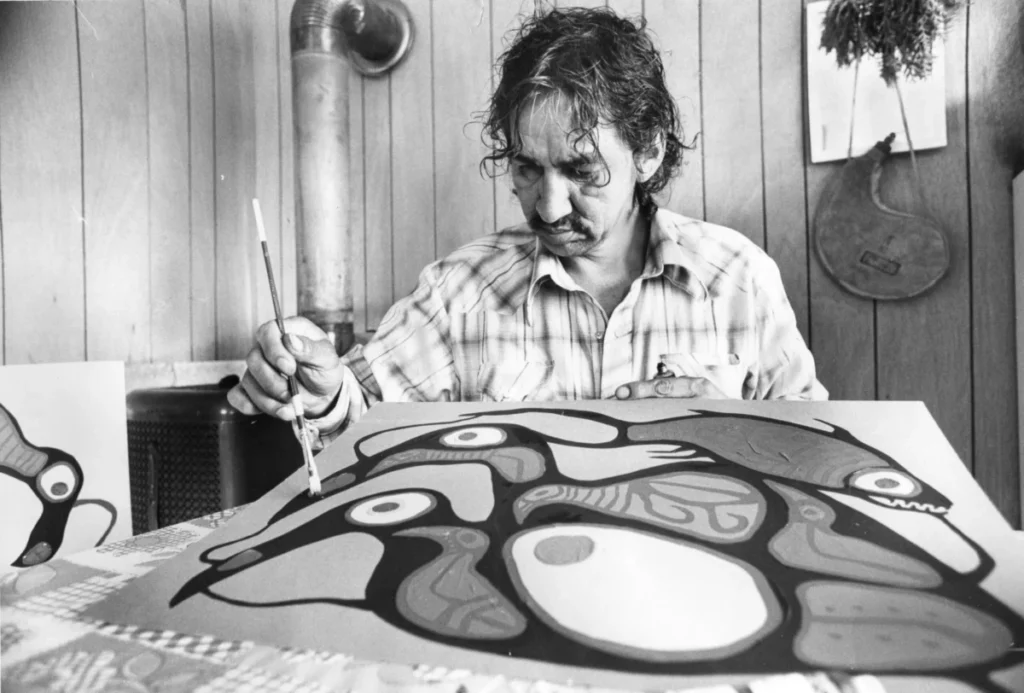
For years, the Canadian art market was haunted by a ghost—or, more accurately, thousands of them. The legacy of Norval Morrisseau, the visionary Anishinaabe artist and founder of the Woodland School, was systematically cannibalized by a sophisticated criminal enterprise. What began as a series of isolated suspicions eventually blossomed into the largest art fraud investigation in Canadian history, leading to the identification of at least 1,000 forged works.
While the headline-grabbing arrests and the chilling documentary There Are No Fakes brought the scandal to the public eye, a critical piece of the puzzle remained in the shadows. A little-known federal entity, the Canadian Conservation Institute (CCI)—a division of the Department of Canadian Heritage—played a pivotal role in unmasking the forgery ring. By applying rigorous forensic science to the brushstrokes of deceit, the CCI provided the smoking gun that brought the architects of this massive deception to justice.
The Chronology of a Deception
The roots of the fraud trace back to the late years of Norval Morrisseau’s life. As his market value climbed, the artist himself began to notice "works" appearing in galleries across Ontario and Alberta that bore his name but possessed none of his spirit. Morrisseau, who passed away in 2007 at the age of 75, fought a losing battle against the tide of forgeries during his final years. He went so far as to publicly disavow the Morrisseau Family Foundation, an organization ostensibly formed by his own kin to authenticate his work, after realizing it was frequently stamping certificates of authenticity on blatant fakes.
The unraveling of the scheme began in earnest in 2005, when Kevin Hearn, the keyboardist for the globally acclaimed band Barenaked Ladies, purchased a purported Morrisseau painting from the Maslak McLeod gallery in Toronto. Five years later, when Hearn loaned the piece to the Art Gallery of Ontario (AGO), curator Gerald McMaster raised immediate red flags.
The investigation that followed uncovered a trail of fictitious provenance and technical anomalies. The painting was signed on the back—a practice Morrisseau never adopted—and the gallery had fabricated a history for the work that simply did not exist. Although Hearn eventually secured a $60,000 judgment against the gallery, the victory was hollow; the gallery owner died while the case was still in the courts, and the money proved unrecoverable.
The true scale of the operation was not fully grasped until 2019, when the documentary There Are No Fakes exposed the dark reality: a vast, industrialized network of forgers, including members of Morrisseau’s own family, who had coerced children into helping produce the fraudulent works. The film, which the National Post described as "riveting" yet "complicated," served as the catalyst for a two-year-long investigation by the Ontario Provincial Police (OPP).
Forensic Science: The “Paint-by-Numbers” Smoking Gun
In 2021, the OPP turned to the Canadian Conservation Institute for scientific validation. The CCI, which typically provides technical support to over 2,700 museums, libraries, and archives across the nation, was tasked with examining four suspected forgeries.
The breakthrough came at the hands of Mylène Choquette, a senior scientific documentation technologist at the Institute. Using infrared reflectography—a technique designed to see through top layers of paint—Choquette examined a canvas and made a startling discovery. Beneath the vibrant reds and light blues of the supposed Morrisseau, she identified clear, hand-written codes: "R" and "LB."
"I needed to just step away from the setup and just come back to see if I see it again," Choquette later told CityNews. "Indeed, it was still there."
The discovery was the equivalent of finding a "paint-by-numbers" kit hidden beneath an alleged masterpiece. Further analysis revealed areas marked "medium green," confirming that the forgers had been working from a pre-determined color-coded map. The chemical analysis proved equally damning. While authentic Morrisseau works were painted using professional-grade acrylics, the CCI detected the presence of polyvinyl acetate and styrene—industrial binders that had no business being in a genuine Morrisseau painting.
Bolstered by these findings, the police submitted another 26 contested works. Between 2021 and 2023, the CCI worked systematically to dismantle the veneer of legitimacy that had protected these forgers for decades.
The Prosecution and the Architecture of Fraud
The forensic evidence provided by the CCI served as the bedrock for the subsequent legal proceedings. The OPP eventually charged eight individuals across three distinct fraud rings with a total of 40 charges, including forgery and defrauding the public of sums exceeding $5,000.
The investigation identified David Voss as the primary architect of the scheme. Prosecutors alleged that Voss, alongside figures like Gary Lamont, had systematically recruited Indigenous artists—including members of the Morrisseau family—to churn out the forgeries. The scale was staggering: investigators estimated that at least 1,000 fake paintings had been successfully sold into the market.
The legal fallout saw four suspects plead guilty, including Voss. Benji Morrisseau, the artist’s nephew, also admitted his role in the fraud, with his case being redirected through a First Nations restorative justice program. Charges against two others were eventually dropped. The process culminated in the trial of Jeff Cowan, who was found guilty of fraud and dealing in forged documents. Crucially, representatives from the CCI testified for the prosecution, their scientific expertise providing an unassailable argument against the defense’s claims of authenticity.
Official Responses and the Burden of Integrity
For years, the CCI maintained a wall of silence regarding its involvement in the case. It was only recently, recognizing the educational and cultural necessity of the story, that the Institute opened its doors to the press.
"Norval Morrisseau is one of the most important artists in Canada and his work is culturally significant to every single one of us," said Jennifer Poulin, a senior conservation scientist at the CCI. "When an artist like that is picked out and abused and treated this way, it affects the entire country. It’s really important that we’re able to try to stop this in any way that we can."
The CCI’s stance highlights a growing trend in the art world: the shift toward science as the ultimate arbiter of truth. As provenance documentation becomes increasingly easy to forge, the molecular and infrared analysis performed by institutions like the CCI has become the only true defense against sophisticated criminal syndicates.
Implications: A Market in Crisis
The Morrisseau fraud case is not merely a story of individual greed; it is a symptom of a larger, systemic crisis in the global art market. According to a 2024 study by insurance giant Chubb, fraud and concerns over provenance have overtaken physical damage as the primary worry for high-net-worth art collectors.
The damage done to the Morrisseau market is profound. While the police successfully removed 1,000 fakes from circulation, experts fear that thousands more remain in private collections, basement storage lockers, and even provincial museums, unrecognized and unvetted. The "Morrisseau brand" has been tainted, and the shadow of doubt cast upon the artist’s oeuvre may take decades to clear.
Furthermore, the involvement of the artist’s own family in the exploitation of his name adds a layer of intergenerational trauma that complicates the pursuit of justice. The use of restorative justice programs for some of the perpetrators suggests a path forward that focuses on healing the community and the legacy of the artist, rather than just incarceration.
As the Canadian art world moves forward, the "Morrisseau Affair" stands as a cautionary tale. It demonstrates that the value of art is not merely financial, but cultural—a shared heritage that requires constant, vigilant protection. The unsung heroes at the Canadian Conservation Institute have reminded us that when the truth is obscured by layers of pigment and deceit, it is the cold, hard science of forensics that will eventually reveal the masterpiece—or the lie—beneath.