Introduction: The Silent Sentinels of the High Seas
For centuries, the world’s oceans have served as the lifeblood of global commerce. Today, more than 80% of the volume of international trade in goods is carried by sea. Yet, beneath the vast, serene expanse of the maritime corridors lies a persistent and evolving threat: piracy and armed robbery against ships. As supply chains grow increasingly complex and global economies more interdependent, the security of these vessels is not merely a matter of corporate safety—it is a cornerstone of global stability.
Since its inception in 1991, the International Maritime Bureau’s (IMB) Piracy Reporting Centre (PRC) has functioned as the industry’s primary guardian against maritime criminality. Operating as a 24-hour nerve center, the PRC serves as a vital bridge between vulnerable vessels, naval task forces, and national law enforcement agencies. This report examines the operational framework, historical significance, and ongoing mission of the IMB-PRC in an era where maritime threats are becoming increasingly sophisticated.
The Operational Framework: How the IMB-PRC Functions
The effectiveness of the IMB-PRC lies in its role as a centralized, neutral information hub. Piracy is often characterized by the isolation of the victim; a ship under attack in the Gulf of Guinea or the Sulu-Celebes Seas is frequently beyond the immediate reach of conventional shore-based emergency services.
The 24-Hour Watch
The PRC operates a continuous monitoring service. When a vessel reports an incident—be it a sighting of suspicious small craft, an attempted boarding, or a full-scale hijacking—the PRC acts as an immediate clearinghouse for intelligence. By maintaining a 24/7 watch, the Centre ensures that no report is lost in bureaucratic latency.
Coordinated Response and Early Warning
One of the most vital functions of the Centre is the dissemination of alerts. Upon receiving a distress call or a report of suspicious activity, the PRC immediately broadcasts warnings to ships in the vicinity and issues email alerts to the global maritime community. This "early warning" system allows other masters to adjust their routes, harden their vessels, and maintain heightened vigilance, effectively creating a "neighborhood watch" on the high seas.
The Power of Data-Driven Advocacy
Beyond crisis response, the IMB-PRC is the world’s most trusted source of maritime piracy statistics. By meticulously recording every actual, attempted, and suspected incident, the Centre provides the data necessary for:
- Risk Assessment: Shipping companies use these insights to plan secure routes and allocate insurance resources.
- Resource Allocation: Naval authorities and coast guards rely on PRC data to identify "hotspots," allowing them to deploy patrol vessels where they are needed most.
- Policy Formulation: The ICC uses this data to advocate for better legal frameworks and naval cooperation at the International Maritime Organization (IMO) and other intergovernmental bodies.
A Chronology of Maritime Vigilance
The creation of the IMB-PRC in 1991 was not a preemptive move, but a necessary response to a surge in maritime insecurity that threatened the post-Cold War expansion of global trade.
- 1991: The Founding. Faced with rising reports of piracy in Southeast Asian waters, the ICC established the IMB-PRC to act as a global focal point for incident reporting.
- 1990s–2000s: The Evolution of Threats. The Centre’s early years were spent formalizing reporting protocols. As the 2000s progressed, the rise of piracy off the coast of Somalia transformed the global landscape. The IMB-PRC became a critical source of intelligence for the international naval coalitions, such as Operation Atalanta, providing real-time data that helped secure the shipping lanes of the Gulf of Aden.
- 2010s–Present: The Shift to West Africa and Beyond. As Somalia-based piracy declined due to international naval pressure and "hardened" vessels, the epicenter of maritime crime shifted to the Gulf of Guinea. The IMB-PRC adapted by strengthening its ties with regional authorities in West Africa, emphasizing the importance of timely reporting in regions where local law enforcement capacity is often overstretched.
Supporting Data: The Impact of Reporting
The IMB maintains that the "dark figure" of piracy—incidents that go unreported—is one of the greatest obstacles to maritime security. Without accurate reporting, authorities cannot justify the allocation of patrol assets to specific regions.
Why Reporting Matters
When a shipmaster reports an incident, they are not merely filing a complaint; they are contributing to a global security database. The IMB-PRC categorizes these incidents into three distinct tiers:
- Actual Incidents: Successful boardings or hijackings where cargo, ship stores, or crew belongings are stolen.
- Attempted Incidents: Situations where pirates are thwarted by the vessel’s security measures (e.g., razor wire, water cannons, or citadels).
- Suspicious Incidents: Sightings of unlit small craft, aggressive maneuvers, or unusual patterns of navigation that indicate potential hostiles.
By analyzing these tiers, the IMB can identify emerging trends. For example, a spike in "suspicious" sightings in a specific maritime corridor is often a precursor to a wave of successful attacks. Early reporting allows the IMB-PRC to issue proactive warnings that save lives and prevent the theft of millions of dollars in maritime assets.
Official Responses: The ICC’s Commitment
The International Chamber of Commerce (ICC), as the parent organization of the IMB, plays a pivotal role in amplifying the concerns of the maritime industry. Representing over 45 million companies in 170 countries, the ICC leverages its influence to ensure that maritime safety remains a priority on the international political agenda.
The Role of Leadership
Michael Howlett, Director of the ICC International Maritime Bureau, has consistently emphasized that maritime security is a shared responsibility. According to Howlett, "The goal is to foster a culture of transparency. When shipowners and masters communicate with the PRC, they are acting as the eyes and ears of the industry. This collaboration is the most effective tool we have to compel governments to act."
The ICC’s philosophy is rooted in the idea that "business works for everyone, everywhere." By protecting the integrity of the supply chain, the IMB-PRC fulfills this mission, ensuring that goods—from raw materials to medicine—reach their destinations without the "tax" imposed by criminal syndicates.
Implications: The Future of Maritime Security
The landscape of maritime crime is changing. Modern pirates are increasingly tech-savvy, utilizing high-speed skiffs, satellite communications, and sophisticated navigation tools. Furthermore, the convergence of maritime piracy with other criminal activities—such as fuel theft, smuggling, and illicit human trafficking—means that the IMB-PRC must operate with even greater precision.
The Shift Toward "Hardened" Vessels
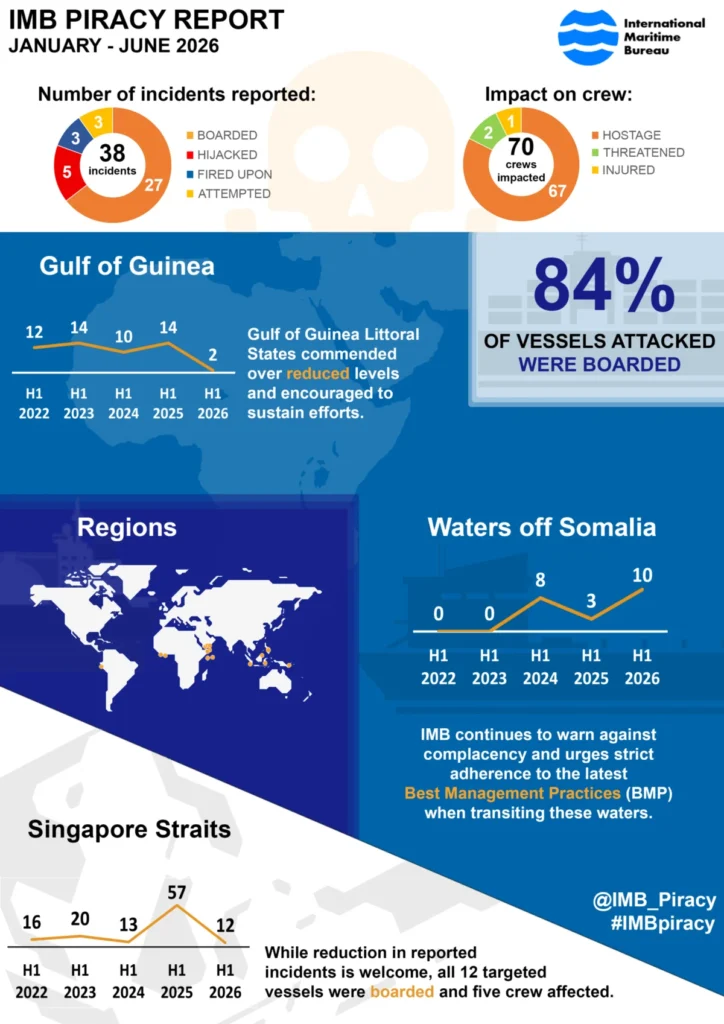
One of the most significant implications of the data provided by the IMB-PRC is the success of "Best Management Practices" (BMP). The data shows that vessels following established security protocols, such as maintaining a 24-hour watch, using citadels, and hardening access points, are significantly less likely to be successfully boarded. The PRC’s role in promoting these practices is as vital as its role in reporting.
The Need for Regional Cooperation
The future of maritime security rests on the ability of coastal states to cooperate. The IMB-PRC continues to lobby for better regional cooperation, particularly in areas where jurisdictional boundaries complicate naval responses. By providing an objective, independent record of incidents, the PRC holds regional authorities accountable, pushing for the implementation of the rule of law in international waters.
Conclusion: A Call to Action for the Maritime Industry
The IMB Piracy Reporting Centre is more than just a reporting office; it is a critical infrastructure component of global trade. Its existence serves as a constant reminder that the seas are not lawless, provided that the maritime community remains vigilant and connected.
The IMB encourages all shipmasters and owners to treat the reporting of piracy not as a choice, but as a professional obligation. By providing accurate, real-time intelligence, every vessel helps the IMB-PRC build a comprehensive picture of maritime threats, which in turn leads to more effective resource allocation and stronger protection for the crews that keep the world moving.
As the ICC continues its mission to promote international trade and responsible business conduct, the IMB-PRC will remain at the forefront of the fight for safer seas. In an increasingly volatile world, the vigilance fostered by the PRC is the best defense against those who would threaten the safety of our oceans.
Contact Information
For those in the maritime industry seeking to report an incident or obtain further information regarding security protocols, the IMB Piracy Reporting Centre remains the primary point of contact:
Michael Howlett
Director, ICC International Maritime Bureau
Tel: +44 207 423 6960
Email: [email protected]
The International Chamber of Commerce (ICC) remains committed to providing the advocacy, solutions, and standard-setting necessary to navigate the complexities of global trade. By supporting the IMB-PRC, the ICC ensures that the maritime sector—the bedrock of our global economy—remains secure, efficient, and resilient.