


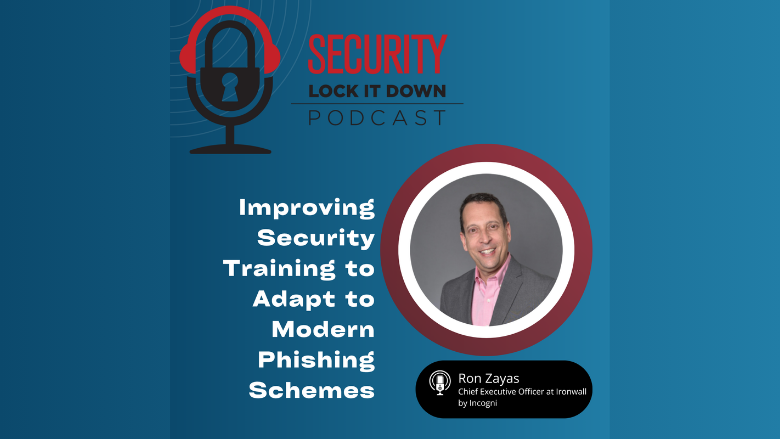
In the digital age, the concept of "private information" has become increasingly fluid. While organizations invest millions in firewalls, endpoint detection, and sophisticated encryption, a glaring vulnerability often sits in plain sight: the vast, easily accessible ocean of personal data floating across the internet. In a recent episode of Lock It Down, the official podcast of Security magazine, Jordyn Alger sat down with Ron Zayas, Chief Executive Officer at Ironwall by Incogni, to dissect the alarming ease with which bad actors can weaponize publicly available information against both individuals and the organizations they lead.
The Reality of Public Data Vulnerability
For many, the term "cybersecurity" conjures images of complex code-breaking and high-stakes hacking. However, Zayas emphasizes a more sobering reality: the most dangerous threats often require little to no technical prowess. The proliferation of "people search" sites and data brokers has effectively democratized reconnaissance for malicious actors.
"We are living in an era where an individual’s digital footprint is no longer just a trace—it is a map," Zayas explained during the discussion. "Bad actors aren’t always looking for a backdoor into a secure server; often, they are looking for the front door of your home, your personal phone number, or your family members’ names, all of which are readily available on legitimate-looking data broker sites."
This accessibility transforms standard phishing attempts from generic "spray and pray" tactics into hyper-personalized, high-success operations. When a threat actor knows an executive’s travel history, their spouse’s name, or their recent real estate transactions, the threshold for social engineering success drops precipitously.
Chronology of an Information Leak
To understand the scope of the threat, one must look at the lifecycle of personal data in the modern ecosystem.
- The Accumulation Phase: Every time an individual registers for a utility, signs up for a retail loyalty program, or fills out a public records request, that data is harvested.
- The Aggregation Phase: Data brokers ingest information from thousands of disparate sources, stitching together a comprehensive profile of an individual—a "dossier" that includes home addresses, email aliases, and professional affiliations.
- The Commercialization Phase: This data is sold, often for pennies, to anyone with a credit card. While intended for marketing or background checks, it is frequently purchased by malicious actors.
- The Weaponization Phase: The information is integrated into a social engineering campaign. Whether it is a "whaling" attack (targeting a C-suite executive) or a physical threat against an employee’s residence, the data serves as the foundation for the assault.
Supporting Data: The Cost of Exposure
The security community has long recognized the nexus between physical and cyber risks. According to recent industry reports, human error and social engineering remain the primary vectors for successful data breaches. When employees’ personal data is exposed, the line between their professional responsibilities and their private lives blurs.
"When you think about the attack surface of an organization, you have to include the homes and private lives of the people who run it," Zayas noted. "If an attacker can threaten an executive’s family or find their private contact details, they bypass the corporate firewall entirely. It’s an end-run around the most sophisticated security infrastructure."
Furthermore, data suggests that the prevalence of people-search sites has grown exponentially over the last five years. Regulations like the GDPR in Europe and the CCPA in California have provided some relief, but the sheer volume of brokers makes total "scrubbing" of the internet an uphill, if not impossible, battle for the average person.
Official Responses and Strategic Shifts
Organizations are beginning to acknowledge that "Security Awareness Training" must evolve. Traditional training modules that focus on identifying suspicious emails are no longer sufficient when those emails are bolstered by accurate, non-public, or semi-public information.
Adapting to Modern Phishing Schemes
Modern phishing is characterized by its high degree of relevance. If an attacker sends a message to a CFO regarding a specific, accurate real estate transaction they completed last week, the likelihood of that CFO clicking a malicious link skyrockets.
To combat this, Zayas advocates for a proactive approach:
- Executive Protection Programs: Treating the personal data of high-value targets as corporate assets.
- Data Minimization: Educating staff on how to opt-out of data broker sites and limit their online exposure.
- Continuous Monitoring: Implementing tools that alert individuals when their private information appears on new, potentially dangerous platforms.
Implications for the Future of Security
The implications of this persistent data leakage are profound for the security industry. First, it forces a shift in the definition of "perimeter." The corporate perimeter is now global and decentralized. An employee’s home office, their smart devices, and their social media footprint are all extensions of the enterprise network.

Second, the burden of security is increasingly shifting toward the individual. While corporations provide the tools, the employee must be the first line of defense in managing their digital identity. This creates a new mandate for Human Resources and Security teams to collaborate on "Digital Hygiene" as a core component of employee wellness and corporate safety.
The Role of Technology
As artificial intelligence (AI) enters the fray, the threat level will only rise. AI-powered tools can now scrape the entire internet in seconds, cross-referencing information to build near-perfect personas for deep-fake voice or video attacks. The defense must be equally sophisticated, leveraging automated scrubbing services—like those offered by Ironwall—to keep pace with the velocity of modern data aggregation.
A Call to Action for Security Leaders
As the discussion concluded, Zayas underscored that the goal is not to disappear from the internet entirely, which is nearly impossible, but to reduce the utility of the data for bad actors. By making it difficult for an attacker to verify a target’s information, an organization can effectively lower the ROI for the attacker, forcing them to move on to easier targets.
"We are in a race," Zayas concluded. "The bad actors are using automation to exploit our data. We must use better automation to protect it."
Key Takeaways for Organizations:
- Conduct a Privacy Audit: Understand exactly what information is available about your leadership team on public search engines and broker sites.
- Empower the Workforce: Provide resources for employees to manage their own digital footprint, not just the company’s.
- Integrate Privacy into Risk Management: Recognize that personal data exposure is a legitimate risk vector that should be reported to the Board alongside traditional cybersecurity metrics.
- Prioritize Education: Shift training from "detecting phishing" to "understanding the digital footprint" and how it informs modern social engineering.
As we move further into an era of hyper-connectivity, the walls between our private lives and our professional duties will continue to erode. For the modern security leader, the challenge is clear: protect the individual to protect the institution. By recognizing the role that publicly accessible data plays in the current threat landscape, organizations can begin to build a more resilient, comprehensive defense that accounts for the reality of the modern, transparent world.
For more in-depth insights into the evolving landscape of physical and cybersecurity, listen to the full episode of Lock It Down on Apple Podcasts or via the Security Magazine website.



