London, 15 January 2026 — The global maritime landscape faced a turbulent year in 2025, as fresh data from the ICC International Maritime Bureau (IMB) reveals a concerning uptick in piracy and armed robbery at sea. While the world’s navies have successfully suppressed the once-dominant threat of Somali piracy, the rise of opportunistic, low-level criminality in critical transit corridors—most notably the Singapore Straits—has introduced new complexities for international shipping.
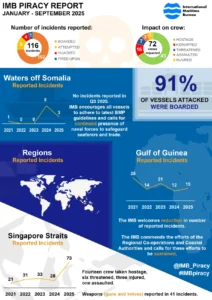
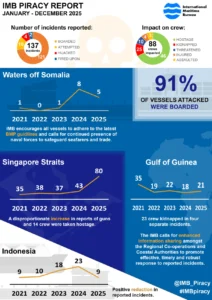
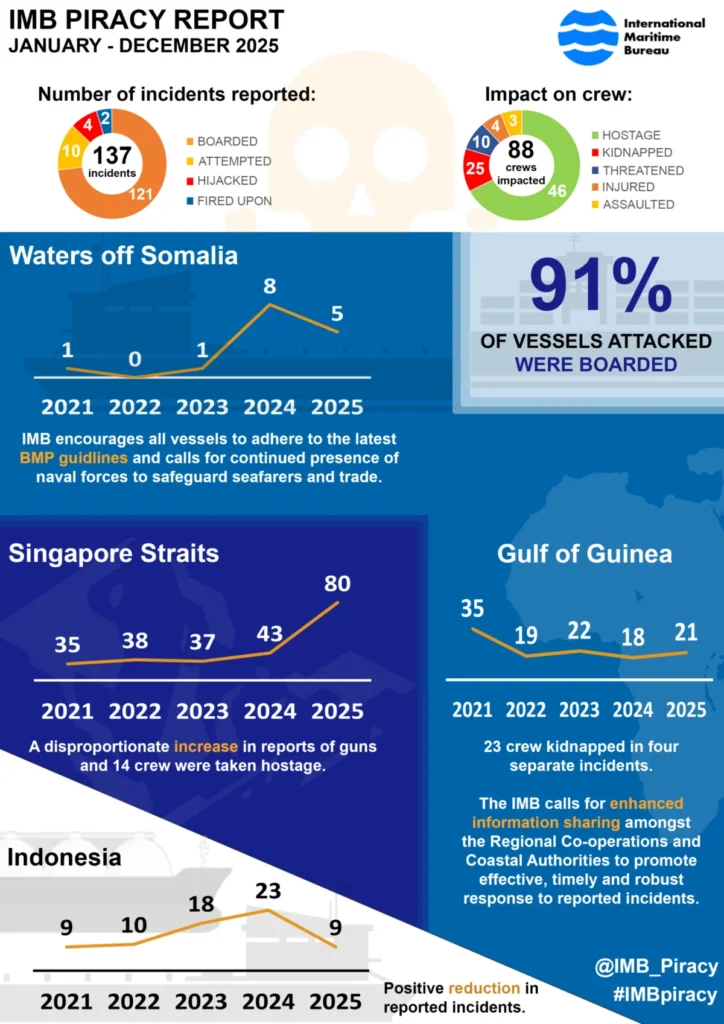
According to the IMB Annual Piracy and Armed Robbery Report, 2025 saw a total of 137 maritime incidents, marking a significant increase from the 116 recorded in 2024 and 120 in 2023. As the global economy remains tethered to the efficiency of its shipping lanes, this surge in criminal activity presents not only a humanitarian crisis for seafarers but a structural threat to the stability of global supply chains.
The Core Data: A Quantitative Analysis of 2025
The IMB’s latest figures provide a granular look at the nature of these maritime threats. Of the 137 reported incidents, the vast majority were classified as "low-level" armed robberies. However, the definition of "low-level" often belies the trauma inflicted upon the crews involved.
Breakdown of Incidents:
- Boardings: 121 vessels were successfully boarded by perpetrators.
- Hijackings: Four vessels were seized by criminal syndicates.
- Armed Aggression: Two vessels were fired upon, and 10 reported attempted attacks.
The data reveals a shift in the nature of weaponry employed by perpetrators. The use of firearms has seen a marked increase, with guns reported in 42 incidents throughout 2025, compared to 26 in 2024. Conversely, the use of knives—the traditional tool of the opportunistic pirate—was reported in 33 incidents, a slight decrease from the 39 recorded the previous year. This transition toward firearms signals a more dangerous operating environment for crews, as attackers appear increasingly willing to escalate to lethal force to achieve their objectives.
Chronology of Trends: From 2023 to 2025
To understand the current trajectory, one must look at the fluctuations over the past three years. The year 2023 served as a baseline, with 120 incidents, which dipped slightly in 2024 to 116. The 2025 figure of 137 represents a 18% jump year-over-year.
Hostage and Kidnapping Statistics
Perhaps the most harrowing metric in the IMB report concerns the human cost of maritime crime.
- Hostage Situations: In 2025, 46 crew members were taken hostage. This is a notable decline from the 126 in 2024 and 73 in 2023, suggesting that while the number of attacks has risen, the intent of the attackers is shifting away from long-term hostage-taking toward rapid theft and extraction.
- Kidnappings: Conversely, kidnappings have spiked. Twenty-five crew members were kidnapped in 2025, nearly doubling the 12 reported in 2024 and exceeding the 14 reported in 2023.
- Assault and Injury: In addition to these major incidents, 10 crew members were threatened, four sustained injuries, and three were physically assaulted during the course of their duties.
These figures illustrate a volatile environment where the risk of abduction is on the rise, forcing shipping companies to re-evaluate their security protocols and crew safety training.
The Singapore Straits: A Global Chokepoint Under Siege
The report identifies the Singapore Straits as the most significant area of concern. Despite consistent calls for increased patrols and regional collaboration, the straits remain a hotbed for opportunistic armed robbery. The high density of vessel traffic, combined with the proximity of multiple jurisdictions, creates an environment where perpetrators can strike and retreat into sovereign waters with relative impunity.
The persistence of these attacks undermines the efficiency of one of the world’s busiest maritime corridors. When vessels are forced to implement "hardened" security measures—such as increased watchkeeping, barbed wire, and speed adjustments—the flow of global trade inevitably slows, leading to cascading delays at ports worldwide.
Official Responses and Strategic Perspectives
The International Chamber of Commerce (ICC) has been vocal regarding the necessity of a coordinated, international response to this maritime menace.
The Stance of the ICC
ICC Secretary General John W.H. Denton AO issued a stern warning following the report’s release:
"Maritime trade remains a cornerstone of real economic activity and growth. The rise in reported maritime incidents highlights the importance of protecting seafarers and securing key shipping routes not only for crew safety, but for the stability of global supply chains and the economies that depend on them. Ensuring safe passage at sea requires sustained cooperation, with regional and international partners working together to safeguard maritime commerce."
The Success of Naval Presence
The report does offer a glimmer of optimism: the threat of Somali piracy, which crippled maritime security in the late 2000s and early 2010s, remains largely contained. The success of international naval coalitions, combined with the widespread implementation of Best Management Practices (BMP), proves that when the international community prioritizes maritime security, the threat can be mitigated. The current challenge, therefore, is to apply that same level of collaborative rigor to the localized hotspots, such as the Singapore Straits and the Gulf of Guinea.
Implications for Global Trade and Maritime Safety
The 2025 statistics serve as a warning to the shipping industry. As piracy methods evolve, the reactive nature of current security measures may no longer be sufficient.
Economic Consequences
The economic impact of piracy extends far beyond the stolen cargo. Increased insurance premiums, the cost of rerouting vessels, the implementation of sophisticated onboard security hardware, and the psychological toll on seafarers—which leads to retention crises—all contribute to the rising cost of sea-borne trade. For an economy like Singapore’s, or for the global consumer who relies on timely arrivals of goods, maritime insecurity is essentially an "invisible tax."
The Call for Technological Integration
Industry experts are increasingly calling for the integration of maritime domain awareness (MDA) technology. By utilizing satellite tracking, automated identification systems (AIS), and AI-driven predictive analytics, shipping companies and naval forces can better identify high-risk areas before an attack occurs. However, technology alone cannot replace the need for "boots on the deck"—the presence of armed guards or naval escort vessels remains the most effective deterrent against boarding attempts.
Legal and Policy Hurdles
One of the primary obstacles to curbing piracy is the "jurisdictional maze." When an incident occurs, determining which state has the authority to prosecute the perpetrators—and whether that state has the legal framework to do so effectively—often leads to the release of suspected pirates due to lack of evidence or procedural delays. The IMB is advocating for stronger legislative cooperation between coastal states to ensure that maritime crime does not go unpunished.
Conclusion: A Call to Action for 2026
As the maritime industry looks toward the remainder of 2026, the data from 2025 serves as a sobering reminder that the seas are not self-policing. The decline in the severity of Somali piracy is a victory, but the rise in armed robbery in Southeast Asia and the increase in kidnappings demonstrate that maritime crime is a shape-shifting adversary.
The solution lies in a three-pronged approach:
- Enhanced Regional Cooperation: Coastal nations must harmonize their patrol efforts and intelligence sharing to prevent the "haven-hopping" that criminals currently exploit.
- Technological Investment: Shipping lines must prioritize the hardening of vessels and the adoption of modern surveillance tools to keep their crews safe.
- Human-Centric Policies: The shipping industry must recognize that the most vulnerable component of the supply chain is the crew. Protecting them is not just a matter of ethics; it is a matter of operational survival.
The IMB’s report is not merely a collection of statistics; it is a blueprint for the security challenges that lie ahead. Without renewed focus and sustained international partnership, the gains made in maritime safety over the last decade risk being eroded by the persistent, rising tide of 21st-century piracy. The world’s economies depend on the safe passage of goods; it is time for the global maritime community to ensure that those passages remain secure for all who traverse them.