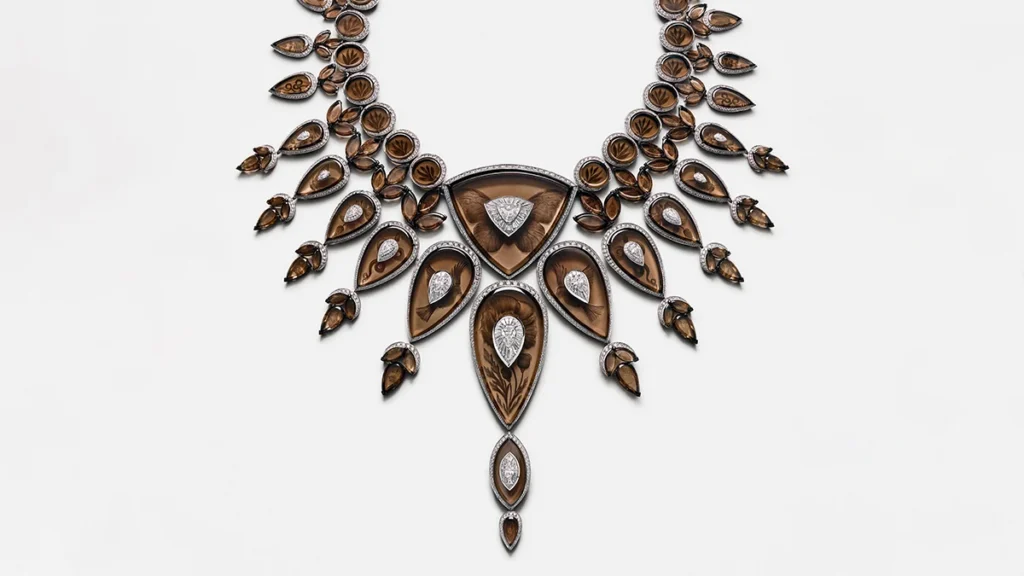
PARIS — On the storied cobblestones of the Place Vendôme, where historic French jewelry houses have long competed through the sheer carat weight of rare gemstones, Boucheron’s Creative Director Claire Choisne continues to operate by an entirely different set of rules. Known across the luxury world as an iconoclast of haute joaillerie, Choisne has once again upended traditional expectations with her latest creation for the maison’s annual Carte Blanche collection: an extraordinary necklace inspired by 19th-century Victorian tattoo iconography, rendered inside 580 carats of masterfully carved smoky quartz.
The piece, which required an astounding 3,220 hours of bench craftsmanship and the fabrication of more than 200 bespoke lapidary tools, bridges two centuries of artistic nonconformity. By using specialized reverse-intaglio glyptic carving, Boucheron has encapsulated founder Frédéric Boucheron’s signature naturalistic motifs—including cicadas, serpents, butterflies, chickadees, and wild poppies—within transparent mineral strata, creating the visual illusion of organic specimens preserved in amber or etched directly upon the wearer’s skin.
                       BOUCHERON CARTE BLANCHE MASTERPIECE
                               At a Glance
 ┌────────────────────────────────┬──────────────────────────────────────────┐
 │ METRIC / SPECIFICATION         │ DETAILS                                  │
 ├────────────────────────────────┼──────────────────────────────────────────┤
 │ Primary Medium                 │ 580 Carats of Natural Smoky Quartz       │
 │ Centerpiece Gemstone           │ 1.74-Carat D-Color, VVS1 Troidia Diamond │
 │ Precious Metal & Accents       │ 18-Karat White Gold with Pavé Diamonds   │
 │ Total Crafting Time            │ 3,220 Atelier Hours                      │
 │ Custom Tooling Manufactured    │ 200+ Bespoke Lapidary & Engraving Tools  │
 │ Primary Artistic Technique     │ Reverse Glyptic Intaglio / Bas-Relief    │
 │ Curatorial Retrospective       │ "Boucheron: In Focus" at Christie's NY   │
 └────────────────────────────────┴──────────────────────────────────────────┘
1. Main Facts: A Masterpiece in Light and Stone
The focal point of the maison’s latest high jewelry collection is a technical and aesthetic triumph that challenges the conventional hierarchy of jewelry materials. Rather than anchoring the design solely around a traditional emerald-cut emerald or a cushion sapphire, Choisne chose smoky quartz as the primary narrative canvas, utilizing 580 carats of the crystalline mineral.
                      ANATOMY OF THE REVERSE-ETCHED QUARTZ

       Incoming Light ─────────► [ Convex Front Surface ]
                                           │
                                           │ (Refraction through crystal)
                                           ▼
                                 [ Intaglio Cavity ]
                                 (Reverse-carved flora & fauna)
                                           │
                                           ▼
       Visual Effect  ◄───────── [ Bas-Relief Appearance ]
                                 "Fossilized in Amber / Tattoo on Skin"
The necklace’s architecture relies on the ancient art of glyptics—the carving and engraving of gemstones. In this instance, artisans executed an intricate reverse-intaglio technique, carving the designs into the back of each quartz segment so that, when viewed from the polished front, the motifs appear three-dimensional and suspended in mid-air.
Key Compositional Elements:
- The Gemological Centerpiece: The necklace is anchored by a 1.74-carat triangular-modified "troidia-cut" diamond, certified D-color and VVS1 clarity, providing an icy, sharp geometric focal point against the warm, atmospheric depths of the quartz.
- Archival Iconography: Carved into the mineral segments are Frédéric Boucheron’s historical flora and fauna motifs—intertwined roses, wild foliage, undulating serpents, cicadas, fluttering butterflies, and chickadees.
- Structural Framework: The quartz elements are bound together by an articulated framework of 18-karat white gold, meticulously pavé-set with brilliant-cut diamonds to trace the contours of the collarbone.
2. Chronology: From 1858 Place Vendôme to 21st-Century Audacity
The release of the Victorian tattoo-inspired necklace marks the latest chapter in a 168-year continuum of aesthetic disruption. Boucheron’s historical identity has been defined by a refusal to follow standard market formulas.
 BOUCHERON INNOVATION TIMELINE

 1858 ── Frédéric Boucheron establishes the Maison in Paris, prioritizing
         nature-inspired realism over rigid classicism.

 1879 ── Invention of the Question Mark Necklace: the first clasp-free,
         asymmetrical high jewelry piece designed for modern feminine autonomy.

 1893 ── Boucheron becomes the first high jeweler to establish a flagship salon
         at 26 Place Vendôme, capturing the square's optimal natural light.

 2011 ── Claire Choisne appointed Creative Director, initiating an era of
         unprecedented material experimentation.

 2020 ── The "Goutte de Ciel" pendant debuts, utilizing NASA Aerogel to capture
         the physical color of the sky.

 2026 ── Debut of the Carte Blanche Tattoo Necklace, fusing Victorian glyptic
         etching with 580 carats of smoky quartz; announcement of Christie's
         New York retrospective.
The Legacy of Frédéric Boucheron (1858–1902)
When Frédéric Boucheron opened his first boutique under the arcades of the Palais-Royal in 1858, he differentiated his workshop through a commitment to naturalism and metallurgical innovation. In 1879, he introduced the Question Mark (Point d’Interrogation) necklace, an asymmetrical, clasp-less wrap-around design that allowed women to put on their jewelry without the assistance of a maid or jeweler—a radical step forward in functional design.
In 1893, he became the first jeweler to move to Place Vendôme, selecting Number 26 at the corner of the Rue de la Paix because it received the most sunlight, ensuring that his stones sparkled with maximum brilliance throughout the day.
The Modern Era of Claire Choisne (2011–Present)
Since taking the creative helm in 2011, Claire Choisne has consistently redefined the boundaries of high jewelry. Under her direction, the annual Carte Blanche collections have introduced materials previously considered unthinkable in high jewelry:
- NASA Aerogel: Incorporating the 99.8% air substance utilized by the Mars Exploration Rover to insulate space equipment and collect stardust, capturing atmospheric light in a physical pendant.
- Algorithmic Modeling: Utilizing computational fluid dynamics and mathematical algorithms to construct structural collars that recreate the appearance of weightless cumulus clouds.
- Holographic Coatings: Applying industrial metal oxides to ceramics and rock crystal to capture the natural optical phenomena of northern lights and prism refractions.
3. Technical Precision and Supporting Data: Engineering Intaglio in Quartz
While Choisne’s earlier collections relied heavily on aerospace technology and mathematical software, the Carte Blanche tattoo necklace represents a triumph of classical lapidary engineering pushed to its extreme physical limits.
                          WORKSHOP LABOR ALLOCATION
                          Total Hours: 3,220

 [ Lapidary Tool Fabrication ] ██████░░░░░░░░░░░░░░░░ (18%)
 [ Quartz Reverse-Intaglio   ] ████████████░░░░░░░░░░ (38%)
 [ High-Precision Setting    ] ████████░░░░░░░░░░░░░░ (24%)
 [ Articulation & Finishing  ] ██████░░░░░░░░░░░░░░░░ (20%)
The Hardness Dilemma and Custom Tooling
Smoky quartz registers a 7 on the Mohs hardness scale. Unlike soft carving mediums, quartz is brittle and resistant to continuous abrasion, leaving zero room for lapidary error. A single fracture or misplaced cut on the reverse face ruins the entire crystal block.

- Tool Engineering: Standard jewelry engraving styluses are incapable of creating deep-relief bas-relief within microscopic dimensions. Boucheron’s workshop had to design and forge more than 200 custom miniature tools, varying from diamond-tipped micro-burs to specialized copper wheels charged with diamond paste.
- Tool Degradation and Remodeling: Because of the quartz’s abrasive density, these custom tools wore down rapidly during micro-sculpting. Craftsmen were forced to pause, reshape, and recalibrate their instruments hundreds of times throughout the process to maintain the precise depth and curvature of every leaf, wing, and petal.
- The Optical Calculation: The lapidary team had to carve the motifs in reverse negative space, constantly factoring in the refractive index of quartz (1.544–1.553). The artisans worked without directly seeing the final positive image, checking their progress by viewing the piece through the polished front face under specialized cross-polarized lighting.
4. Official Perspectives and Creative Vision: "A Tattoo Written in Light"
Discussing the creative genesis of the piece, Claire Choisne contextualized the necklace not as an ornamental trinket, but as a dynamic, luminous extension of human anatomy.
"For this masterpiece, I envisioned a tattoo written in light, where motifs from our heritage seem to emerge directly onto the skin," Choisne stated. "We did not simply want to reproduce archival drawings on a flat surface; we wanted to capture the illusion of time, nature, and legacy suspended within an incorruptible mineral layer."
Choisne’s design philosophy treats historical references as dynamic catalysts rather than museum artifacts. By transforming Victorian tattoo culture—traditionally considered subversive or decorative—into a high-craft glyptic art form, the maison reframes the dialogue between the wearer’s body and the gemstone.
                        TRADITIONAL JEWELRY vs. CHOISNE'S VISION
 ┌───────────────────────┬───────────────────────────────────┬─────────────────────────────────┐
 │ DESIGN PARAMETER      │ CONVENTIONAL HIGH JEWELRY         │ BOUCHERON CARTE BLANCHE         │
 ├───────────────────────┼───────────────────────────────────┼─────────────────────────────────┤
 │ Material Priority     │ Carat weight of precious stones   │ Light interaction & medium feel │
 │ Historical Reference  │ Literal archival reproductions   │ Avant-garde reinvention         │
 │ Wearer Interface      │ Adornment placed upon the skin    │ Jewelry merging with anatomy    │
 │ Craft Objective       │ Gem-setting & metal polishing     │ Lapidary sculpture & invention  │
 └───────────────────────┴───────────────────────────────────┴─────────────────────────────────┘
The artistic dialogue will receive major curatorial recognition this autumn in an institutional setting. Christie’s New York will partner with the French house to host an immersive retrospective titled:
"Boucheron: In Focus—A Monograph of a Visionary"
- Dates: October 9–18, 2026
- Location: Christie’s New York Galleries, Rockefeller Center
- Focus: A historical and material survey tracing 168 years of Boucheron’s design history, presenting Frédéric Boucheron’s 19th-century archival pieces directly alongside Choisne’s modern Carte Blanche creations.
5. Cultural and Market Implications: Redefining Value in Haute Joaillerie
The debut of this necklace and its upcoming New York exhibition highlight a broader structural evolution within the luxury goods sector. As private collectors become more discerning, the high jewelry market is witnessing an ideological shift: the true value of a masterwork is increasingly measured by artistic vision, technical rarity, and intellectual audacity, rather than raw carat weight alone.
                        THE HAUTE JOAILLERIE VALUE SHIFT

           TRADITIONAL PARADIGM                   EMERGING PARADIGM
      ┌─────────────────────────────┐        ┌─────────────────────────────┐
      │  Raw Gemstone Carat Weight  │        │  Craft Rarity & Innovation  │
      │  High-Carat Classic Stones  │  ───►  │  Sculptural Glyptics & Art  │
      │  Safe, Formulaic Geometries │        │  Non-Traditional Materials  │
      │  Static Financial Asset     │        │  Museum-Grade Significance  │
      └─────────────────────────────┘        └─────────────────────────────┘
1. The Blurring Boundary Between High Jewelry and Fine Art
Historically, jewelry houses relied on high-carat diamonds, rubies, sapphires, and emeralds to attract ultra-high-net-worth buyers. Boucheron’s continued focus on non-traditional stones like smoky quartz, rock crystal, and industrial-grade substances re-elevates high jewelry to the status of museum sculpture. The value lies in the 3,220 hours of human endeavor, the specialized toolmaking, and the intellectual narrative.
2. The Institutional Validation of Modern Lapidary Craft
The collaboration with Christie’s New York underscores how modern creations are being positioned directly within art history. Major auction houses and institutions are no longer evaluating contemporary jewelry merely as luxury merchandise; they treat modern works as significant cultural artifacts.
3. Preserving and Modernizing Disappearing Savoir-Faire
By forcing ateliers to master historic glyptics alongside modern micro-tool engineering, Boucheron helps preserve endangered artisanal techniques. Glyptic art, which flourished in ancient Greece, Renaissance Italy, and 19th-century Europe, faced extinction as jewelry manufacturing shifted toward computer-aided design and automated 3D printing. The development of more than 200 custom tools proves that classical hand craftsmanship remains indispensable for true luxury innovation.
Through this combination of Victorian intaglio, archival naturalism, and cutting-edge lapidary engineering, Boucheron proves that honoring the past does not mean repeating it—it means looking at the world through a radically different lens.