In the rarefied world of high horology, where technical mastery often battles with aesthetic tradition, few brands dare to bridge the gap between avant-garde science fiction and classical artistry. Urwerk has long been the industry’s disruptor, pushing the boundaries of how we visualize the passage of time. For its latest 2026 masterpiece, the brand has returned to its most ambitious platform—the UR-1001 “Zeit Device”—to unveil a one-of-a-kind creation: the Urwerk UR-1001 “Amadeus.”
This piece-unique creation is not merely a watch; it is a horological monument that pairs the complex, celestial-tracking internal architecture of the original Zeit Device with a masterfully engraved titanium exterior, bridging the gap between the 18th-century decorative arts and the 22nd-century mechanical engineering.
The Genesis of a Time-Keeping Titan
The UR-1001 lineage is legendary among collectors of independent watchmaking. First introduced in 2011, the “Zeit Device” was Urwerk’s answer to the limitations of the wrist. By moving to a pocket-watch format, founders Felix Baumgartner and Martin Frei were liberated from the constraints of ergonomics, allowing them to create a device that could track time on a cosmic scale.
The 2015 "Titan" iteration further cemented the model’s reputation for rugged, industrial minimalism. However, the "Amadeus" represents a departure. It is a synthesis of Urwerk’s cold, mechanical precision and the warmth of human craftsmanship. By enlisting master engraver Florian Güllert, Urwerk has transformed a sterile, industrial titanium block into a tactile, baroque masterpiece, proving that even the most technical instruments can possess a soul.

Chronology: From Concept to Engraved Perfection
The journey of the "Amadeus" began long before its 2026 debut. The partnership between Urwerk and Florian Güllert is not new; it was solidified with the 2017 UR-210 "Amadeus," a watch that stunned the industry with its intricate, hand-chiseled motifs. However, the new UR-1001 project was exponentially more daunting.
A Three-Month Labor of Love
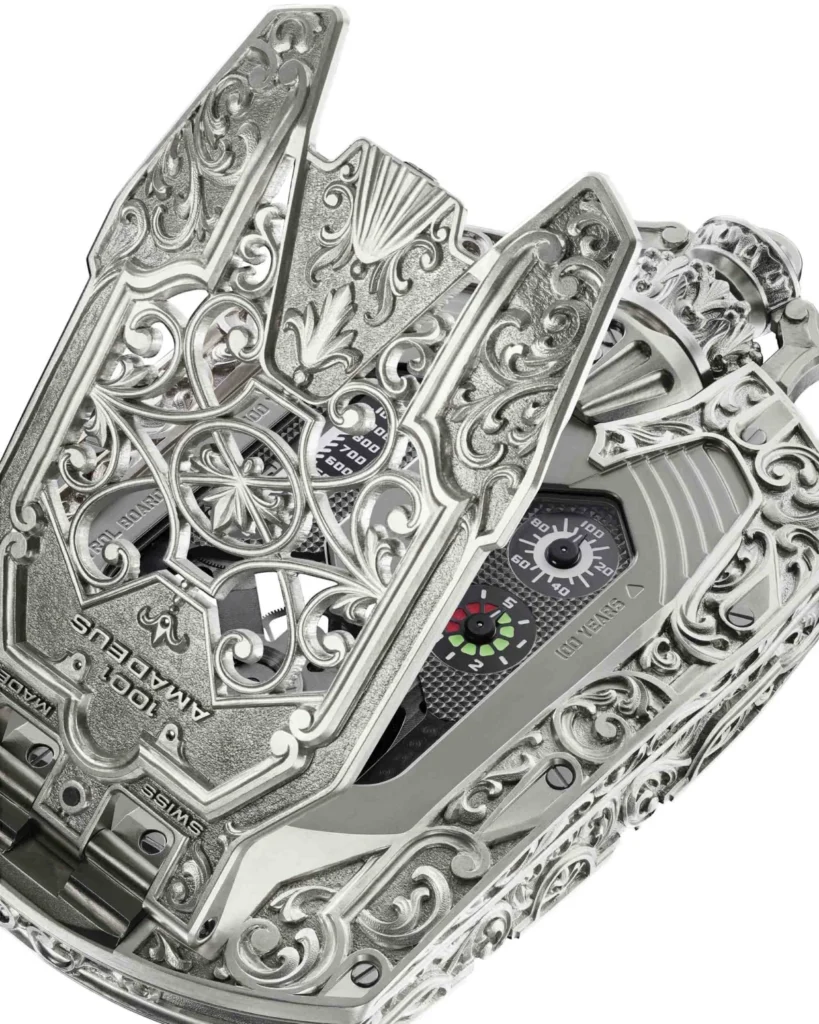
The case of the UR-1001 is a behemoth, measuring 62mm in width, 23mm in thickness, and a staggering 106mm in length. Unlike the UR-210, which offered a more contained canvas, the UR-1001 presented a massive surface area that demanded hundreds of hours of focused attention. Güllert dedicated approximately 500 hours—nearly three months of continuous, meticulous work—to applying the baroque-style engravings that now adorn the titanium chassis.
The result is a contrast that defines the piece: the deep, shadow-trapping recesses of the hand-carved floral and geometric patterns against the stark, modern satellite displays. Every stroke of the burin was calculated to complement the watch’s architecture, ensuring that the decorative elements do not impede the function of the hinged caseback or the operation of the crown.
Technical Architecture: Tracking Millennia
At the heart of the "Amadeus" lies the Caliber UR-10.01, a movement that remains one of the most complex in the Urwerk catalog. While many tourbillons and perpetual calendars focus on the current date, the UR-10.01 is designed to track time as a continuous, unfolding history.

Satellite Complexity
The primary dial utilizes Urwerk’s signature rotating satellite system. In this configuration, the hours are displayed on rotating cubes that traverse a minute track, creating a dynamic, fluid movement that mimics the celestial dance of planets. This is paired with:
- Retrograde Minutes: A precision display that snaps back to zero upon completion.
- Annual Calendar: A secondary satellite system tracking the month and date with high legibility.
- Day/Night and Power Reserve: Essential indicators for a manual/automatic hybrid system that ensures the owner never loses track of the device’s status.
The Reverse Side: A View of the Infinite
The true brilliance of the UR-1001 is found under the hinged caseback. Opening the lid reveals a secondary dashboard for the patient timekeeper:
- The Oil Change Indicator: A pragmatic feature that tracks the movement’s service life, signaling every five years—a nod to the fact that such a complex machine requires meticulous maintenance.
- The Century Counter: A circular display that marks the passage of time in five-year increments, designed to track a full hundred-year cycle.
- The Millennium Indicator: Perhaps the most poetic element of the watch, this linear display moves at an agonizingly slow pace, covering a thousand-year trajectory. It serves as a reminder of the watch’s longevity, intended to be passed down through generations.
Despite this complexity, the caliber operates at a brisk 28,800vph (4Hz) with a 39-hour power reserve, balancing high-frequency accuracy with the massive torque requirements of its many complications.
Supporting Data and Specifications
The sheer physical presence of the "Amadeus" is part of its appeal. It is not a watch for the faint of heart or the subtle collector. It is an object of gravity.

- Case Dimensions: 62mm (W) x 106mm (H) x 23mm (T).
- Material: Grade 5 Titanium with hand-applied Baroque engraving by Florian Güllert.
- Movement: Caliber UR-10.01, automatic-winding.
- Frequency: 4Hz (28,800 vibrations per hour).
- Power Reserve: 39 hours.
- Complications: Satellite hour/minute display, annual calendar, power reserve, day/night indicator, 5-year "oil change" service indicator, 100-year century counter, 1,000-year millennium indicator.
The Philosophy of the "Amadeus"
In official communications, Urwerk has characterized the "Amadeus" as a reflection on the nature of time itself. By naming the watch after Wolfgang Amadeus Mozart—a figure whose work transcended his time and remains relevant centuries later—the brand is drawing a parallel between the ephemeral nature of a human life and the near-eternal nature of their mechanical creations.
"We are building objects that outlive their owners," noted a spokesperson for the brand. "The Amadeus is not just a tool to tell you that you are late for a meeting. It is a machine that helps you contextualize your existence within the span of a century or a millennium."
Implications for the Market and Collectability
The unveiling of the UR-1001 "Amadeus" sends a strong signal to the luxury watch market: the trend of "Grand Complication" pocket watches is far from dead; it is evolving. By blending the high-concept, avant-garde design of Urwerk with the traditional craft of hand-engraving, the brand is successfully courting two different types of collectors: the modern "tech-enthusiast" and the traditional "art-connoisseur."
A New Standard for "Piece-Unique"
In an era of mass-produced limited editions, the "Amadeus" stands out as a true piece-unique. Its value is not dictated by the rarity of the base model, but by the investment of 500 hours of human labor. This shift toward "hyper-craftsmanship" suggests that brands like Urwerk are moving away from purely industrial manufacturing and toward a model where the watchmaker is treated as an artist-engineer.

For the secondary market, this piece represents an apex asset. Because the UR-1001 platform is no longer in standard production, and because the engraving is a one-of-a-kind application, the "Amadeus" is essentially priceless. It serves as a flagship for what is possible when a brand refuses to compromise on size, complexity, or aesthetic narrative.
Conclusion: A Monument to the Future
The Urwerk UR-1001 "Amadeus" is a polarizing piece of engineering. It is too large for the wrist, too complex for the casual user, and too ornate for the minimalist. Yet, in those very contradictions, it finds its perfection. It is a bold statement that the act of measuring time is a sacred, historical, and deeply artistic endeavor.
As we look toward the future of horology, the "Amadeus" reminds us that time is not just a series of seconds to be ticked off, but a vast, sweeping landscape. With its century counters and millennium indicators, Urwerk has given us a tool to look further ahead than we ever have before—all while wrapped in the timeless beauty of a master’s hand.