Introduction: A Violent Legacy from the Void
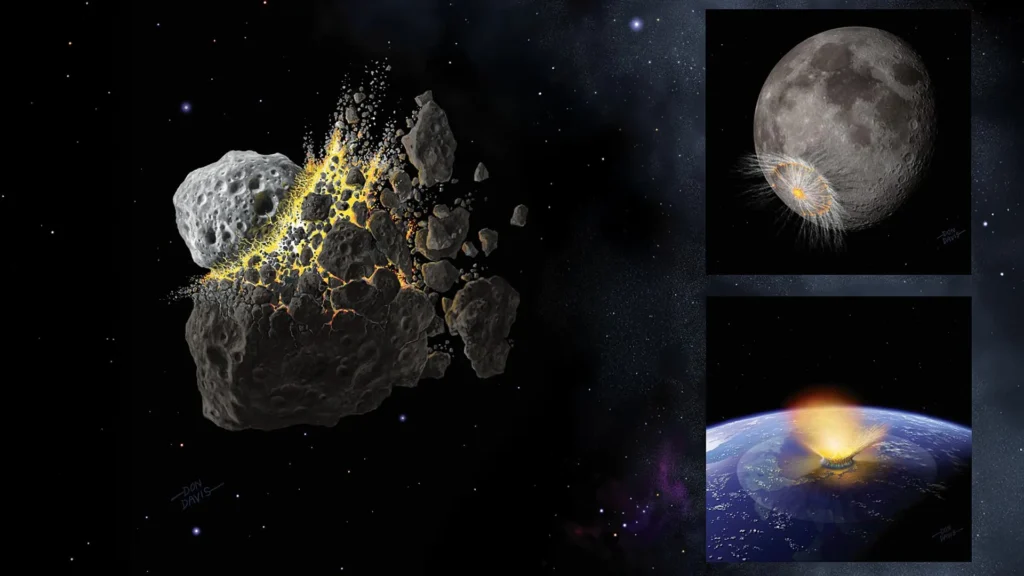
Roughly 800 million years ago, a colossal event occurred in the dark expanse of the main asteroid belt, situated between the orbits of Mars and Jupiter. A massive parent object—a primitive, carbon-rich body—was obliterated in a violent collision. This singular moment of destruction, according to a groundbreaking study led by the Southwest Research Institute (SwRI), likely initiated a sustained, apocalyptic wave of impacts that pelted the inner solar system for over 150 million years.
The debris from this breakup did not merely drift into the void; it was funneled toward the terrestrial planets. As researchers piece together this ancient history, they are uncovering a narrative that suggests our own planet’s geological, climatic, and biological evolution may have been fundamentally altered by a barrage of celestial shrapnel.
The Chronology of a Solar System Storm
The Eulalia Breakup
The study identifies the formation of the "Eulalia asteroid family" as the smoking gun for this period of bombardment. By utilizing complex collisional and dynamical models, the team, led by Dr. William Bottke, executive director of SwRI’s Solar System Science and Exploration Division, reconstructed the event. The parent body, a carbonaceous chondrite-like object, met its end while positioned precariously close to a gravitational "exit ramp" known as the 3:1 mean motion resonance with Jupiter.
The Immediate Aftermath
The timing of this collision was particularly catastrophic. Upon the parent body’s disintegration, roughly 50% of the resulting fragments were immediately captured by the 3:1 resonance. Jupiter’s immense gravitational influence acted like a slingshot, flinging these rocks out of the asteroid belt and onto elongated, chaotic orbits that intersected with the trajectories of Earth, the Moon, and Mars.
The Yarkovsky Effect: A Slow-Motion Siege
The bombardment was not a short-lived event. While the initial surge was immediate, the siege continued for 100 to 150 million years. The culprit was the "Yarkovsky effect"—a subtle physical phenomenon where sunlight heats an asteroid unevenly, causing it to emit infrared radiation that acts as a miniature thruster. This persistent, gentle push nudged another 25% of the Eulalia fragments into the same gravitational resonance, ensuring that the inner solar system remained under a continuous, multi-million-year threat.
Supporting Data: Reading the Moon’s Static Surface
The Difficulty of Earthly Records
Reconstructing events from 800 million years ago is a daunting task for geologists. Earth is a dynamic planet; plate tectonics, persistent volcanism, and the relentless erosion caused by water and wind continuously recycle the surface. These processes act as a geological eraser, scrubbing away the scars of ancient history. Consequently, identifying specific impact craters from the Neoproterozoic era is nearly impossible, as most have been buried or subducted into the mantle.
The Moon as a Celestial Time Capsule
To bypass the limitations of Earth’s geology, Dr. Bottke’s team turned to the Moon. Lacking an atmosphere, plate tectonics, or liquid water, the Moon serves as a near-perfect preservation chamber for impact history. By analyzing lunar crater counts and impact-melted glass recovered during the Apollo missions, researchers have long suspected an uptick in cratering around 800 million years ago.
The current research bridges the gap between these lunar observations and asteroid belt dynamics. By matching the chemical composition of carbonaceous chondrites—the primitive material found in Eulalia—with the specific timing of lunar impact glass, the team has built a compelling case that the lunar cratering surge was a direct result of the Eulalia family’s creation.
Official Perspectives: Bridging Dynamics and Biology
The Perspective of Dr. William Bottke
"The role impacts have played in shaping the origin and evolution of life in our solar system is poorly understood," says Dr. Bottke, who also directs the Center for Lunar Origin and Evolution (CLOE) at NASA’s Solar System Exploration Research Virtual Institute. He notes that while the public is familiar with the Chicxulub impact—the 66-million-year-old strike that wiped out the dinosaurs—that event is a relatively recent anomaly.
"The heavily cratered surface of the Moon serves as a reminder of the large impacts in Earth’s past," Bottke adds. "Because the Moon remains static, it allows us to infer what happened on Earth and Mars in ancient times." His team’s work underscores that the Earth was likely a much more dangerous place than the fossil record currently suggests. Because of its larger mass and stronger gravitational pull, Earth would have intercepted roughly 20 large asteroids for every one that struck the Moon.
The Modeling Approach
The team’s "cosmic forensics" relied on state-of-the-art simulations. By calculating the orbital mechanics of the fragments post-breakup, the researchers were able to demonstrate that the debris stream was not a random scattering, but a focused, sustained delivery system. This high-fidelity modeling provides the mathematical backbone for a theory that, until now, remained purely speculative.
Implications: A Catalyst for Planetary Change
Earth’s Climate and Biological Shifts
The timing of this 800-million-year-old bombardment is eerily coincident with significant climate shifts on Earth, including periods of widespread cooling. While the researchers are careful not to claim that the asteroid barrage definitely caused these changes, the correlation is impossible to ignore. A sustained influx of carbonaceous material—rich in organic compounds and water-bearing minerals—could have had profound effects on the primitive biosphere, potentially altering the chemical composition of the atmosphere or oceans.
Seismic and Volcanic Activity on Mars
The implications extend beyond Earth. On Mars, the impacts would have been violent enough to trigger massive seismic events. Some researchers suggest these impacts could even be linked to surges in volcanic activity, as the shockwaves reverberated through the crust of the Red Planet. This realization forces planetary scientists to rethink the geological history of Mars, suggesting that external, extraterrestrial forces may have driven internal planetary evolution more frequently than previously theorized.
A New Framework for Future Study
The findings from the Southwest Research Institute provide a new roadmap for planetary science. If a single asteroid breakup can influence the climate and biology of multiple worlds over millions of years, then the history of the solar system is not just a series of isolated planetary developments, but a deeply interconnected process of cosmic exchange.
As we look toward the future, the team’s research serves as a catalyst for deeper investigation into the Neoproterozoic era. By cross-referencing the "impact clock" provided by the Moon with terrestrial biological and climatic markers, scientists hope to create a more precise timeline of how the solar system’s violent history has fostered—or hindered—the development of life.
Conclusion: The Cosmic Connection
The story of the Eulalia family is a sobering reminder of the solar system’s inherent instability. We reside in a neighborhood where a collision in the asteroid belt can ripple across space, delivering millions of years of turmoil to the inner planets.
While the Earth has done its best to hide the scars of this ancient barrage, the evidence is written in the lunar dust and the hidden rhythms of our planet’s climate. As our understanding of celestial dynamics improves, so too does our appreciation for the fragile, often chaotic journey that has led to the current state of our world. The "missing chapters" of Earth’s history are finally being written, and they reveal a planet that was forged not just by the fires of its own interior, but by the relentless, unyielding rain of the stars.