

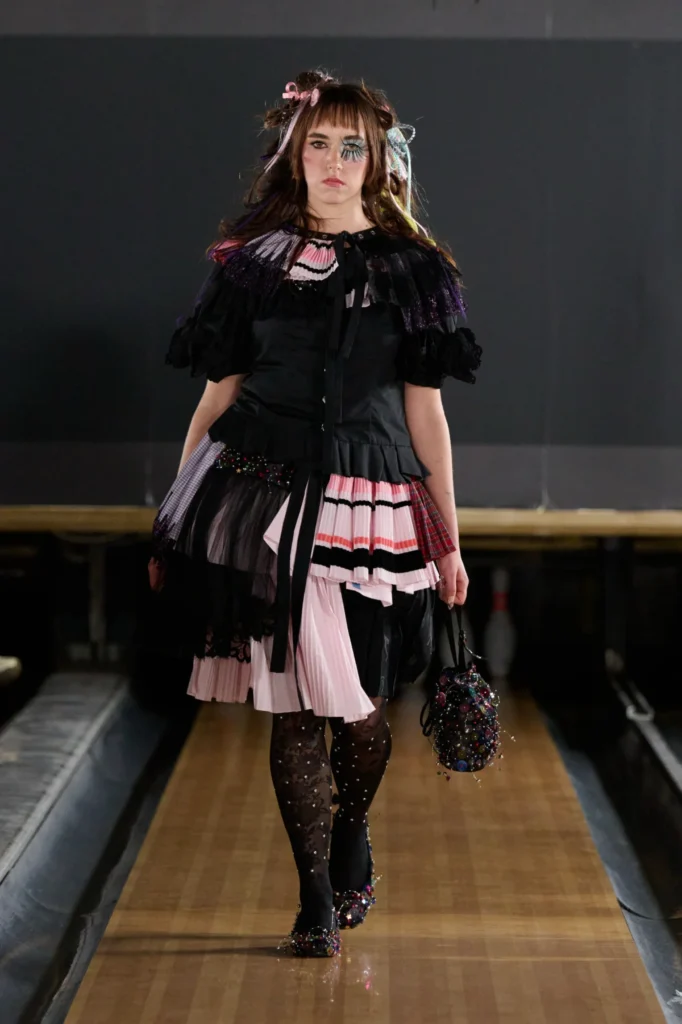
In the high-stakes world of London fashion, where trends are often discarded as quickly as they are birthed, the design duo Emma Chopova and Laura Lowena have carved out a niche that is as intellectually rigorous as it is visually arresting. Their latest collection—a haunting, high-octane exploration of Slavic folklore and 1950s Americana—was not merely a runway show; it was a ritualistic summoning. By elevating the archetype of the "witch" from a derogatory slur to a badge of creative agency, Chopova Lowena has once again asserted their dominance as the industry’s premier architects of the macabre-chic.
The Slavic Fever Dream: A Venue Transformed
The choice of venue set the stage for a narrative that blurred the lines between the mundane and the mystical. A nondescript London bowling alley was completely subsumed by the brand’s aesthetic vision, transformed into a "Slavic fever dream." This was not the sleek, minimalist backdrop often favored by luxury houses. Instead, the space was littered with totemic objects and overgrown branches, creating a liminal space where the urban environment collapsed into a primordial forest.
Guests, sequestered within this immersive installation, witnessed a collision of two worlds: the kitsch, neon-lit nostalgia of 1950s league-night bowling and the ancient, brooding energy of Eastern European myth. It was a study in juxtaposition, mirroring the brand’s foundational ethos of blending aggressive sportswear with delicate, heritage-inspired craftsmanship.
Folklore as Fashion: The Muses of the Spring
At the heart of the collection were the "muses of the spring"—a cohort of folkloric figures whose historical roles were often misunderstood. These were not the sanitized fairies of children’s storybooks, but the "sinister spirits" tasked with enforcing rules and maintaining the cosmic order.
Among the figures channeled by the duo were Baba Yaga, the formidable forest-dwelling crone, and Morana, the Slavic goddess of winter and death. Historically, Morana’s effigies were drowned or burned to herald the arrival of spring—a violent, cathartic ritual that the designers translated into wearable art. One standout piece featured a white corset with boning designed to mimic the human ribcage, paired with a cropped shrug and a low-slung skirt. It was a visual representation of the duality inherent in these myths: pretty on the surface, yet ghostly and skeletal at its core.
A later black dress, bristling with hand-cut and laser-cut chiffon spikes, offered a softer, more ethereal take on Baba Yaga. It was an "evil" design, but one executed with a level of technical precision that demanded respect.
Technical Mastery and the Evolution of the Carabiner Skirt
While the storytelling was rooted in myth, the construction was firmly grounded in the technical evolution of the brand. The signature Chopova Lowena pleated carabiner skirt—a garment that has become a cult object in the fashion world—returned with a new sense of purpose. This season, the skirt was reimagined in tapestry fabrics that paid homage to the early days of the brand, signaling a return to roots even as the designers pushed toward modularity.
The focus on modularity was the collection’s most significant technical leap. The complex, layered looks presented on the runway were not static; they were composed of snap-on aprons and detachable carabiner panels. These components could be stripped away and clipped onto everyday denim, offering the wearer a sense of agency over the garment. This adaptability mirrors the designers’ belief that their muse—the Chopova Lowena woman—is a figure of autonomy. She is not a passive recipient of fashion, but a participant who can reshape her silhouette as easily as she might brew a potion.
Supporting Data: Nostalgia and Collaboration
The collection was further grounded by a deliberate infusion of retro Americana. Inspired by the 1950s bowling legend Marion Ladewig, the designers integrated bowling shirts and house dresses into the lineup. These pieces provided a domestic, familiar anchor for the more surreal elements of the show.
Furthermore, the brand’s highly anticipated collaboration with Dr. Martens, slated for a November release, was integrated into the styling. The partnership feels organic; both brands share a history of being adopted by subcultures that prioritize durability, rebellion, and a distinct lack of interest in "polite" society. By marrying the utilitarian grit of Dr. Martens with the intricate, folkloric lace and beadwork of the collection, Chopova Lowena created a look that is both ready for the street and fit for a pagan ritual.
Official Responses and Creative Intent
In interviews surrounding the collection, Emma Chopova and Laura Lowena have been clear about their objective: the reclamation of the witch. To the duo, being called a witch is not an insult, but a recognition of power.
"We are interested in the figures who were placed to set rules," the designers noted. By reinterpreting these figures, the brand seeks to reclaim the power that has historically been stripped from women who fall outside the norm. This intent is perhaps most visible in the brand’s new "Clubhouse" merchandise, which features tongue-in-cheek slogans like "help me chop Owa Lowena."
These pieces are more than just promotional apparel; they are a manifesto. They suggest a woman who is not afraid of being perceived as dangerous or eccentric. As the designers implied, their target audience is one who "possesses agency—and perhaps arsenic."
Implications: The Future of Myth-Making in Fashion
The implications of this collection for the wider fashion industry are profound. In an era where "quiet luxury" and minimalism have dominated the conversation, Chopova Lowena’s maximalist, narrative-driven approach feels like a necessary disruption.
- The Modular Future: By emphasizing modularity, the brand is addressing the modern consumer’s desire for versatility and sustainability. The ability to deconstruct a high-fashion look into wearable, everyday pieces is a masterstroke of consumer-centric design.
- The Power of Folklore: The collection proves that historical and folkloric narratives are not just aesthetic window dressing; they are potent tools for building brand identity. By rooting their designs in the "sinister" side of Slavic history, Chopova Lowena has created a mythology that fans are eager to participate in.
- Agency as a Design Principle: The brand’s consistent focus on the "Chopova Lowena woman" as someone with agency—someone who is "witchy" and unapologetic—challenges the traditional fashion model of the "passive muse."
Conclusion: A Ritual of Empowerment
As the fashion world looks toward the future, the success of this collection suggests that the hunger for authentic, story-rich design is only growing. Chopova Lowena has managed to do what few brands can: they have taken the ancient and the arcane and made it feel entirely, urgently relevant.
Through their mastery of materials—the laser-cut spikes, the tapestry pleats, the snap-on aprons—they have built a world that is equal parts terrifying and beautiful. By reclaiming the title of "witch," they have provided their followers with a uniform for the modern age: a collection that is as much about the protection of the home as it is about the celebration of the self. In the end, the Slavic fever dream was not just a runway show; it was a declaration that the rules of the game have changed, and the witches are the ones currently setting them.



