For over a century, the Grand Canyon has stood as the world’s most iconic classroom for geological history. Its colorful, layered walls offer a vertical timeline of Earth’s crust, documenting two billion years of deposition. Yet, geologists have long been haunted by a missing chapter: the "Great Unconformity," a mysterious gap in the rock record where up to a billion years of history seemingly vanished without a trace.
New research, published in the journal Geology, has finally provided a compelling solution to this geological riddle. A team of international scientists, led by the University of Southampton, has uncovered evidence of a colossal, ancient cliff system—a "Great Escarpment"—that acted as a massive conveyor belt of erosion, stripping away kilometers of rock nearly a billion years before the Colorado River began its own famous carving work.
The Architect of Erosion: A New Geological Narrative
The prevailing wisdom regarding the Grand Canyon has long focused on the erosive power of the Colorado River, which began cutting into the landscape roughly five to six million years ago. While this process is undeniably responsible for the canyon’s current architectural splendor, the new study suggests that the canyon’s deepest, most ancient rocks were exposed by a much older, more violent process.
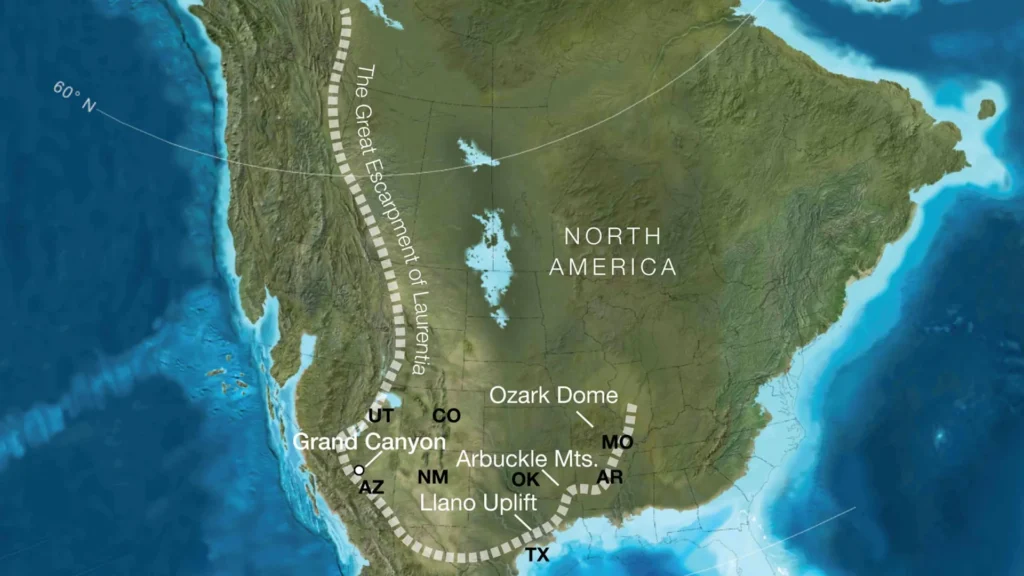
Led by Professor Thomas Gernon of the University of Southampton, the research team posits that about 800 million years ago, as the supercontinent Rodinia began to fragment, the tectonic upheaval created a mountainous "Great Escarpment." These cliffs, estimated to be up to a kilometer in height, stretched across thousands of kilometers of western North America.
"Our paper suggests the Canyon’s basement rocks were progressively brought to the surface as part of an immense escarpment that developed during the breakup of an ancient supercontinent," explains Professor Gernon. "The findings shed light on the formation of the Great Unconformity, a mysterious gap in the rock record that spans over a billion years. We are essentially filling in a massive blank page in the history of the North American continent."
A Chronology of Continental Transformation
To understand the scale of this prehistoric landscape, the researchers had to look back to a time when North America—then known as the craton Laurentia—was part of a vastly different world.
The Fragmentation of Rodinia (c. 800 Million Years Ago)
As Rodinia began to break apart, the crust underwent significant tectonic stretching. This process, known as rifting, did not just create oceans; it created steep, high-elevation rims along the continental margins. According to the study, the future site of the Grand Canyon was positioned near one of these massive, rift-related escarpments.
The Great Migration of Cliffs (c. 800 to 600 Million Years Ago)
Unlike the static walls of the modern Grand Canyon, this ancient escarpment was a dynamic feature. Over tens of millions of years, as erosion battered the high ground, the escarpment migrated inland. This "retreat" of the cliff face was relentless, acting like a giant saw that shaved off as much as eight kilometers of rock in some locations. This period of intense degradation is the primary culprit behind the Great Unconformity, explaining why so much sedimentary rock from that era is missing from the record.
The Pre-Cambrian Landscape
As this massive cliff system eroded, it dictated the flow of ancient rivers and the deposition of sediments across a vast region. The study estimates that the escarpment’s influence spanned an area that today includes Arizona, Utah, Idaho, Wyoming, Colorado, Texas, Oklahoma, Arkansas, Missouri, and Illinois. This massive mountain rim served as a gatekeeper, determining where sediment collected and influencing the encroachment of ancient, shallow seas that would eventually host the rapid diversification of life during the Cambrian Explosion.
Supporting Data: Reconstructing a Lost World
The researchers did not rely on speculation alone. To reconstruct a landscape that vanished hundreds of millions of years ago, the team employed a multi-disciplinary approach, combining plate tectonic modeling with geomorphological evolution data.
By comparing the ancient North American landscape to modern, active escarpments—such as the Great Escarpment of South Africa and the coastal ranges of Brazil—the team was able to validate their models. These modern-day analogs provide a "living laboratory," showing how rifted continental margins respond to long-term erosion.
The data shows a striking correlation: the estimated 5 to 10 kilometers of rock missing from the Grand Canyon’s geological sequence matches the predicted volume of material removed by the migrating ancient escarpment. This numerical agreement provides robust evidence that the "missing" rock was not simply never deposited, but was instead systematically scraped away by a mountain-building and subsequent erosion cycle that defined the late Proterozoic era.
Official Perspectives: A Global Collaboration
The research was a true international effort, involving scientists from the GFZ Helmholtz Centre for Geosciences and the University of Potsdam in Germany, as well as the University of Illinois Urbana-Champaign in the United States.
The collaborative nature of the study allowed for a holistic view of the continent. By integrating geological records from across North America, the team was able to move beyond the local context of the Grand Canyon and understand the phenomenon as a continental-scale event.
"This long-lived tectonic landscape provides a missing piece in understanding why erosion associated with the Great Unconformity varies so dramatically across the southwestern US," says Professor Gernon. He notes that the study does more than just solve a canyon-specific mystery; it provides a framework for geologists worldwide to re-examine other "gaps" in the global rock record.
Implications for Geological Science
The implications of this study extend far beyond Arizona. If this model of "migrating escarpments" holds true for North America, it could explain similar geological anomalies in other parts of the world.
Reinterpreting Earth’s History
Geologists have long struggled with the Great Unconformity because it represents a period of profound geological silence. By identifying the tectonic and erosional mechanisms that created it, researchers can now begin to "read" the silence. The study suggests that the "mountainous rim" of ancient Laurentia was not just a topographical feature, but a climate-altering, sediment-distributing powerhouse that influenced the environment for early complex life.
The Grand Canyon in a New Light
For the millions of visitors who flock to the Grand Canyon each year, this research adds a new layer of wonder to the view. While the Colorado River is the sculptor that revealed the canyon’s beauty to modern eyes, it is the ancient, long-vanished escarpment of Rodinia that did the heavy lifting. The rocks exposed at the base of the canyon—some of the oldest on the planet—were prepared for their "reveal" by a massive, continental-scale event that took place hundreds of millions of years before dinosaurs walked the Earth.
Future Research Directions
The research team hopes that their findings will encourage further exploration into the links between tectonic rifting and erosional patterns. By applying these models to other cratons, such as those in India, Antarctica, and Australia, scientists may be able to reconstruct the paleogeography of Earth’s ancient supercontinents with unprecedented accuracy.
In the words of Professor Gernon, "Today’s escarpments in Africa, Brazil, India, and Antarctica provide windows into the forces that shape continents over hundreds of millions of years. By comparing the Grand Canyon’s ancient history with active landscapes, we’re able to see North America’s most iconic geologic landmark in an entirely new light. We are seeing the ghost of a landscape that once redefined the very shape of the continent."
As geologists continue to piece together this monumental puzzle, the Grand Canyon remains a testament to Earth’s capacity for both violent destruction and breathtaking preservation. The mystery of the billion-year gap is finally being bridged, not by a single cataclysm, but by the slow, grinding, and inevitable power of continental evolution.