Introduction: The Invisible Shield of Global Trade
The global economy functions on the back of a vast, interconnected network of maritime trade. Over 80% of the world’s goods are transported via the sea, making the stability and security of international shipping lanes not just a matter of logistics, but a fundamental pillar of global economic health. However, beneath the surface of this colossal industry lies a persistent, evolving threat: maritime piracy and armed robbery against ships.
Since 1991, the International Maritime Bureau (IMB) Piracy Reporting Centre (PRC) has stood as the primary sentinel against these threats. Operating as a 24-hour, 365-day emergency hub, the PRC has transformed from a niche information-gathering body into a critical component of global maritime infrastructure. As piracy tactics shift from low-level opportunistic boarding to sophisticated, technology-driven maritime criminality, the PRC remains the definitive point of contact for shipmasters and owners facing the perils of the open ocean.
Main Facts: The PRC’s Operational Mandate
The IMB Piracy Reporting Centre is a specialized division of the ICC International Maritime Bureau. Its mission is two-fold: immediate crisis intervention and long-term strategic analysis.
The 24/7 Response Mechanism
The PRC operates a continuous alert system. When a vessel is under threat—or when an incident has occurred—the PRC serves as the first line of defense. By maintaining real-time communication with national response agencies, navies, and coast guards, the Centre ensures that reports of piracy are not merely filed but acted upon.
Data-Driven Security
Beyond reactive measures, the PRC is the world’s most trusted repository for piracy statistics. By encouraging the reporting of both actual and attempted incidents, the Centre provides a comprehensive "heat map" of global maritime risk. This data is indispensable for:
- Vessel Routing: Helping shipping companies identify "high-risk areas" to avoid.
- Policy Advocacy: Providing empirical evidence to the International Maritime Organization (IMO) and national governments to justify the deployment of naval assets.
- Trend Analysis: Tracking how pirates adapt their weaponry, boarding techniques, and target selection.
Chronology: A History of Resilience (1991–2025)
To understand the significance of the PRC, one must look at the evolution of maritime crime over the past three decades.
The Formative Years (1991–2000)
Founded in response to a spike in piracy incidents in Southeast Asia, the PRC began as a centralized clearinghouse for data. During the 1990s, the focus was primarily on establishing a standardized reporting protocol, as there was no global mechanism for shipmasters to safely report incidents without fear of legal or bureaucratic repercussions.
The Age of Somali Piracy (2005–2012)
The early 2000s saw a massive shift toward the Horn of Africa. Piracy evolved from small-scale theft to the systematic hijacking of massive oil tankers and cargo vessels for multi-million dollar ransoms. During this era, the PRC’s role became critical. It acted as the central communication hub between hijacked crews, their families, and the international naval task forces patrolling the Gulf of Aden.
Modern Challenges (2013–Present)
While Somali piracy was largely curtailed through international naval presence, the threat moved to the Gulf of Guinea and subsequently manifested in various forms, including kidnappings for ransom, cyber-enabled targeting, and armed robberies in regional hubs. The 2025 reporting period reflects a shift toward more agile, opportunistic criminality that requires the PRC’s sophisticated alert system more than ever.
Supporting Data: The 2025 Landscape
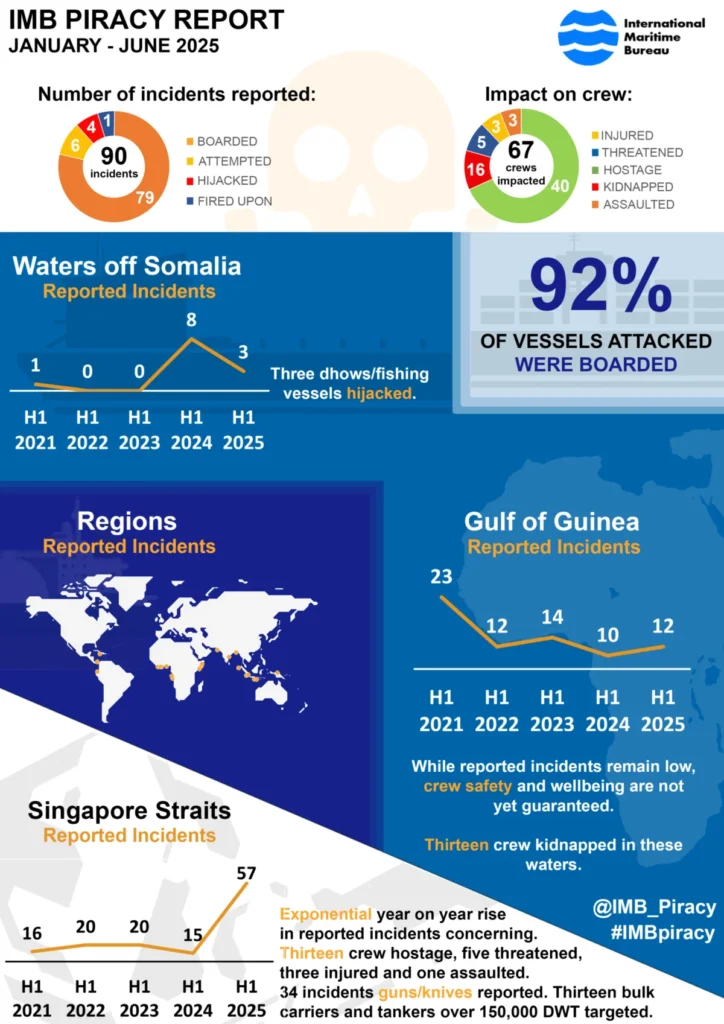
The recently released Piracy and Armed Robbery Against Ships report (Jan–June 2025) highlights the persistent nature of maritime crime. While some regions have seen improvements, others remain volatile.
Analysis of Incident Trends
The data gathered by the PRC for the first half of 2025 demonstrates that maritime piracy is far from a relic of the past.
- Under-reporting: A major concern for the PRC is the "dark figure" of piracy—incidents that go unreported. Many owners fear increased insurance premiums or vessel delays, but the PRC emphasizes that unreported incidents lead to "security vacuums" where authorities fail to allocate resources.
- Boarding vs. Hijacking: Recent data shows a higher frequency of boardings while at anchor, particularly in regional ports, compared to high-seas hijackings. This reflects a shift toward "petty" but dangerous armed robberies that threaten crew safety.
- Regional Hotspots: The report identifies specific corridors where the threat of armed robbery remains elevated, often coinciding with local socio-economic instability and inadequate port security.
For detailed statistics and regional breakdowns, stakeholders are encouraged to request the full 2025 Jan–June report directly from the IMB.
Official Responses and Strategic Implications
The IMB’s influence extends into the highest levels of international maritime governance.
Collaboration with Authorities
The PRC does not operate in a vacuum. Its effectiveness is predicated on its relationships with international maritime security organizations. When the PRC issues an alert, it triggers a chain reaction:
- Warning Broadcasts: Ships in the vicinity receive immediate, actionable intelligence to adjust their course or increase security measures.
- Naval Coordination: By feeding verified data to maritime security centers, the PRC ensures that naval assets are positioned where the risk is highest.
The Call to Action for Stakeholders
Director Michael Howlett has consistently emphasized that maritime security is a collective responsibility. The IMB urges shipmasters and owners to adopt a proactive posture:
- Immediate Reporting: Reporting an incident as it happens is the most effective way to protect other vessels in the vicinity.
- Resource Allocation: When owners report all suspected activities, they provide the IMB with the data required to lobby governments for better maritime patrols and safer anchorage zones.
- Crew Training: The data provided by the PRC serves as the basis for modern "Best Management Practices" (BMP), which are essential for training crews to repel boarders and secure vessels.
Implications: The Future of Maritime Safety
As we look toward the remainder of the 2025 calendar year and beyond, the implications of the IMB’s work are profound.
Technology as a Double-Edged Sword
Pirates are increasingly using AIS (Automatic Identification System) spoofing and drone surveillance to identify high-value targets. The IMB is currently expanding its monitoring capabilities to address these modern threats, ensuring that the PRC’s defensive measures evolve alongside the criminals’ offensive tools.
Economic Impact
The cost of piracy is not limited to the value of stolen goods or ransom payments. It includes increased insurance premiums, diverted shipping routes, higher fuel consumption, and, most importantly, the psychological and physical trauma inflicted upon the crews. By maintaining the PRC’s operations, the international community significantly lowers the "hidden tax" that piracy imposes on global consumer prices.
Conclusion: A Call for Vigilance
The IMB Piracy Reporting Centre remains the heartbeat of maritime safety. Its 34-year history proves that information is the most potent weapon against piracy. As the global shipping industry navigates an increasingly complex geopolitical environment, the role of the PRC is more vital than ever.
Shipowners, operators, and masters are reminded that the first step in the fight against maritime crime is a simple, standardized report to the IMB. By doing so, they not only protect their own vessels and crews but also contribute to the broader tapestry of global maritime security.
Contact Information for Assistance
For those seeking to contribute to the global security effort or requiring assistance, the IMB Piracy Reporting Centre remains available 24/7.
Contact Details:
- Director: Michael Howlett
- Organization: ICC International Maritime Bureau
- Tel: +44 207 423 6960
- Email: [email protected]
Access the Latest Intelligence:
To stay informed on the evolving state of maritime crime, request the latest Piracy and Armed Robbery Against Ships report for the 2025 January–June period here.
Security on the high seas is a collaborative effort. The IMB continues to invite all stakeholders to join this ongoing mission to ensure that the world’s oceans remain open, safe, and secure for trade.