
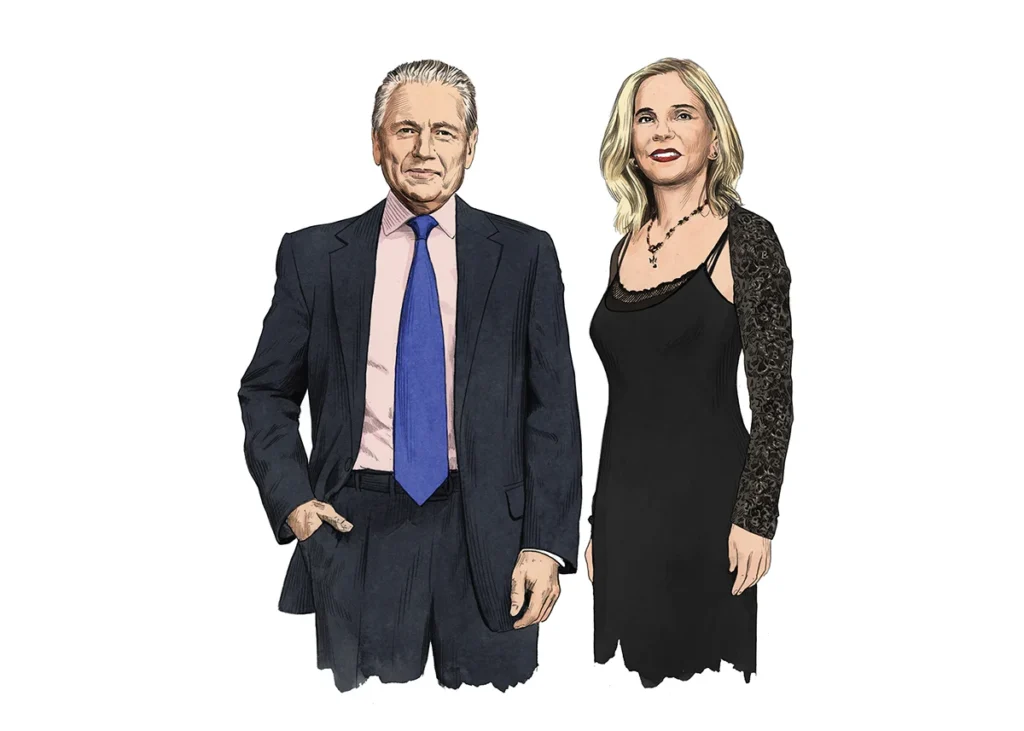
In the high-stakes landscape of the international art world, a new breed of patron has emerged—one that bridges the gap between the private collector and the public institution. J. Tomlinson Hill and Lonti Ebers, two of the most influential figures in contemporary art patronage, represent this shift. Both have transitioned from decades of private collecting to founding their own public-facing foundations in New York City, while simultaneously steering the world’s most prestigious museums from their respective boardrooms.
Through the Hill Art Foundation in Chelsea and Amant in East Williamsburg, Hill and Ebers are not merely displaying their trophies; they are creating "third spaces" that prioritize education, residency, and experimental dialogue. Their recent joint reflections offer a rare glimpse into the mechanics of high-level collecting, the necessity of market corrections, and the evolving "experiential" demands of the 21st-century museum visitor.
Main Facts: A Tale of Two Foundations
The careers of Hill and Ebers follow a parallel trajectory of accumulation and public service. J. Tomlinson Hill, a longtime hedge-fund manager and Chairman Emeritus of the Hirshhorn Museum, opened the Hill Art Foundation in 2019. Situated in the heart of Chelsea, the space was designed by Peter Marino and occupies two floors of a modern complex. Hill’s collection is famously eclectic yet disciplined, focusing on four distinct pillars: Renaissance bronzes, Old Master paintings, a select group of Postwar titans (such as Francis Bacon and Cy Twombly), and emerging contemporary artists, with a specific emphasis on women.

Conversely, Canadian-born Lonti Ebers has focused her three decades of collecting on the cutting edge of contemporary and radical feminist art. In 2021, she launched Amant, a multi-building "campus" in Brooklyn designed by the architectural firm SO-IL. Unlike a traditional gallery, Amant functions as a laboratory, featuring artist residencies, performance spaces, and a bookstore. Ebers, who chairs the Media & Performance Committee at MoMA, has recently expanded Amant’s footprint to include a restaurant, Zoli, and a new exhibition space called AZ, with further outposts planned for Tuscany and Uruguay.
While their aesthetic focuses differ—Hill looking toward the "game changers" of history and Ebers toward the "radicality" of the present—both collectors share a commitment to using their private wealth to foster public cultural literacy.
Chronology: From Vienna to New York
The aesthetic sensibilities of both Hill and Ebers are rooted in the European tradition, specifically the cultural crucible of Vienna.

The Educational Foundation (1960s–1980s)
For Lonti Ebers, the art world was a familial inheritance. Her grandfather, an obsessive collector of historical works in Vienna, served as a "mythical presence" during her childhood. This early exposure led her to the University of Toronto, where an attempt at art restoration ended abruptly after sulfuric acid ruined her wardrobe—a "disaster in the lab" that redirected her toward art history. By the late 1980s, while living in Canada, Ebers began traveling to Cologne, acquiring works by German masters like Gerhard Richter and Sigmar Polke at a time when they were largely ignored by the Canadian establishment.
J. Tomlinson Hill’s education was equally immersive. His mother was a sculptor, providing an early informal introduction to the medium. However, his formal "tutorial" occurred at the Kunsthistorisches Museum in Vienna. Under the guidance of senior curator Manfred Leithe-Jasper in the 1990s, Hill developed a deep expertise in Renaissance bronzes, specifically the patronage of Rudolf II. This historical grounding would eventually inform his "Rule of Four"—a collecting philosophy that seeks to acquire four pivotal works from different periods of a "game-changing" artist’s career.
The Pivot to Public Spaces (2019–2024)
After decades of lending to museums and serving on boards, both collectors realized that their personal visions required a permanent physical home.

- 2019: Hill opens the Hill Art Foundation, integrating his personal collection with an education program for "teen curators" in partnership with the Guggenheim.
- 2021: Ebers launches Amant in Brooklyn, prioritizing the artist-in-residence model over the static exhibition model.
- 2024: Ebers expands the Amant campus with the opening of Zoli and AZ, while Hill prepares for "Thucydides’ Fever Dream," a major exhibition of contemporary Chinese art.
Supporting Data: Philosophies of Acquisition
The strength of these foundations lies in the rigor of their acquisition strategies. Hill and Ebers do not buy based on trends; they buy based on historical inflection points.
Hill’s "Rule of Four" and the Game Changers
Hill’s collection is built on the concept of the artist as a "data scientist" or "recording device." He points to Andy Warhol—his first major purchase in the 1990s—as the ultimate example. Hill famously sold a record-breaking Mark Rothko painting to fund the purchase of a fourth Francis Bacon "Pope" painting, adhering to his belief that a collection should tell a complete story of an artist’s evolution.
- Core Artists: Warhol, Bacon, de Kooning, Twombly, Lichtenstein, Ruscha, and Marden.
- Emerging Focus: N. Dash, Sarah Crowner, and Minjung Kim.
Ebers’ Radical Feminism and German Postwar
Ebers’ collection is arguably the most significant repository of "radicality" in the United States. She holds what is believed to be the largest collection of works by Sturtevant and Carol Rama in the country. Her interest lies in the "conditions that cause radicality," leading her to acquire works by Carolee Schneemann and, more recently, a Marcel Duchamp shovel (a 1964 Arturo Schwarz edition) to complement her David Hammons "tarp" painting.

- Core Artists: Richter, Polke, Sturtevant, Carol Rama, Paul Thek, and Tetsumi Kudo.
Official Responses: On the Market and the Future of Museums
In recent dialogues, Hill and Ebers addressed the shifting dynamics of the global art market and the institutional challenges facing major museums.
On the Art Market "Correction"
Both collectors view the current cooling of the art market as a positive development. Hill, drawing on his background in finance, compares the art market to the stock market, noting that "euphoria" often leads to overvaluation. "We’re going through a really healthy correction phase right now," Hill remarked.
Ebers corroborated this view, suggesting that primary market prices had been artificially inflated by the overhead costs of galleries—high rents and the grueling art fair circuit—rather than the artists themselves. "You’re seeing the cutting back of dealers’ cost structure, which is healthy," she noted.

On the "Experience" Economy
A recurring theme for both patrons is the evolution of the museum visitor. Hill argues that the "old museum model," which was didactic and aimed at an older demographic, is obsolete. Today’s viewers, particularly younger generations, want "experiences." They want to take selfies, have a cup of coffee, and connect with peers.
Ebers’ creation of Zoli, the restaurant at Amant, was a direct response to this need. By installing a site-specific aquarium piece by Pierre Huyghe behind the bar, she has turned dining into an extension of the artistic experience. "People want to coalesce, and they coalesce around eating and drinking," Ebers explained.
Implications: Legacy and the Institutional Landscape
The emergence of the Hill Art Foundation and Amant signals a shift in how legacy is managed in the art world. However, the two founders have vastly different plans for the future of their institutions.

Sustainability vs. Expiration
One of the most striking revelations in their recent discourse is the planned lifespan of their foundations. Hill has stated clearly that the Hill Art Foundation will shut down when he is no longer able to run it. "It’s not the Broad. It’s not what Mitch Rales has created with Glenstone," Hill said, noting that his daughters have not expressed interest in taking over.
In contrast, Ebers has ensured that Amant is built for the long term. She has established a large endowment and trust to ensure the organization does not have a fixed expiration date. This ensures that Amant’s unique mission—supporting the "too hot to handle" radical work of artists like Florentina Holzinger—will continue indefinitely.
The Museum of the Future
As board members of MoMA and the Guggenheim, Hill and Ebers are helping to navigate the "silo-breaking" of the future. Ebers’ endowment of a curatorial position at MoMA for Media and Performance highlights the need for museums to embrace multimedia and performance as core disciplines, rather than peripheral interests.

The "stereoscopic view" held by these two patrons—one eye on the private market and the other on institutional discipline—suggests that the future of art will not be found in a single museum or gallery, but in the interconnected, experiential, and radical spaces they are currently building. As Hill noted of Ebers’ Brooklyn campus: "If I were in my 20s or 30s… I’d be living in Brooklyn and hanging out at Amant." It is this vibrancy, rather than mere preservation, that defines the new era of art patronage.