"Just because an artist is not thinking directly about politics while making a work does not mean they are outside the political context," says Xuxa Rodríguez, curator of Turn the Volume Up!, the ambitious new exhibition at Duke University’s Nasher Museum of Art.
This statement serves as the conceptual anchor for an exhibition that defies the simple categorization of "protest art." While the show features iconic works of dissent, Rodríguez’s vision is far more expansive, positioning art as a vital, daily participant in the life of a democracy. Spanning a century of posters, paintings, sculptures, and photographs, the exhibition—which runs through July 2027—serves as an urgent mandate for the present: to vote, to petition, and to re-engage with the communities that define our social fabric.
The Genesis of a Movement: From Mayoral Races to National Echoes
The origins of Turn the Volume Up! are as iterative as the political processes they mirror. According to Rodríguez, the project began as a meditation on the U.S. Constitution and the two-century-long struggle to refine its promises. However, the exhibition found its specific contemporary pulse during the 2025 New York mayoral election.
"I was watching the election from Durham, and then the numbers came in: two million people turned out to vote," Rodríguez recalls. "Some reports suggested the city hadn’t seen those numbers since 1969. I thought, ‘Wow, this is history happening live.’"

The exhibition’s title was sparked by the election speech of candidate Mukhtar Mamdani, who quoted the hip-hop pioneer KRS-One. In an era often marked by political cynicism and disillusionment, Mamdani’s call to "turn the volume up" resonated with Rodríguez’s research into how artists and activists organize for change. She saw in the massive voter turnout a parallel to the role of art: an effort to bring marginalized voices to the table and, ultimately, to make the table bigger.
A Structural Anatomy of Activism
To translate this abstract concept into a physical gallery space, Rodríguez structured the exhibition into five distinct thematic sections: "Remarks," "Organized," "Records," and "Petitions" (with a fifth currently being finalized). Each section is intentionally named to mirror the vernacular of governance, blurring the lines between the halls of Congress and the neighborhood meeting house.
- Remarks: This section examines how artists comment on historical and sociocultural events, providing a space for dialogue that bridges the past and the present.
- Organized: This portion highlights the utility of art. It showcases works that transcend the frame—posters that function as flyers, prints used to raise funds, and visuals designed to mobilize collective action.
- Records: Here, the exhibition explores the act of documentation. Through photography and painting, artists do not just record history; they "speak back" to it, challenging official narratives and forcing viewers to confront unresolved injustices.
- Petitions: This section focuses on advocacy, presenting contemporary issues through a lens that invites the viewer to participate in the push for legislative or social change.
Supporting Data: The Power of Representation
The exhibition design, helmed by the Nasher’s head of graphic design, Joel Johnson, is a masterclass in participatory art. Throughout the galleries, visitors encounter silhouettes of demonstrators holding blank placards. These empty signs serve as a psychological prompt, inviting visitors to reflect on their own political agency.
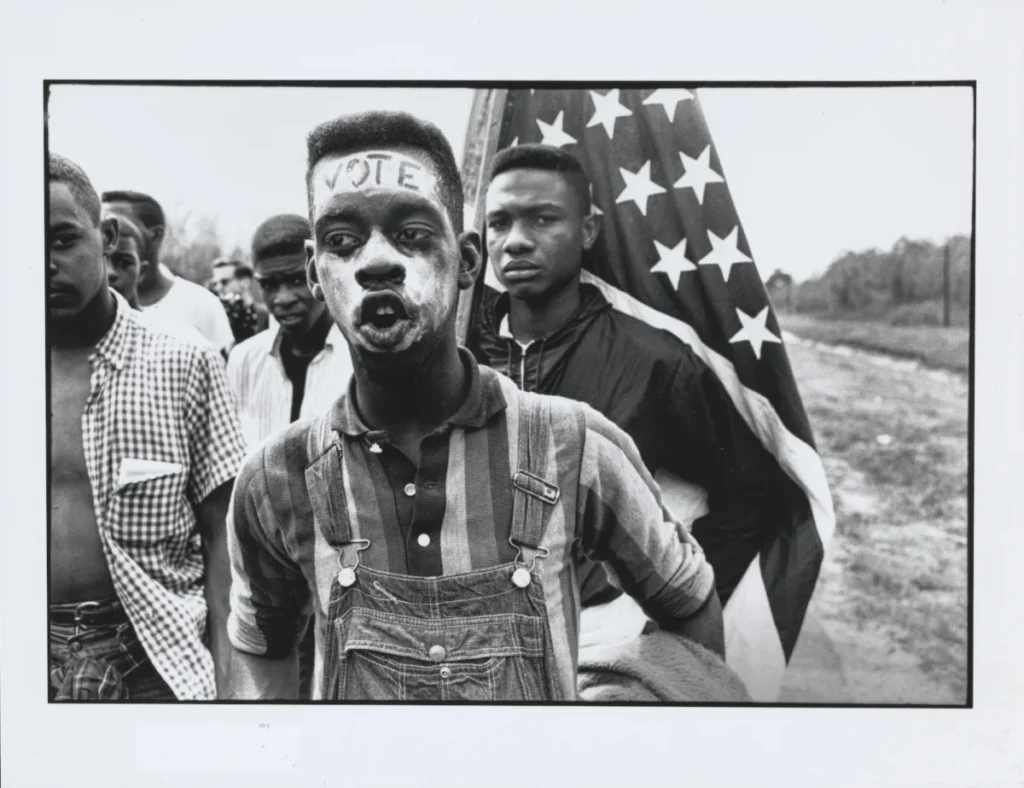
The exhibition is populated by heavyweights of the art world—Kara Walker, Bruce Davidson, Marlene Dumas, and the Guerrilla Girls—whose work has provided civil rights with a tangible face and voice.

One standout work is Robert Colescott’s 1978 painting The Wreckage of the Medusa. In a bold subversion of Théodore Géricault’s original, Colescott places himself among the drowning passengers, using the metaphor of the shipwreck to critique the "I don’t see race" doctrine. By depicting a captain who refuses to acknowledge the reality of his drowning crew, Colescott offers an incisive commentary on the dangers of willful blindness in contemporary politics.
Similarly, Carlos Vega’s portrait of Malala Yousafzai, Who is Malala (2016), utilizes the visual language of Renaissance votive images to frame modern activism. By surrounding Yousafzai with stars containing portraits of other women and femme organizers, Vega elevates grassroots advocacy to a position of historical reverence.
Official Perspectives: The Role of the University Museum
The Nasher Museum of Art, founded in 2005, has long functioned as a laboratory for the intersection of contemporary art and social consciousness. Its predecessor, the Duke University Museum of Art, established a foundation that the Nasher has aggressively expanded by prioritizing contemporary African diasporic art and works from emerging artists who challenge the status quo.
"The museum was already doing this from day one," Rodríguez notes. "It isn’t just about what museums should be doing today; it’s about acknowledging that building a great collection means attending to the many voices that make up a community."

This ethos is central to the museum’s mission. As an institution within a university, the Nasher serves as a critical bridge between academic inquiry and civic engagement. For Rodríguez, the exhibition is a testament to the "practice of radical hope." It is a belief that museums are not merely repositories of the past, but containers for a future that has not yet been realized.
Implications: The Politics of Being
The most profound implication of Turn the Volume Up! is the argument that neutrality is a myth. By documenting the histories of exile, warfare, and the dehumanization inherent in violence—as seen in Carol Summers’s 1967 print Kill for Peace—Rodríguez forces visitors to recognize that no individual exists outside of the political structures that govern their lives.
The exhibit explicitly tackles the current climate of censorship and political polarization. By juxtaposing historical works with contemporary challenges, the exhibition suggests that history moves in cycles, and that the courage required to protest in the 1980s is the same courage required to demand justice today.
"Infrastructure is people," Rodríguez reminds us. When discussing the photographs of Leonard Freed, which document the tragic murders of Black children in 1970s Atlanta, she points out the necessity of such images in building empathy. "You can’t unsee these images," she says. "They allow me, in 2026, to encounter moments I could not physically have witnessed."

Looking Toward 2029: A Legacy of Engagement
As the exhibition runs through 2027, the Nasher is already looking ahead. Rodríguez is currently developing a 2029 exhibition focused on the climate catastrophe. It promises to be a similarly difficult, necessary, and hopeful investigation into how humanity might rebuild after systemic collapse.
Ultimately, Turn the Volume Up! is not just an exhibition about art; it is an exhibition about the "one wild and precious life" that each visitor possesses. It asks a fundamental, recurring question: If you could record your remarks for history, what would you say?
By the time visitors exit the Nasher, the goal is not that they have viewed a series of historical artifacts, but that they feel the weight of their own agency. As Rodríguez puts it, "We are all imagining that there will be a tomorrow. We don’t know what it will look like, but we hope it will be here." Through the lens of the Nasher’s latest curation, that tomorrow is something worth fighting for, one vote, one petition, and one voice at a time.