LONDON, 15 January 2026 – The global maritime landscape faced a precarious year in 2025, as the ICC International Maritime Bureau (IMB) released its comprehensive Annual Piracy and Armed Robbery Report, detailing a significant uptick in incidents against commercial shipping. While the threat posed by Somali piracy has been largely contained through persistent international naval cooperation, new hotspots—most notably the Singapore Straits—have emerged as critical areas of concern.
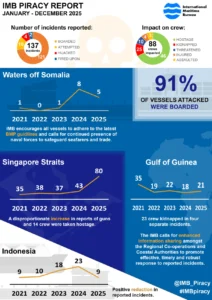
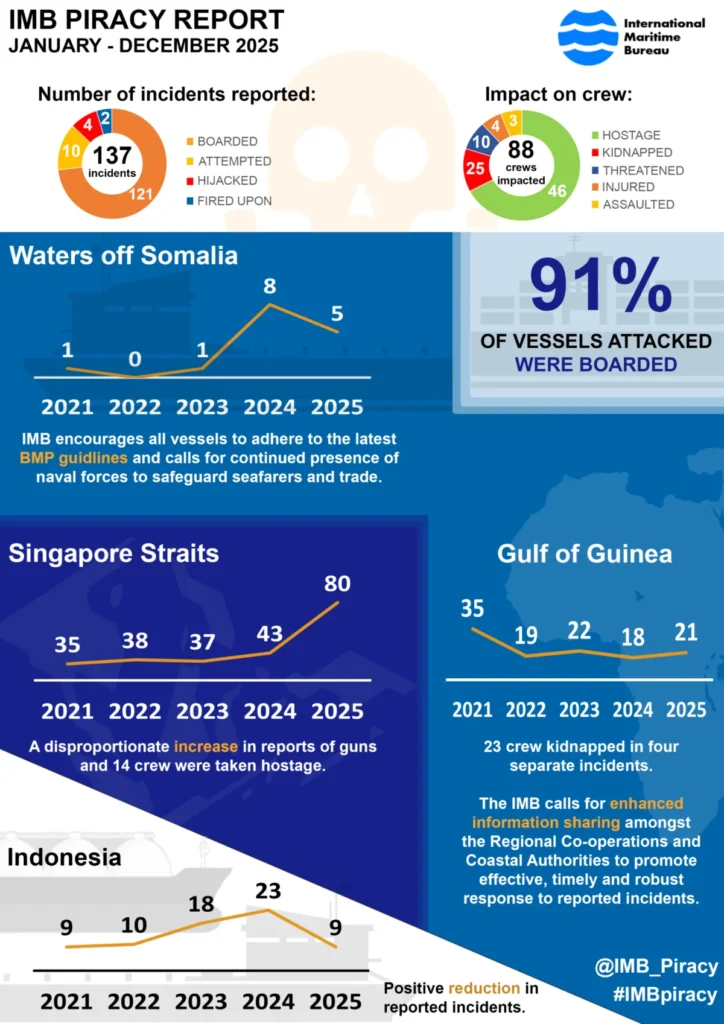
The report, which tracks security incidents across the world’s oceans, underscores the fragile nature of global trade corridors. With 137 recorded incidents in 2025—up from 116 in 2024 and 120 in 2023—maritime stakeholders are sounding the alarm over the safety of seafarers and the integrity of the global supply chain.
The State of Global Maritime Security: Key Facts
The 2025 data paints a picture of a maritime industry increasingly under siege by opportunistic criminals and organized piracy syndicates. Of the 137 incidents reported:
- 121 vessels were boarded, marking a significant increase in successful breaches.
- Four vessels were hijacked, representing a dangerous escalation in operational capability by pirate groups.
- Two vessels were fired upon, signaling a shift toward more aggressive, high-risk tactics.
- 10 attempted attacks were thwarted, often due to the alertness of crews and the implementation of Best Management Practices (BMP).
While the majority of these incidents are classified by the IMB as "low-level," the cumulative impact on the maritime industry is profound. These are not merely statistics; they represent hundreds of lives placed in jeopardy and millions of dollars in potential losses due to cargo theft, insurance premium hikes, and operational delays.
Chronology of a Volatile Year
The trajectory of maritime crime throughout 2025 was characterized by shifting regional dynamics.
Q1 2025: The Surge in Southeast Asia
The first quarter saw an immediate spike in activity in the Singapore Straits. As global trade volumes hit peak levels, transit traffic through this vital bottleneck increased, providing criminals with more targets. The IMB noted that perpetrators in this region are increasingly well-organized, utilizing high-speed skiffs to board vessels in the dead of night, often while ships are underway.
Q2–Q3 2025: The Persistence of Crew Risk
Mid-year reports highlighted a distressing trend in crew-related violence. While the number of hostages taken in 2025 (46) was lower than in previous years (126 in 2024; 73 in 2023), the kidnapping of crew members surged to 25. This indicated a shift in criminal methodology—moving away from mass hostage-taking toward high-value individual kidnappings, which are often easier to manage logistically for criminal groups.
Q4 2025: The Weaponization of Maritime Crime
The final quarter of 2025 witnessed a concerning evolution in the weaponry deployed by attackers. The use of firearms reached a record high, featuring in 42 separate incidents—a dramatic jump from 26 in the previous year. This proliferation of high-caliber weapons suggests that criminal networks are better funded and more willing to engage in lethal force to achieve their objectives.
Supporting Data: An Analysis of Trends
The IMB’s data provides a granular view of the changing nature of maritime threats. When analyzing the longitudinal data from 2023 to 2025, several clear trends emerge:
The Weaponry Shift
The decline in the use of knives (33 incidents in 2025, down from 39 in 2024) contrasted sharply with the rise in the use of guns. This indicates a "hardening" of the criminal element. Attackers are no longer relying on intimidation through bladed weapons; they are increasingly employing firearms to force vessel compliance, signaling a dangerous trend toward more lethal maritime crime.
Crew Safety Metrics
Despite a decrease in the raw number of hostages, the human cost remains unacceptable. The data reveals:
- 25 Kidnappings: A significant increase over 2024 (12) and 2023 (14).
- Injuries and Assaults: Four crew members were injured and three were assaulted in 2025, while 10 were explicitly threatened.
These metrics highlight the psychological and physical toll on seafarers. The industry is currently facing a recruitment crisis, and the rise in piracy is a significant deterrent to the next generation of maritime professionals who are increasingly wary of the risks associated with long-haul transits in high-risk zones.
Official Responses and Strategic Calls to Action
The International Chamber of Commerce (ICC), which oversees the IMB, has issued a stern call for a coordinated global response. ICC Secretary General John W.H. Denton AO emphasized that maritime trade is the "cornerstone of real economic activity."
The Call for Cooperation
Denton noted: "The rise in reported maritime incidents highlights the importance of protecting seafarers and securing key shipping routes not only for crew safety, but for the stability of global supply chains and the economies that depend on them. Ensuring safe passage at sea requires sustained cooperation, with regional and international partners working together to safeguard maritime commerce."
International maritime authorities are now pushing for:
- Enhanced Intelligence Sharing: Establishing a real-time information exchange platform between shipping lines, coastal states, and naval patrols to provide early warnings for vessels transiting known hotspots.
- Naval Presence: The success of the naval presence in containing Somali piracy is being touted as a model for other regions. Authorities argue that a sustained, visible naval footprint is the most effective deterrent against organized pirate groups.
- Vessel Hardening: Encouraging shipowners to invest in advanced security technology, including long-range acoustic devices (LRADs), high-pressure water monitors, and citadel-style reinforced safe rooms.
Implications for Global Commerce
The findings of the 2025 IMB report have far-reaching implications for the global economy. Maritime transport accounts for over 80% of global trade volume. When key arteries like the Singapore Straits are compromised, the ripple effects are felt in every corner of the world.
Supply Chain Resilience
Every time a ship is boarded or hijacked, it causes a cascade of delays. Port congestion, missed berthing windows, and the subsequent rerouting of vessels add significant costs to the transport of goods. For industries operating on "just-in-time" delivery models, these disruptions can result in millions of dollars in lost revenue and inventory shortages.
Insurance and Financial Impacts
Insurance premiums for vessels transiting "high-risk" areas have historically risen in lockstep with piracy statistics. The 2025 report is likely to trigger a review of insurance premiums for several shipping lanes, further driving up the cost of global goods. This creates an inflationary pressure on commodities, as the cost of "securing the cargo" is ultimately passed down to the consumer.
The Human Element: A Long-Term Challenge
Perhaps the most concerning implication is the impact on the global maritime workforce. Seafarers are the unsung heroes of the global economy. As violence against crews increases, the psychological burden of working in these corridors becomes unsustainable. Retention rates are expected to fall, and the industry may face a labor shortage if governments and shipping companies do not prioritize security as a fundamental right for all maritime workers.
Conclusion: A Call for Vigilance
The 2025 IMB Annual Piracy and Armed Robbery Report serves as a stark reminder that maritime safety is not a static achievement, but a continuous effort. While the containment of the Somali piracy threat demonstrates that progress is possible through collective action, the rising figures in Southeast Asia and the increased use of firearms prove that criminals are adapting to new environments.
As we move deeper into 2026, the focus must shift from reactive measures to proactive security strategies. The maritime industry, in conjunction with international governmental bodies, must move beyond mere reporting and toward actionable, unified security protocols. The stability of the global economy—and the safety of the men and women who keep it moving—depends on it.