London, 15 January 2026 — The global maritime landscape faced a precarious year in 2025, as fresh data from the ICC International Maritime Bureau (IMB) reveals a concerning uptick in piracy and armed robbery against ships. While the once-dominant threat of Somali piracy remains largely contained by a robust international naval presence, the surge in incidents across other critical chokepoints—most notably the Singapore Straits—signals a shift in the nature of maritime crime that threatens both the lives of seafarers and the stability of global supply chains.
The State of Global Maritime Security: An Overview
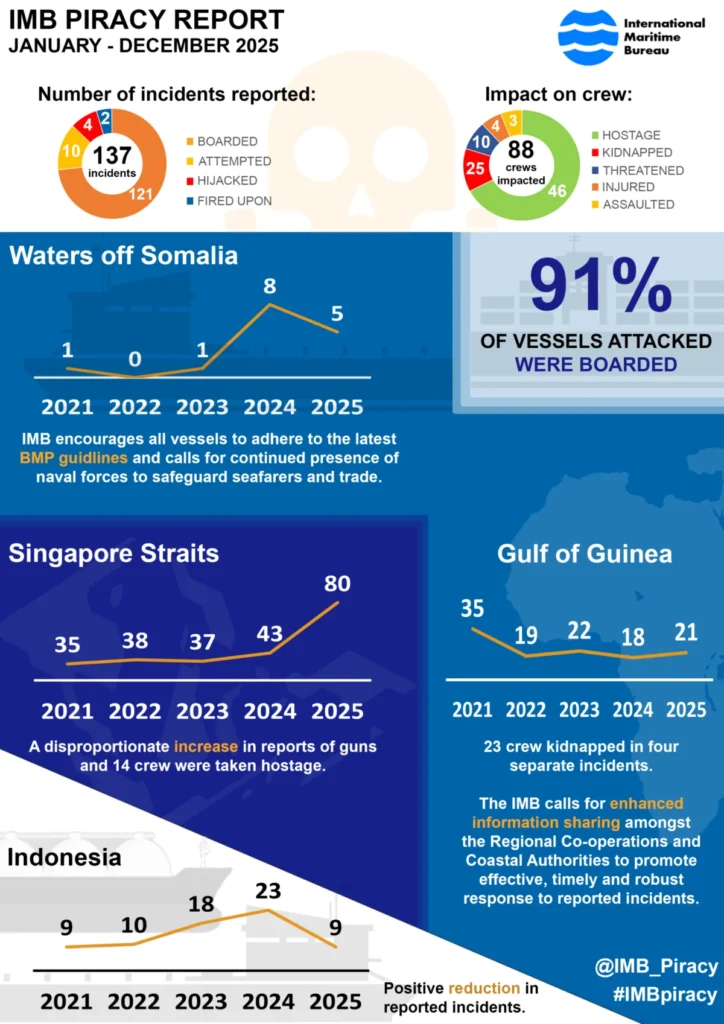
According to the IMB’s Annual Piracy and Armed Robbery Report for 2025, the maritime industry recorded 137 incidents of piracy and armed robbery. This figure marks a significant escalation from the 116 incidents reported in 2024 and the 120 documented in 2023.
The methodology of these criminal activities remains diverse, though the majority are categorized as "low-level" opportunism. The 2025 breakdown is sobering:
- Boardings: 121 vessels were successfully boarded by perpetrators.
- Hijackings: Four vessels were seized.
- Armed Aggression: Two vessels were fired upon.
- Attempts: 10 separate attacks were reported but thwarted by crew vigilance or defensive measures.
While the "low-level" classification might suggest a decrease in sophistication, the human cost remains high. The data paints a picture of a sector where seafarers are increasingly caught in the crosshairs of opportunistic yet violent criminal actors.
Chronology of Escalation: 2023–2025
To understand the trajectory of maritime insecurity, one must look at the three-year trend line. The increase from 116 incidents in 2024 to 137 in 2025 suggests that the lull experienced during the mid-2020s may be eroding.
2023: The Baseline of Recent Volatility
In 2023, the industry recorded 120 incidents. At the time, maritime security analysts pointed toward post-pandemic economic stressors and regional instability as primary drivers. Seafarer safety was a significant concern, with 73 crew members taken hostage and 14 kidnapped.
2024: A Temporary Dip and Strategic Shifts
The slight decrease to 116 incidents in 2024 was met with cautious optimism by the shipping industry. However, behind the headline numbers, the nature of the violence shifted. While hostage numbers surged to 126, the maritime community saw the implementation of stricter reporting protocols and enhanced vessel hardening measures, which temporarily deterred smaller criminal syndicates.
2025: The Surge in Weaponized Conflict
The year 2025 shattered the stability observed in the previous cycle. The increase to 137 incidents was accompanied by a qualitative shift in weaponry. The use of firearms spiked, with guns reported in 42 incidents—a dramatic rise from 26 in 2024. Conversely, knife-related incidents fell from 39 to 33, indicating that criminal groups are increasingly prioritizing firepower over melee tools, thereby increasing the lethality of encounters.
Supporting Data: The Human and Operational Cost
Beyond the statistics of vessels targeted, the IMB report provides a stark accounting of the human toll. Piracy is not merely a financial or logistical issue; it is a humanitarian crisis occurring in international waters.
The Human Toll
The psychological and physical trauma inflicted upon crews remains a priority for the industry:
- Hostage Situations: 46 crew members were taken hostage in 2025. While this is a decrease from the anomalous highs of 2024 (126), it remains a critical concern for maritime unions and welfare organizations.
- Kidnappings: The number of kidnapped seafarers nearly doubled, rising to 25 from 12 in 2024 and 14 in 2023. This indicates that for certain criminal organizations, the abduction of high-value crew members has become a more lucrative and tactical objective than cargo theft.
- Assault and Threat: In addition to kidnappings and hostage-taking, 10 crew members were explicitly threatened, four sustained physical injuries, and three were subjected to direct physical assault.
Weaponry and Tactics
The shift toward firearms is a major point of concern for port authorities and vessel operators. The rise in gun-related incidents implies that attackers are becoming bolder and more willing to engage in armed confrontation to achieve their goals. The resilience of the Somali-based piracy threat, meanwhile, has been successfully mitigated by the persistent presence of multinational naval task forces. However, this has inadvertently caused a "balloon effect," where criminal activity is displaced toward regions with less naval coverage, such as the Singapore Straits and select West African waters.
Official Responses: Navigating Toward Stability
The response from the international maritime community has been one of urgent coordination. ICC Secretary General John W.H. Denton AO issued a call to action, emphasizing that the health of the global economy is inextricably linked to the safety of those at sea.
"Maritime trade remains a cornerstone of real economic activity and growth," Denton stated. "The rise in reported maritime incidents highlights the importance of protecting seafarers and securing key shipping routes—not only for crew safety, but for the stability of global supply chains and the economies that depend on them."
Denton’s sentiment is echoed by industry leaders who advocate for a three-pronged approach:
- Enhanced Intelligence Sharing: Improving the real-time communication between merchant vessels and regional maritime security centers to allow for faster naval response times.
- Multilateral Cooperation: Encouraging coastal states in high-risk zones to take a more proactive role in policing their territorial waters, rather than relying solely on international naval coalitions.
- Vessel Hardening: Standardizing the "Best Management Practices" (BMP) across all commercial fleets to ensure that even "low-level" threats are unable to board vessels easily.
Implications for the Global Economy
The implications of these findings extend far beyond the shipping companies that suffer the immediate financial losses. When maritime insecurity rises, the entire global supply chain experiences ripple effects.
Increased Operational Costs
Insurance premiums for vessels traversing high-risk areas have faced upward pressure. When piracy is a constant threat, shipping lines are often forced to deviate from established routes, leading to increased fuel consumption, longer transit times, and potential delays in delivery schedules.
Supply Chain Fragility
In an era where "just-in-time" delivery remains the standard, any disruption in the maritime lane acts as a bottleneck. The 2025 data suggests that the "low-level" incidents in the Singapore Straits—one of the world’s busiest and most vital shipping lanes—could lead to systemic slowdowns. If attackers continue to board ships at current rates, the cumulative impact on the efficiency of international trade could be substantial.
The Humanitarian Imperative
Finally, the industry faces an existential crisis regarding its workforce. The profession of a seafarer is already challenging, characterized by long absences from home and demanding work environments. The threat of kidnapping and assault acts as a deterrent for potential recruits, potentially worsening the existing labor shortage within the global maritime industry.
Conclusion: A Call for Sustained Vigilance
As we move deeper into 2026, the 2025 IMB report serves as a critical wake-up call. The containment of Somali piracy stands as a success story, proving that coordinated international action can suppress criminal activity. However, the rise of incidents elsewhere demonstrates that piracy is an evolving, adaptable threat.
Ensuring safe passage at sea will require more than just defensive measures on individual ships. It necessitates a sustained, unified approach from international partners to safeguard maritime commerce. Without such cooperation, the economic stability of nations—and the lives of the seafarers who sustain them—will remain at risk in the volatile waters of the 21st century. The path forward is clear: maritime security must be treated not as a local concern, but as a global necessity that requires constant attention, investment, and international political will.