

Introduction: The Invisible Frontline
In the vast, ungoverned expanse of the global ocean, where 90% of the world’s trade flows, the threat of maritime piracy remains a persistent and evolving menace. For over three decades, the International Chamber of Commerce (ICC) International Maritime Bureau’s (IMB) Piracy Reporting Centre (PRC) has stood as the maritime industry’s most critical bulwark against these criminal elements. Since its inception in 1991, the PRC has evolved from a fledgling monitoring service into a sophisticated, 24-hour nerve center, coordinating responses to piracy and armed robbery across the world’s most dangerous waterways.
As the global supply chain faces increasing complexity—from geopolitical instability to the emergence of high-tech criminal syndicates—the role of the IMB PRC has never been more significant. By providing real-time intelligence, immediate response coordination, and rigorous data analysis, the Centre does more than just track incidents; it safeguards the lives of seafarers and the integrity of international commerce.
The Main Facts: A 24/7 Shield for Global Trade
At its core, the IMB Piracy Reporting Centre functions as the industry’s single point of contact for maritime emergencies. When a vessel is under threat, the seconds between a distress signal and an official response can determine the fate of the crew and the cargo.
The Mandate
The PRC operates on three fundamental pillars:
- Incident Reporting: A round-the-clock hotline that allows shipmasters to report piracy and armed robbery incidents in real-time.
- Rapid Response Coordination: Liaising directly with regional law enforcement, navies, and maritime authorities to ensure that distress signals are acted upon with the necessary urgency.
- Intelligence Dissemination: Sending immediate warning broadcasts and targeted email alerts to vessels operating in high-risk zones, allowing shipmasters to implement hardening measures before an encounter occurs.
By serving as a neutral, professional intermediary, the IMB ensures that data is captured accurately and shared with the relevant authorities, bridging the gap between isolated incidents on the high seas and the regional political frameworks required to dismantle criminal networks.
Chronology: A History of Vigilance
The necessity of the IMB PRC is rooted in the shifting landscape of maritime crime. To understand its importance, one must look at how the nature of the threat has changed over the decades.
1991–2000: The Establishment
The 1990s saw a spike in piracy incidents in Southeast Asian waters. Recognizing that national authorities were often overwhelmed or siloed, the ICC established the PRC in Kuala Lumpur. This decade focused on standardizing incident reporting, as many shipowners previously chose not to report attacks for fear of increased insurance premiums or operational delays.
2001–2015: The Somali Crisis
The turn of the millennium brought the rise of Somali piracy, which moved the theater of danger into the Gulf of Aden and the Indian Ocean. This era tested the PRC’s ability to coordinate with international task forces (such as EUNAVFOR). The Centre became the primary source of truth for the international community, mapping the expansion of "pirate motherships" and the increasing range of hijacking operations.
2016–2025: The Age of Cyber-Intelligence
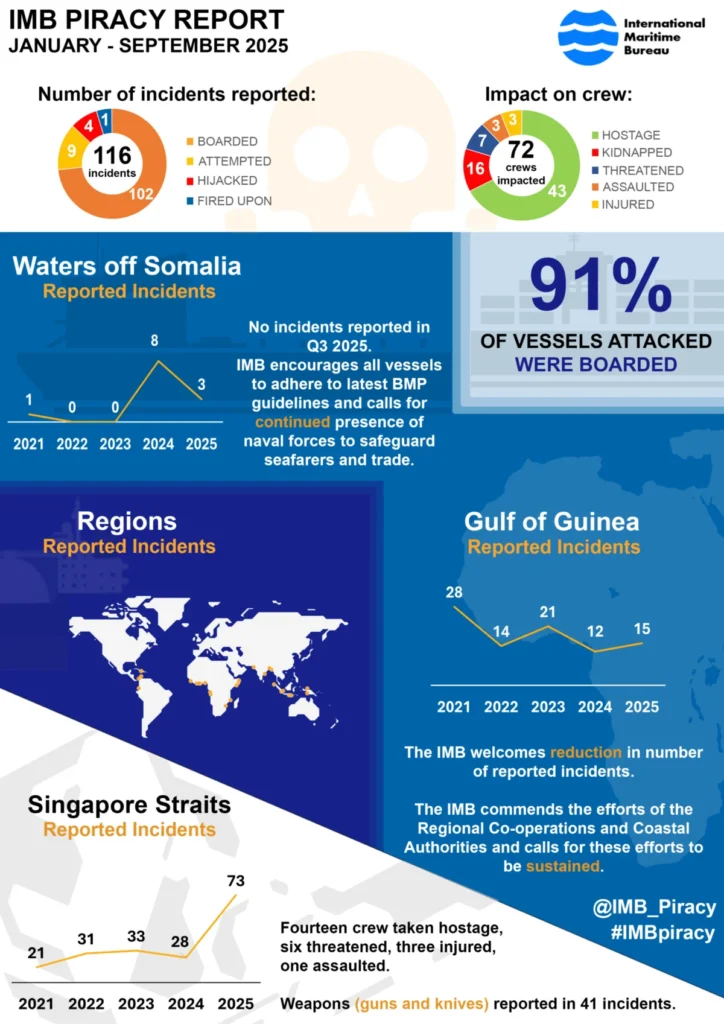
In recent years, the threat has shifted again toward armed robbery in the Gulf of Guinea and the Singapore Straits. The current period is defined by data-driven security. The IMB’s annual and quarterly reporting, including the newly released January–September 2025 report, utilizes advanced mapping to provide a macro-view of global hot zones, forcing governments to allocate resources based on empirical evidence rather than anecdotal reports.
Supporting Data: Analyzing the 2025 Landscape
The recently published Piracy and Armed Robbery Against Ships report (January to September 2025) provides a sobering look at the state of maritime security. While the efforts of the PRC and international navies have suppressed certain types of attacks, the data highlights that complacency is the sailor’s greatest enemy.
Key Trends in 2025
- The Persistence of Opportunity: Analysis shows that a significant percentage of incidents occur while ships are at anchor. Criminals are increasingly targeting vessels with lower freeboards, exploiting periods of low vigilance.
- Regional Concentration: While piracy has decreased in some traditional hotspots, new, localized surges have appeared. The IMB’s data shows that specific coastal choke points remain high-risk zones, necessitating the continuous broadcasting of security warnings.
- The Under-Reporting Gap: The IMB emphasizes that the data is only as good as the reports received. The Centre maintains that every incident, regardless of how minor it may seem, provides a piece of the puzzle that helps authorities understand criminal patterns, weapon types, and operational tactics.
The 2025 report acts as a barometer for the shipping industry. Shipowners utilize this intelligence to adjust their "Best Management Practices" (BMP), adjust insurance coverage, and determine if armed security guards are required for specific transits.
Official Responses: A Collaborative Defense
Maritime security cannot be solved by private entities alone. The IMB PRC acts as the "connective tissue" between the shipping industry and state authorities.
According to Michael Howlett, Director of the ICC International Maritime Bureau, the effectiveness of the Centre is entirely dependent on the partnership between the bridge and the bureau. "We provide the eyes and ears on the water, but we require the political and tactical will of governments to ensure those waters are safe," Howlett notes.
Government and Navy Coordination
When a vessel reports an incident to the PRC, the Bureau immediately relays this information to the nearest Maritime Rescue Coordination Centre (MRCC) or naval command. This collaborative model has saved countless lives. In regions where naval patrols are thin, the PRC’s warnings act as a deterrent, prompting vessels to increase their speed, maneuverability, and internal security protocols, effectively hardening the "soft target."
The Call for Transparency
The IMB has consistently lobbied for greater transparency in reporting. A recurring theme in official responses from the Bureau is the encouragement of all shipmasters—regardless of flag state or vessel size—to report every incident. By creating a comprehensive, global database, the IMB empowers organizations like the International Maritime Organization (IMO) to hold flag states and littoral nations accountable for security in their territorial waters.
Implications: The Future of Maritime Security
As we look toward the latter half of the 2020s, the implications of the IMB’s work are profound.
Economic Impact
Maritime piracy is not merely a security issue; it is an economic one. Insurance premiums for vessels passing through high-risk areas can skyrocket based on the data provided by the IMB. By providing accurate, timely reports, the PRC helps stabilize the cost of global trade, preventing localized piracy from causing global inflationary spikes in commodity prices.
Technological Advancements
The future of the IMB PRC lies in the integration of AI and satellite tracking. As vessels become more digitized, the PRC is poised to incorporate real-time automated tracking data to identify suspicious vessel patterns—such as "dark ships" that turn off their AIS transponders—before an attack even begins.
The Human Element
Beyond the logistics and the data, the IMB PRC remains a humanitarian organization. Behind every report is a crew facing the terrifying prospect of hostage-taking or violence. The Centre’s psychological support and the assurance that an alarm has been raised provides a crucial lifeline to crews in distress.
Conclusion: A Call to Action
The January to September 2025 report is not just a collection of statistics; it is a call to vigilance. The IMB Piracy Reporting Centre remains the heartbeat of maritime security, serving as a constant reminder that the safety of the global supply chain depends on the willingness of those at sea to share information.
Shipmasters, owners, and operators are urged to download the latest report to better understand the threats facing their fleets today. By staying informed and maintaining rigorous reporting standards, the maritime community can ensure that the high seas remain a conduit for trade rather than a theater for crime.
For those seeking to stay ahead of the curve, the resources provided by the IMB are an essential component of operational safety. For more information, inquiries, or to report an incident, the IMB Piracy Reporting Centre remains open, 24 hours a day, 365 days a year.
Contact Information:
Michael Howlett
Director, ICC International Maritime Bureau
Tel: +44 207 423 6960
Email: [email protected]
To download the January to September 2025 Piracy and Armed Robbery Against Ships report, please visit the ICC-CCS official website.



