

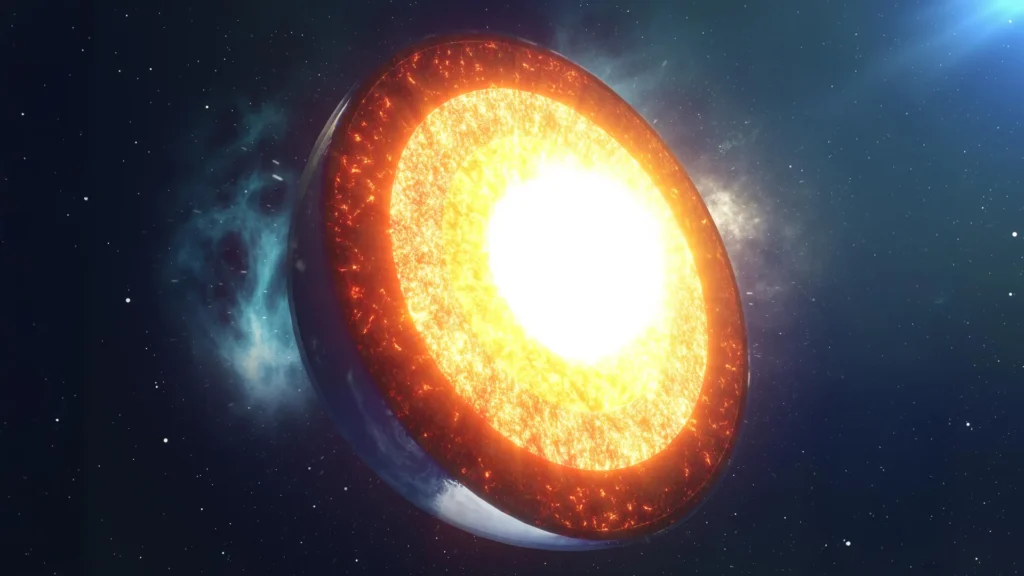
To the average observer, the passage of time is anchored by the rhythmic, clockwork rotation of our planet. We build our lives, our economies, and our digital infrastructures around the assumption that a day is a fixed, immutable 24-hour cycle. Yet, beneath our feet, a complex and dynamic dance is occurring that challenges this fundamental perception. Earth is not a rigid, spinning marble; it is a fluid, shifting engine, and its rotation is far from perfectly constant.
While the fluctuations are measured in mere milliseconds, their implications are profound. New research is shedding light on a long-standing geophysical mystery: why the length of our days oscillates over decades. By peering into the molten heart of our planet, scientists have discovered that the Earth’s inner core and its rocky mantle are engaged in a perpetual gravitational tug-of-war, a delicate exchange of momentum that keeps time itself in flux.
The Main Facts: Time as a Variable
For decades, geophysicists have known that the Earth’s rotation is subject to subtle variations. These changes are not caused by external celestial events, but by internal dynamics—specifically, the complex interaction between the planet’s layers. The Earth is composed of a solid inner core, a liquid outer core, and the thick, rocky mantle that supports the crust.
The core and the mantle are not locked in a static embrace. Instead, they trade rotational momentum. When the liquid outer core accelerates, the mantle—the layer we reside upon—decelerates, and vice versa. Because the law of conservation of angular momentum requires the planet’s total rotation to remain balanced, this internal “momentum swap” forces the mantle to adjust its speed. Even a minuscule variation in the mantle’s rotation translates into a perceptible change in the length of a day (LOD).
These variations are tiny, often amounting to no more than a few milliseconds, yet they are detectable by modern atomic clocks and satellite observations. This confirms that the Earth is not a rigid sphere, but a dynamic, evolving system whose heartbeat—the length of its day—is constantly being fine-tuned by its interior.
Chronology of a Geophysical Mystery
The realization that the Earth’s rotation is irregular is not new, but the mechanisms driving it have remained elusive.
- The Early Observations: Throughout the 20th century, as observational technology improved, scientists noticed periodic discrepancies between "Universal Time" (based on Earth’s rotation) and "Atomic Time" (based on atomic oscillations).
- The Core-Mantle Coupling Theory: By the late 20th century, researchers identified that the liquid outer core exhibits significant changes in its rotational speed over decades. These changes were correlated with fluctuations in the Earth’s magnetic field, suggesting that the core’s movement is inextricably linked to the planet’s internal electromagnetic environment.
- The Decadal Oscillations: It was observed that the core speeds up and slows down in cycles lasting several decades. For a time, the scientific community struggled to define the exact “coupling” mechanism—how the liquid core could exert enough force on the solid mantle to affect the rotation of the entire planet.
- The September 2024 Breakthrough: The latest chapter in this story comes from a study published in Nature on September 23, 2024, by Huifeng Zhang and Professor Mathieu Dumberry of the University of Alberta. Their research finally bridges the gap between theoretical modeling and observational data, identifying the "gravitational torque" that governs the interaction between the inner core and the mantle.
Supporting Data: The Gravitational Torque Mechanism
The crux of the recent breakthrough lies in the realization that the Earth’s inner core is not a perfect sphere. Because of its irregular shape and the uneven distribution of mass within it, the inner core acts as a gravitational anchor.
As Zhang and Dumberry explain, the inner core is subject to what they call "gravitational torque." When the inner core’s rotation shifts, its gravitational field interacts with the uneven mass distribution in the mantle. This interaction creates a subtle drag or push, effectively transferring momentum between the core and the mantle.
This mechanism competes with another phenomenon known as "core-mantle boundary torque." This second force involves friction and electromagnetic drag occurring at the interface between the molten outer core and the solid mantle. This boundary torque acts as a counter-resistance, preventing the day length from spiraling into extreme fluctuations.
The observed decadal variations in the length of a day are essentially the result of the shifting balance between these two competing forces: the gravitational torque and the core-mantle boundary torque. When the gravitational interaction between the inner core and the mantle dominates, the Earth’s rotation accelerates; when the frictional drag at the core-mantle boundary takes precedence, the planet slows down.
Official Responses and Scientific Context
The scientific community has reacted to the University of Alberta study with significant interest. Dr. Mathieu Dumberry noted that while the forces at play are subtle, their existence resolves a paradox that has persisted in geophysical literature for years.
"For a long time, we knew the core and mantle were talking to each other, but we didn’t fully understand the language," says Dumberry. "By identifying the gravitational torque, we are seeing that the solid inner core plays a much more active role in the planet’s rotation than previously suspected."
Peer reviews of the study highlight the elegance of the math involved. By applying fluid dynamics and gravitational modeling to the planet’s interior, Zhang and Dumberry have moved beyond mere observation. They have provided a predictive model that accounts for the decadal oscillations observed in the historical record of Earth’s rotation. This shift from "descriptive science" to "mechanistic science" is being hailed as a milestone in deep-earth geophysics.
Implications: A More Dynamic Interior
The implications of this study reach far beyond the simple measurement of time. The findings suggest that the Earth’s interior is far more "viscously deformable" than scientists once thought.
1. Reassessing Planetary Composition
The study suggests that the inner core deforms on a time scale of approximately 10 years. This implies that the core is not a rigid, unchanging solid but a material capable of flowing or shifting under extreme pressure. This challenges existing models of planetary formation and composition, suggesting that the deep interior of the Earth is capable of responding to forces with a fluidity that mimics semi-solid materials.
2. Refining GPS and Navigation
Precision in timekeeping is the backbone of global navigation systems. GPS relies on high-precision clocks that must account for every millisecond of variation in Earth’s rotation. Understanding the internal physics of these variations allows scientists to create more accurate models for Earth’s rotation, which in turn leads to better satellite positioning, more reliable long-range telecommunications, and enhanced global synchronization.
3. Insights into Earth’s Magnetic Field
Since the rotational dynamics of the core are linked to the Earth’s magnetic field, this research provides a window into the health and stability of our planet’s protective shield. If the core’s movement is more dynamic than previously modeled, our understanding of how the magnetic field is generated and sustained—and how it might change in the future—must be updated.
4. A New Era of Geophysical Modeling
Finally, this research opens the door to a new era of "Earth systems science." By recognizing that the planet’s surface is inextricably linked to the physics of its core, researchers can begin to build holistic models that link mantle convection, core rotation, and even volcanic activity. We are moving toward a comprehensive understanding of the Earth as a singular, pulsing organism.
Conclusion: The Pulsing Planet
The realization that the length of our day is subject to the internal churning of a liquid core 3,000 kilometers beneath our feet is a humbling reminder of our place in the universe. We live on the skin of a volatile, shifting, and profoundly dynamic body.
While we may go about our daily lives under the assumption that time is fixed, the planet itself is dancing to a different rhythm—one dictated by gravity, friction, and the relentless, slow-motion movement of the Earth’s deepest layers. As Zhang and Dumberry’s work has demonstrated, the mystery of the changing day is not merely a quirk of timekeeping; it is a vital key to understanding the very nature of the planet we call home. We are only just beginning to learn how to listen to the rhythm of the Earth, but with every millisecond accounted for, our view of the world becomes clearer, deeper, and infinitely more fascinating.



